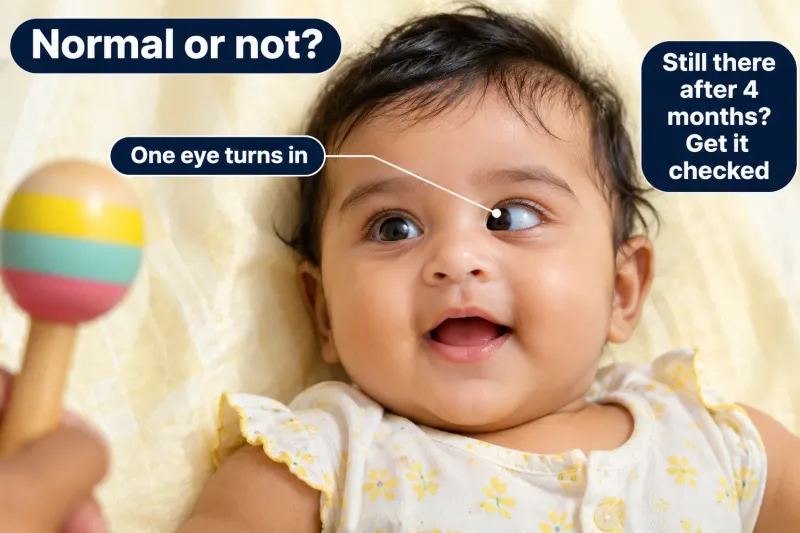
Are your baby's eyes crossing? See what is normal from birth to 12 months, how to check at home, the signs that need an eye doctor and how it is treated.
Is It Normal for a Baby's Eyes to Cross?
Yes, for brief moments in the first 2 to 3 months, while the two eyes are learning to work together. Most babies settle by about 4 months. See an eye doctor for crossing that is constant at any age, is getting worse after 2 months, is new after 3 months, or is still there after 4 months.
You are feeding your six-week-old, you look down, and one eye has wandered towards the nose. A moment later it is back. Almost every parent sees this at some point, and then lies awake reading about it.
Most of the time, in the first couple of months, it means nothing is wrong. A newborn's eyes are still learning to work as a pair. The job for parents is to know when that stops being true, because a real eye turn in a baby is one of the few things in child vision that should not wait.
What is normal, month by month
Babies develop at their own pace and those born early can take longer, so treat these as rough guides.
| Age | What you may see | What to do |
|---|---|---|
| Birth to 2 months | Brief drifts in or out that come and go. Your baby looks at faces close up but does not hold the gaze for long. | Usually normal. Mention it at the next check. See a doctor if one eye stays turned all the time. |
| 2 to 3 months | Drifts get smaller and less frequent. Your baby begins to follow your face or a toy. | Get it checked if the drifting is becoming more frequent or larger, not less. |
| 3 to 4 months | The eyes are straight most of the time. Your baby starts reaching out for things. | A new turn at this age needs an eye check. |
| 4 to 6 months | The eyes should stay together. Depth perception is starting to appear. | Any crossing, constant or on and off, should be examined. |
| 6 to 12 months | Eyes straight during crawling, reaching and picking up small things. | Any turn should be examined. Do not wait for a routine visit. |
| 1 to 4 years | A new inward turn, often during close looking or when tired, can be linked to plus power. | Book an eye exam with drops to measure the power. The turn often responds to glasses. |
The American association of paediatric eye specialists (AAPOS) puts it simply: crossing under about 20 weeks is common and often goes away by itself, particularly if it is small and comes and goes. Constant crossing is a concern at any age, and any crossing after about 4 months should be checked.
Why a young baby's eyes wander
Newborns are not born with their two eyes working as a team. The muscles are ready, but the brain has not yet learned how to use both eyes on a single target. In the first weeks of life, an infant's vergence system, the part that aims both eyes at the same point, is still being tuned. In one study of young babies, these early drifts were already shrinking by 2 months and had gone by 4 months in babies with healthy vision.
This is vision development happening in front of you. Between about 3 and 5 months the brain starts combining the two images, and depth perception begins to appear. Your baby needs both eyes pointing at the same thing for this to happen. It is also the time your baby starts reaching for toys, and later judging the distance to the floor while crawling. Vision and movement grow together.
That is why a real turn is worth taking seriously. If one eye is pointing somewhere else, the brain gets two different pictures. A baby does not complain about this. The brain just begins to ignore one eye, and the skills that depend on two eyes working together may not develop properly. In time, this can lead to a lazy eye.
Could it just be the shape of your baby's face?
Quite often, yes. Many babies have a flat, wide nasal bridge and small folds of skin at the inner corners of the eyes. These hide the white of the eye on the nose side, so the eyes look crossed, particularly when your baby glances sideways. This is called pseudostrabismus, which means a false squint. It tends to fade as the face grows.
Here is a simple check. Take a photo with the flash on while your baby looks straight at the phone. Look for the small white dot of light on each eye. If it sits in the same position on both, the eyes are probably straight. If it is centred in one eye and off to the side in the other, get that looked at.
Photos can mislead you, though. If your baby is looking slightly to one side, even straight eyes can seem misaligned. Take a few, and if you are still unsure, an eye doctor can tell you in minutes.
While you have the photos, look at the pupils as well. If one pupil looks white or pale, or glows differently from the other, see an eye doctor within days. It can be a sign of cataract or, rarely, a tumour in the eye.
When to book an eye exam
- One eye stays turned all the time, at any age
- The drifting is getting worse from 2 months onward
- A new turn appears after 3 months
- Crossing is still there after 4 months, even if it comes and goes
- Your baby does not follow your face by about 3 months
- The eyes shake or wobble rapidly, which is called nystagmus
- Your baby always tilts or turns the head to look at things, or fusses when one particular eye is covered
Be quicker to get checked if your baby was premature, if a close relative had a squint or lazy eye, or if your baby has a condition that affects development such as cerebral palsy or Down syndrome. These babies have a higher chance of eye problems.
A note on sleep: many parents search for crossed eyes during sleep. When a baby is drowsy or half asleep, the eyes can roll and drift, and this alone does not tell you much. What matters is how they look when your baby is awake and alert.
What happens if it is a true eye turn
The usual examination takes a short time and does not need your baby to answer anything. The doctor shines a light, watches how the eyes follow a toy, covers each eye in turn, and uses dilating drops to measure power and look inside the eye.
After that, it depends on the type:
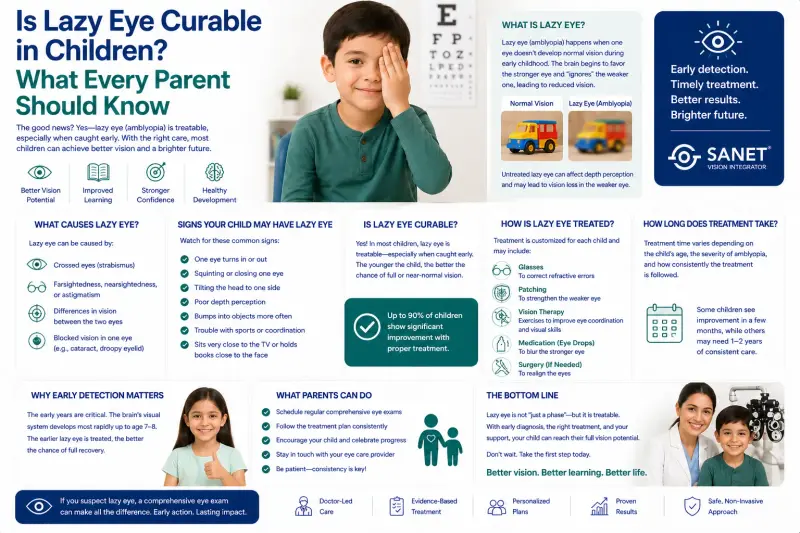
- Infantile esotropia begins in the first 6 months, and the turn is usually large and constant. A large, constant turn after about 10 weeks is unlikely to resolve by itself. Treatment is commonly surgery under a paediatric ophthalmologist. A Cochrane review could not settle the best age or the best type of operation, so expect your doctor to discuss the timing with you.
- Accommodative esotropia usually appears later, most often between about 1 and 4 years. It comes from plus power that makes the child focus hard, and the eyes turn in as a result. Glasses are often the main treatment.
- Turns caused by an eye problem, such as cataract or poor vision in one eye, need that problem treated first.
- Exotropia, where the eye drifts outward, is a separate pattern and also needs an examination.
If you have been told that a baby is too young for glasses, that is not correct. Babies can wear them, and soft frames made for infants stay on better than you would expect.
Developmental and behavioural optometry: the part after straight eyes
Glasses or surgery can line the eyes up. That does not automatically teach them to work together. A child can have straight eyes in photos and still have weak depth perception, poor eye teaming or one eye the brain tends to ignore. With infantile esotropia in particular, straightening the eyes is usually the easier goal, and two-eyed vision often remains the harder part.
This is where behavioural vision care comes in, usually led by a developmental and behavioural optometrist. Working alongside your ophthalmologist, they follow how your child uses vision as they grow, including:
- Whether fixing, following and reaching are on track for age
- How vision is linked with movement during tummy time, crawling and walking
- Whether both eyes are being used, or one is being switched off
- How the glasses are working, and whether the power needs to change
- Which play at home will help at each stage
In babies this is mostly guided play: faces, slow-moving toys, reaching games on both sides of the body and plenty of floor time. Formal vision therapy usually begins at around 3 to 4 years, once a child can join in with activities. Its purpose at that stage is to build functional vision: eye teaming, tracking, depth judgement and the eye-hand skills that school will soon ask for.
Please do not expect exercises to straighten a baby's eye. They do not, and trying them should never delay an examination.
What to do today
If your baby is under 3 months and the drift comes and goes, take a short video in good daylight, keep watching, and show it at your next check. If you have seen any of the signs above, book an eye exam now and take the video with you, as babies have a habit of looking perfect in the clinic.
You know your baby's face better than anyone. If it looks wrong to you, it is fine to ask. Book a child vision assessment at Caring Vision Therapy, and we will either put your mind at rest or tell you what needs to happen next.
Explore More at Caring Vision Therapy
Frequently Asked Questions
Is it normal for a newborn's eyes to cross?
My baby is 3 months old and the eyes still cross. Should I worry?
My baby is 6 months old with crossed eyes. What should I do?
Will my baby grow out of crossed eyes?
Why do my baby's eyes look crossed when sleeping?
Can holding toys close make a baby cross-eyed?
Can exercises fix a baby's crossed eyes?
Sources
- Esotropia. American Association for Pediatric Ophthalmology and Strabismus.
- Typical and Atypical Development of Ocular Alignment and Binocular Vision in Infants. American Academy of Ophthalmology.
- Neonatal Ocular Misalignments Reflect Vergence Development but Rarely Become Esotropia. British Journal of Ophthalmology, 2003.
- Infantile Esotropia. EyeWiki, American Academy of Ophthalmology.
- Interventions for Infantile Esotropia. Cochrane Database of Systematic Reviews, 2023.
Reviewed by the Caring Vision Therapy clinical team. Updated November 2026.