ADHD and vision problems overlap almost entirely. How functional vision issues mimic ADHD, and how an evaluation reveals the true cause.
Book a ConsultationADHD vs Vision Problems: How to Tell the Difference in Your Child
ADHD and vision problems overlap almost entirely. How functional vision issues mimic ADHD, and how an evaluation reveals the true cause.
If your child has been labelled inattentive, hyperactive, or diagnosed with ADHD, there is one question that frequently goes unasked: Has anyone tested how well their eyes actually work together?
The overlap between attention deficit disorders and undetected functional vision problems is striking - and widely underappreciated by both parents and clinicians. This article explains why, what the key differences are, and when a full vision evaluation should be part of any attention or learning assessment.
Why ADHD and Vision Problems Look the Same
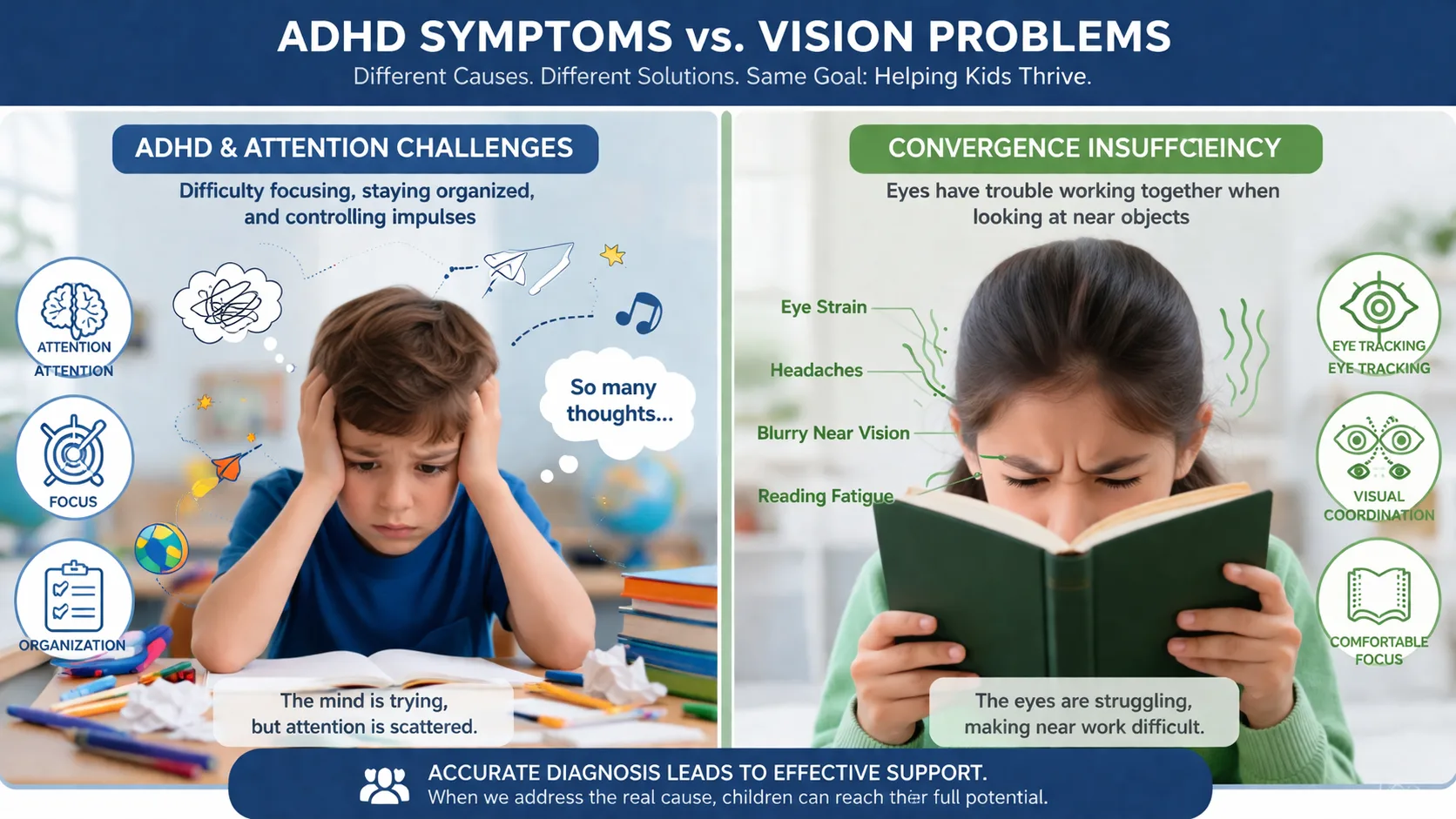
ADHD is characterised by inattention, impulsivity, and hyperactivity. Functional vision problems - particularly convergence insufficiency, poor eye tracking, and visual processing deficits - produce a remarkably similar set of behaviours in children.
A child with convergence insufficiency cannot sustain comfortable near vision. Reading is physically uncomfortable. Their eyes strain, words blur or double, and the brain expends enormous effort just keeping the eyes on the page. The result: the child fidgets, looks away, avoids the task, loses focus, and appears inattentive or disruptive - behaviours that tick every box on an ADHD checklist.
The Symptom Overlap
Both ADHD and functional vision problems can cause:
- Short attention span, especially during reading or near tasks
- Difficulty completing homework or schoolwork
- Avoidance of reading and written tasks
- Restlessness and fidgeting during desk work
- Poor academic performance despite normal intelligence
- Difficulty following multi-step instructions
The key difference that standard ADHD assessments typically miss: children with vision-related attention problems often have fewer difficulties with non-visual tasks. They may engage well in physical activities, hands-on learning, and verbal conversations - but struggle specifically when visual near work is involved.
What a Standard Eye Test Misses
This is critical: a standard school eye screening or routine optometry appointment tests visual acuity - how clearly a child can see a letter on a chart at six metres. It does not test how well the eyes work together at near distances, how smoothly the eyes track across a page, how quickly the focusing system adjusts between distances, or how the brain processes and makes sense of what the eyes see.
A child can have perfect 20/20 visual acuity and still have a significant convergence insufficiency, poor saccadic eye tracking, or a visual processing deficit that makes reading painful and attention impossible. These problems are only identified through a full functional vision evaluation - a specialised assessment that takes 60–90 minutes and tests the visual system under the demands of real reading and near work.
Key Signs That Vision May Be the Primary Problem
Consider a functional vision evaluation if your child:
- Struggles specifically with reading and near tasks but manages well in other areas
- Complains of headaches, tired eyes, or blurred vision after reading
- Closes or covers one eye to read or watch screens
- Loses their place frequently when reading or skips lines
- Has been assessed for ADHD but the diagnosis doesn't feel complete
- Has ADHD but does not fully respond to medication or behavioural therapy
ADHD and Vision Problems Can Co-Exist
It is important to emphasise: ADHD and functional vision problems are not mutually exclusive. Research suggests that children with ADHD have a higher rate of convergence insufficiency and other binocular vision disorders compared to the general population. In these children, treating the visual component often makes the ADHD more manageable - attention improves, reading becomes less effortful, and the cognitive load of just keeping the eyes on the page is reduced.
Vision Therapy Does Not Treat ADHD
To be clear: vision therapy does not cure ADHD. It addresses functional vision deficits. But when a child has both ADHD and a vision problem, treating the vision issue removes one significant source of functional difficulty - making the remaining ADHD symptoms easier to manage with appropriate support.
What the Research Says
The Convergence Insufficiency Treatment Trial (CITT), one of the largest randomised controlled studies of vision therapy, found that children with ADHD had significantly higher rates of convergence insufficiency than the general population. Another key finding: when convergence insufficiency was treated with office-based vision therapy, attention and reading behaviours improved measurably - including in children with a formal ADHD diagnosis.
Getting the Right Evaluation in Chennai
A full functional vision evaluation at Caring Vision Therapy in Chennai tests all the visual skills that standard optometry appointments miss - binocular vision, eye teaming at near, eye tracking, focusing flexibility, visual processing, and visual motor integration. The evaluation takes approximately 90 minutes and provides a clear clinical picture of whether a visual problem is contributing to your child's attention and learning difficulties.
If your child is struggling in school, being assessed for ADHD, or has already been diagnosed and is not responding fully to current support, a functional vision evaluation is a sensible, non-invasive next step.
Learn more about our ADHD visual processing therapy or book a full functional vision evaluation in Chennai.