Traumatic brain injury (TBI) and concussion are among the most complex medical conditions affecting vision, and their visual consequences are among the most frequently overlooked aspects of recovery. Because the visual system involves more than half of the brain's neural connections, virtually any injury to the brain, regardless of location or severity, has the potential to disrupt some aspect of visual function. Research from neuro-rehabilitation centres consistently shows that 50 to 90 percent of individuals who sustain a TBI experience significant visual symptoms, including many who are told following a standard eye examination that their eyes are structurally normal and their vision is fine.
The visual symptoms following TBI and concussion are wide-ranging and include double vision (diplopia) or blurred vision during reading and computer use, difficulty tracking moving objects or following text across a page, increased sensitivity to light and visually busy environments, headaches triggered by visual tasks or screen use, dizziness and balance problems related to disruption of the vision-vestibular system, poor depth perception and spatial disorientation, visual field deficits affecting peripheral awareness, slow and effortful reading, and difficulty concentrating due to rapid visual fatigue. These symptoms can persist for months or years after the initial injury and significantly impair the ability to return to work, school, or normal daily activities. Many patients experience frustration because their eye structures look normal on standard examination, yet they struggle every day with visual symptoms that are real, measurable, and treatable.
The reason these symptoms are frequently missed is that standard eye examinations test for structural eye disease and visual acuity, not for the subtle binocular, oculomotor, and visual processing deficits that TBI produces at the neurological level. The structures of the eye can be entirely intact while the neurological networks that coordinate eye teaming, focusing, tracking, and spatial awareness are significantly disrupted. Neuro-optometric evaluation is specifically designed to assess these functional visual networks and identify the deficits that standard examinations do not detect.
Neuro-optometric rehabilitation is the evidence-based treatment approach for visual deficits following TBI and concussion. Developed and validated through decades of clinical research by the Neuro-Optometric Rehabilitation Association (NORA) and its affiliated specialists, neuro-optometric rehabilitation uses structured, progressive vision therapy to retrain the neurological pathways that control visual function. Treatment addresses eye teaming, focusing, tracking, visual processing, spatial awareness, and the integration of vision with vestibular and proprioceptive systems to support balance and spatial orientation.
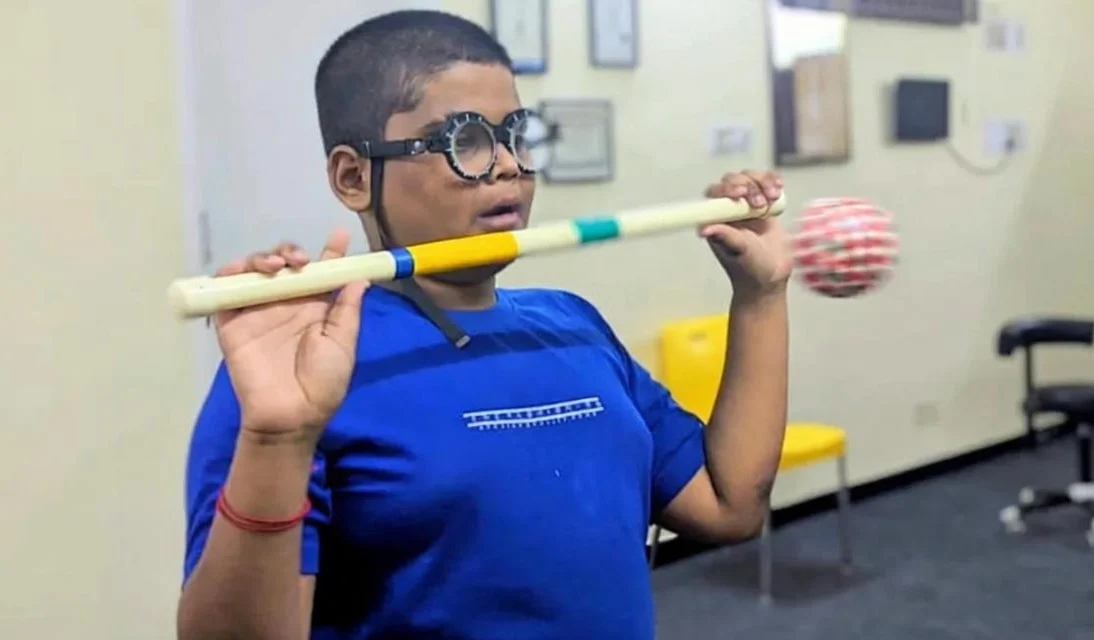
At Caring Vision Therapy in Chennai, our NORA affiliated specialists provide complete neuro-optometric rehabilitation for patients recovering from TBI, concussion, stroke, and other neurological events. The treatment programme is designed following a thorough neuro-optometric evaluation and is matched to the patient's specific symptom profile, stage of recovery, and functional rehabilitation goals. Treatment tools include vergence therapy to restore eye teaming that has been disrupted by the injury, prism lenses and prism therapy to correct spatial distortions and eliminate or reduce double vision, saccadic and pursuit eye movement training to restore oculomotor control needed for reading and tracking, visual-vestibular integration therapy to address balance and dizziness caused by the disruption of vision-vestibular coordination, and optometric syntonics phototherapy to support neurological recovery of the visual processing pathways affected by the injury.
A defining component of neuro-optometric rehabilitation at Caring Vision Therapy is coordinated multidisciplinary care. Our specialists work closely with neurologists, physiotherapists, occupational therapists, and speech therapists to ensure that vision rehabilitation is integrated into the patient's broader recovery programme. Vision problems after brain injury do not exist in isolation, and the most effective recovery plans address all systems in a coordinated way. We communicate regularly with other treating clinicians to ensure that therapy goals are aligned and that visual rehabilitation supports rather than conflicts with other aspects of the patient's recovery.
Recovery from TBI-related vision problems is achievable, but it requires early, specialist intervention. The sooner neuro-optometric rehabilitation begins after medical clearance, the more responsive the visual system is typically to treatment. At Caring Vision Therapy, we have supported patients who initiated rehabilitation months or years after their initial injury and have still achieved significant functional improvements in visual comfort, reading ability, and daily independence. The visual system retains neuroplasticity well into adulthood, and it is rarely too late to benefit from targeted neuro-optometric rehabilitation.
If you or a family member has experienced a head injury, concussion, stroke, or other neurological event and is living with visual symptoms that have not been adequately addressed, contact Caring Vision Therapy in Chennai or Hyderabad to arrange a full neuro-optometric evaluation. Recovery of visual function can meaningfully accelerate overall rehabilitation and significantly improve quality of life during and after recovery.
Related Reading