Autism Spectrum Disorder (ASD) is a complex neurodevelopmental condition characterised by differences in communication, social interaction, sensory processing, and behaviour. While much clinical attention is given to the social and behavioural dimensions of ASD, a widely underrecognised aspect of the condition involves functional vision, meaning not how clearly the eyes see, but how efficiently the visual system processes and interprets the information it receives. Research consistently indicates that a large proportion of individuals on the autism spectrum have co-occurring functional vision problems that contribute to sensory overload, learning difficulties, and many of the behavioural responses that are attributed solely to the neurological profile of ASD.
The functional vision difficulties most commonly observed in individuals with autism include abnormal peripheral and central vision balance, where some individuals rely heavily on peripheral vision for getting around and recognising objects while actively avoiding central fixation, poor visual tracking and oculomotor control, difficulty maintaining comfortable eye contact due to genuine visual sensory discomfort rather than purely social avoidance, hypersensitivity to light, pattern, and high-contrast visual environments, poor visual-motor integration affecting handwriting, drawing, catching, and fine motor coordination, difficulty interpreting spatial relationships and depth perception, and reduced visual attention span and visual processing speed. These are measurable, documentable deficits in the functional visual system, not imagined or purely behavioural responses.
Because many autistic individuals, particularly children, have difficulty articulating visual discomfort or comparing their visual experience to any other reference point, these difficulties frequently go unrecognised for years. The behaviours they produce, such as avoiding eye contact, moving very close to objects to see them, tilting or turning the head, covering one eye, becoming distressed in bright or visually busy environments, or appearing inattentive, are often interpreted as core ASD behaviours rather than as understandable responses to genuine visual difficulty. A specialist functional vision evaluation is essential to distinguish what is neurological from what is driven by unaddressed visual dysfunction.
Unaddressed functional vision problems significantly amplify the challenges of daily life, education, and social participation for individuals with ASD. When the visual system is operating inefficiently, the brain must allocate additional cognitive resources simply to process incoming visual information, leaving less capacity available for communication, attention, and learning. Addressing the visual component of ASD does not change the individual's neurodevelopmental profile, but it can meaningfully reduce the sensory burden and free up cognitive and attentional resources for more productive use in therapy, education, and daily interaction.
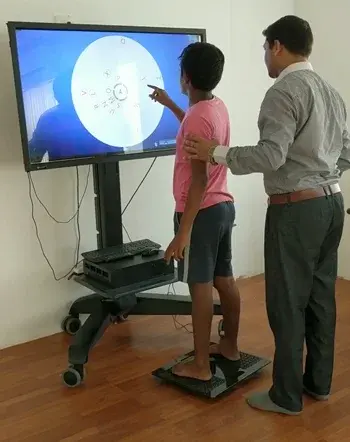
At Caring Vision Therapy in Chennai, we conduct full functional vision evaluations adapted for individuals on the autism spectrum. Our assessment process is sensory-friendly, individually paced, and designed to accommodate the specific communication and sensory needs of each patient. The evaluation measures all relevant aspects of functional visual performance including eye tracking, binocular coordination, focusing, visual processing speed, light sensitivity, and the balance between central and peripheral visual function.
Vision therapy for individuals with ASD at our Chennai clinic is structured, evidence-based, and delivered in a calm, sensory-considerate environment. Treatment may include optometric syntonics phototherapy using selected light frequencies to regulate neurological responses to visual stimulation and reduce light sensitivity, visual tracking and coordination therapy to improve oculomotor control and reduce the effort required for sustained fixation, binocular vision therapy to develop more stable and comfortable visual function, sensory integration strategies using ambient and yoked prism lenses to improve spatial grounding and reduce visual sensory overload, and primitive reflex integration therapy where retained infant reflexes are contributing to visual processing and sensory difficulties. All therapy is coordinated closely with families and, where appropriate, with occupational therapists, speech therapists, and educational specialists.
The goals of vision therapy in autism are practical and functional. Patients and families commonly report improvements in visual attention, tolerance of visually stimulating environments, handwriting quality, reading comfort, and the ability to make and sustain eye contact with greater ease and comfort. These changes can meaningfully support participation in education, therapy, and daily life activities.
At Caring Vision Therapy, every individual on the autism spectrum is approached as unique. Treatment is not one-size-fits-all, and our specialists take the time to understand each patient's sensory profile, communication needs, and functional goals before designing a programme. If you have a child or family member on the autism spectrum who shows signs of visual difficulty, contact our Chennai or Hyderabad clinic to arrange a specialist functional vision evaluation and discuss how vision therapy can support their development and quality of life.
Related Reading