Dyslexia is a specific learning difference that primarily affects the ability to read, write, and spell due to differences in how the brain processes the phonological (sound-based) components of language. It is not caused by vision problems, and vision therapy does not treat dyslexia directly. This distinction is important for families seeking the right combination of support. However, the relationship between dyslexia and functional vision is clinically significant because a substantial proportion of children with dyslexia also have co-occurring functional vision problems that compound their reading difficulties. When these visual components are present and untreated, they make an already challenging learning profile more exhausting and harder to improve through language-based instruction alone.
The functional vision problems most commonly found alongside dyslexia include convergence insufficiency, where the eyes struggle to team accurately at near distances causing fatigue and avoidance of reading tasks, saccadic (eye tracking) dysfunction, where the eyes cannot move smoothly and accurately along a line of text causing children to lose their place, skip words, and re-read lines, accommodative disorder, where the focusing system cannot maintain clear stable vision during sustained near work, and visual processing deficits, where the brain processes visual information such as letter forms, sequences, and spatial patterns less efficiently than typical. None of these conditions cause dyslexia, and treating them does not cure dyslexia. However, each of them makes reading more effortful, more tiring, and more uncomfortable, and they respond directly and often dramatically to structured vision therapy.
A common and important question at Caring Vision Therapy is whether the reading difficulty in a child has a visual cause, a language processing cause, or both. The answer requires a full evaluation that includes both a functional vision assessment and, where appropriate, an assessment by an educational psychologist or speech and language specialist. Our Chennai clinic works closely with educational specialists to ensure that children receive accurate, multidisciplinary assessment so that the appropriate support for every component of their learning profile can be identified and delivered.
At Caring Vision Therapy, the full functional vision evaluation for a child with suspected dyslexia or reading difficulties includes detailed measurement of eye tracking accuracy and stamina during reading-like tasks, convergence and divergence ability, accommodative flexibility and accuracy, binocular vision stability under sustained near demand, visual processing speed and accuracy, visual memory, and visual-motor integration. This assessment generates an objective, data-driven picture of where the visual system is performing well and where measurable deficits exist that may be contributing to the reading difficulty.
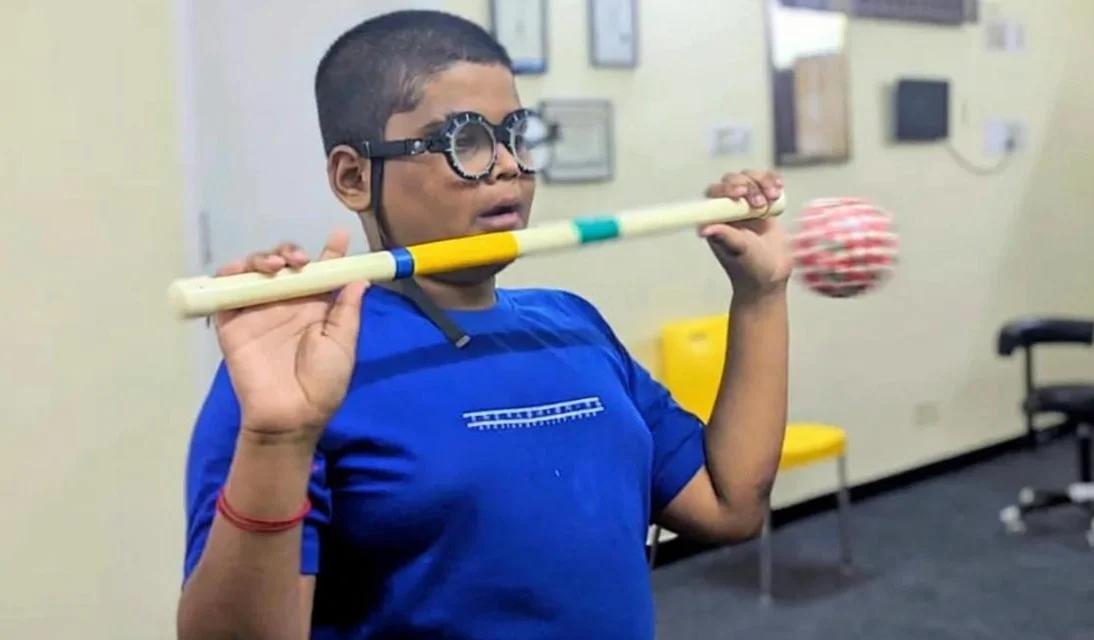
Where functional vision deficits are identified, a structured vision therapy programme is designed to address the specific areas of weakness. Treatment typically includes saccadic eye movement training to improve the accuracy and stamina of reading-specific eye movements, vergence therapy to build convergence ability and eliminate near vision fatigue, accommodative therapy to improve focusing flexibility and clarity during sustained reading tasks, visual processing training to improve visual discrimination, pattern recognition, and visual memory, and optometric syntonics phototherapy to support neurological regulation of the visual processing system. The therapy programme is designed to run alongside other educational and therapeutic interventions for dyslexia, complementing them rather than replacing them.
Vision therapy should be understood as one important component of a multidisciplinary support plan for dyslexia, not as a standalone cure. A child who receives vision therapy to address convergence insufficiency and eye tracking problems will find reading physically easier and far less tiring. This does not eliminate the phonological processing difficulties associated with dyslexia, but it removes a significant layer of visual difficulty that was preventing the child from engaging effectively with the reading instruction they were already receiving. Many families and teachers report that a child's progress in structured literacy programmes accelerates noticeably after vision therapy is completed, because the visual foundation for reading has been strengthened.
At Caring Vision Therapy in Chennai, our FCOVD/FOVDR certified specialists are experienced in working with children and adults who have complex, multifaceted reading and learning profiles. We take a collaborative, evidence-based, and family-centred approach to vision support for dyslexia. Realistic expectations are discussed openly with every family: vision therapy addresses the visual component, and language therapy addresses the phonological component, and both are necessary for optimal reading outcomes when both components are present.
If your child is receiving support for dyslexia and you want to ensure that a visual component is not complicating their progress, or if your child has not yet been evaluated and is showing signs of both reading difficulty and visual discomfort during near tasks, contact Caring Vision Therapy in Chennai or Hyderabad to schedule a full functional vision evaluation.
Related Reading