How functional vision problems affect reading, grades, attention and academic success. FCOVD/FOVDR-certified clinical insights.
Book a ConsultationHow Does Vision Affect Learning and Academic Success?
How functional vision problems affect reading, grades, attention and academic success. FCOVD/FOVDR-certified clinical insights.
How Vision Affects Learning: The Complete Picture
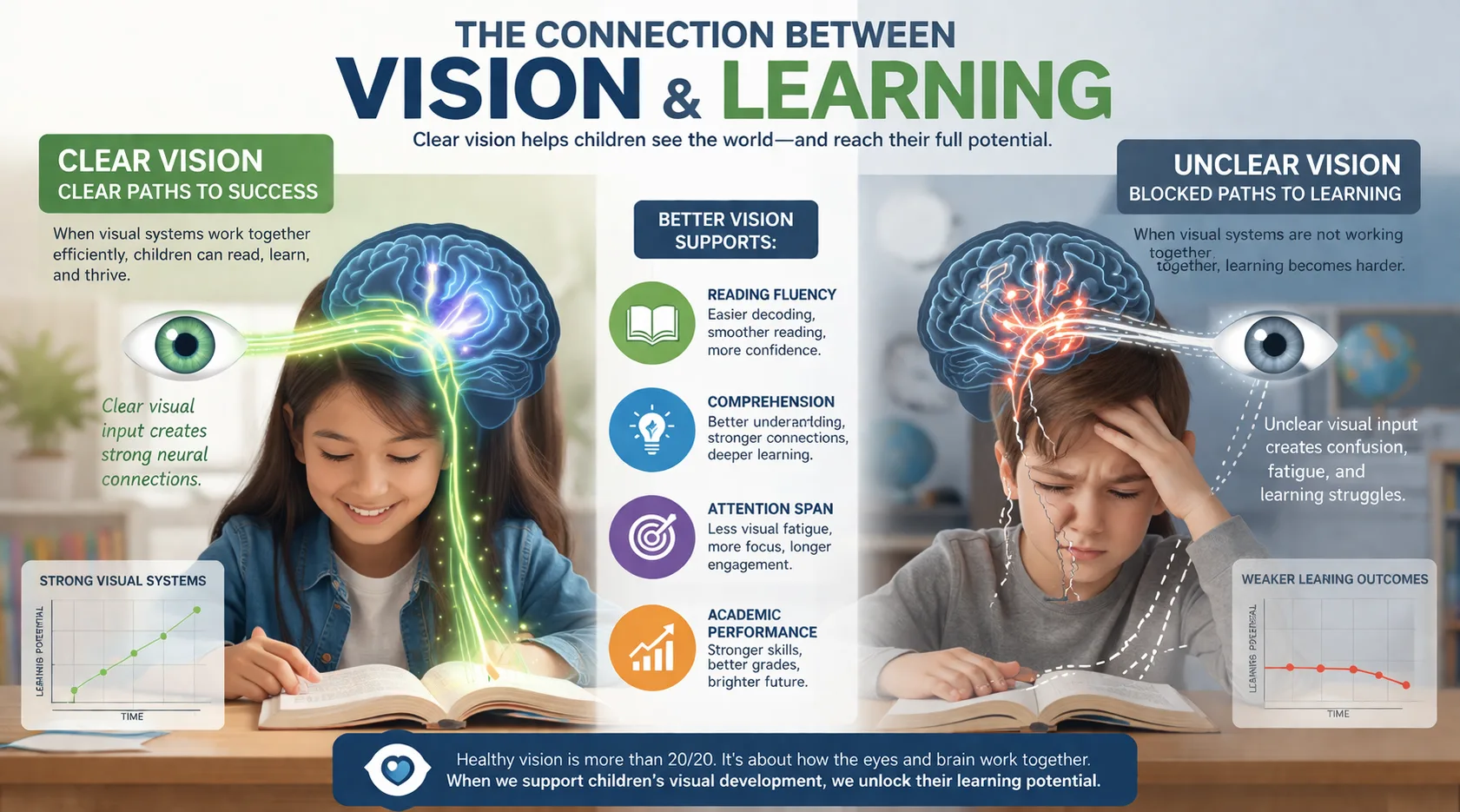
Vision is far more than seeing 20/20 clearly. It's the foundation of learning. Poor vision can dramatically compromise academic performance, attention, and educational development. Yet many children with vision problems go undetected because standard school eye exams measure only distance clarity, missing functional vision issues that directly impact reading, writing, and learning.
Vision Skills Required for Academic Success
Successful learning depends on multiple vision skills beyond simple clarity:
- Distance Vision: Seeing the board clearly
- Near Vision & Focusing: Reading, writing, and sustained close work
- Eye Tracking: Following lines of text smoothly without skipping
- Binocular Vision: Both eyes working together for depth perception
- Visual Processing: Brain interpreting visual information quickly
- Visual-Motor Integration: Coordinating vision with hand movements (writing)
- Visual Endurance: Maintaining focus during homework and tests
How Functional Vision Problems Hurt Academic Performance
Reading Difficulties
Convergence insufficiency and poor eye tracking are leading uncorrected causes of reading difficulty. Children skip lines, lose their place, need frequent re-reading, and develop reading avoidance.
Poor Attention Span
Visual discomfort or strain causes children to avoid near work, appearing inattentive. Often misdiagnosed as ADHD when the real problem is a treatable vision issue.
Slow Academic Progress
When vision requires extra effort, less cognitive energy remains for actual learning. Children tire quickly and show progress plateaus.
Handwriting & Fine Motor Problems
Poor visual-motor integration affects pencil control, letter formation, and writing accuracy. Students appear clumsy or careless when vision is the root cause.
Test Performance
Vision problems directly impact test performance through reading errors, processing delays, and fatigue during extended near work.
Vision Disorders Affecting Learning
- Convergence Insufficiency - eyes don't team well during reading
- Amblyopia (Lazy Eye) - one eye underdeveloped, affecting depth perception
- Strabismus (Eye Turn) - misaligned eyes causing double vision or suppression
- Accommodative Dysfunction - difficulty focusing at near distances
- Visual Processing Disorder - slow interpretation of visual information
- Oculomotor Dysfunction - difficulty moving eyes smoothly and accurately
Vision and Dyslexia: An Important Connection
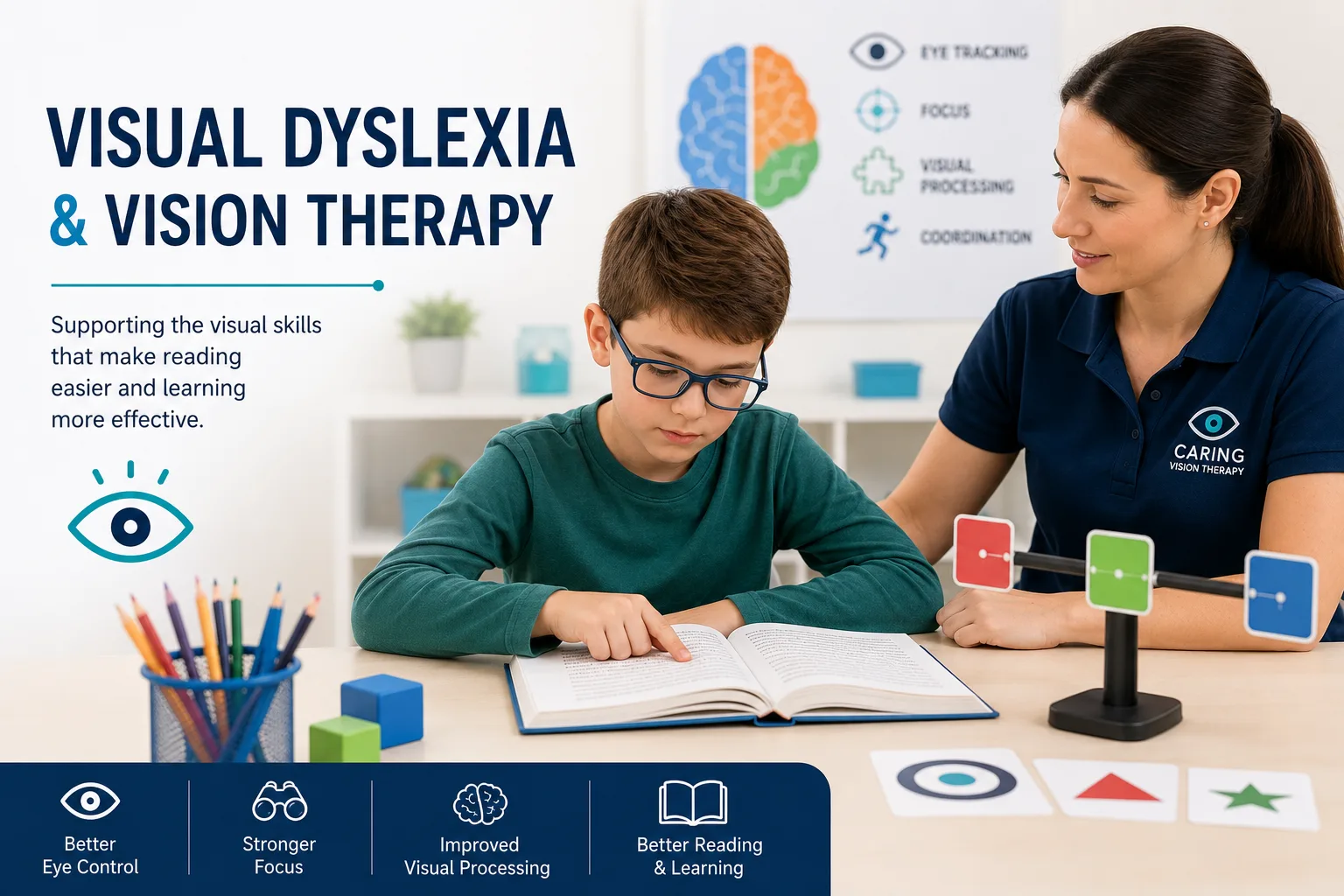
While dyslexia is a language processing issue, many children with dyslexic symptoms actually have undiagnosed functional vision problems like poor eye tracking or binocular misalignment. A full functional vision evaluation can identify whether vision is contributing to reading difficulty.
The Vision-ADHD Misdiagnosis Problem
This is critical: Children with vision problems often appear to have ADHD because they:
- Avoid near work and appear inattentive
- Fidget due to visual discomfort
- Show poor impulse control when frustrated by vision strain
- Have difficulty focusing during reading
A functional vision evaluation should be ONE of the first assessment steps when ADHD is suspected.
Success Rates: Vision Therapy and Academic Improvement
Research shows that treating functional vision problems through vision therapy leads to:
- Average 2-grade improvement in reading level
- 20-30% faster reading speed after treatment
- Improved comprehension and retention
- Better school grades and test performance
- Increased classroom engagement and focus
When vision problems are corrected, learning potential is released.
Explore More at Caring Vision Therapy
Frequently Asked Questions
How much does vision affect learning?
Significantly. Research shows 80% of classroom learning is visual. Children with functional vision problems struggle with reading, writing, and attention. Undetected vision issues are a leading overlooked cause of academic underperformance.
Can vision problems cause ADHD-like symptoms?
Yes. Children with convergence insufficiency, poor eye tracking, or visual processing problems often appear inattentive, fidgety, and restless. A functional vision evaluation should be included when ADHD is suspected.
Will treating vision problems improve my child's grades?
Often yes. When functional vision problems are corrected through therapy, students typically show improved reading speed, accuracy, comprehension, and academic performance. Average improvements of 2 grade levels have been documented.
My child has 20/20 vision but still struggling in school. Could it be a vision problem?
Absolutely. 20/20 only measures distance clarity. It says nothing about eye tracking, binocular coordination, focusing ability, or visual processing - all critical for academic success. A full functional vision evaluation is needed.
Is dyslexia always a language problem?
While dyslexia is primarily a language processing issue, functional vision problems can mimic or worsen dyslexic symptoms. Many children benefit from vision evaluation as part of full dyslexia assessment.