Understand Visual Snow Syndrome symptoms including static vision, photophobia, palinopsia, dizziness, and visual motion sensitivity. Explore neuro optometric rehabilitation at Caring Vision Chennai.
Book a ConsultationWhat Is Visual Snow Syndrome?
Understand Visual Snow Syndrome symptoms including static vision, photophobia, palinopsia, dizziness, and visual motion sensitivity. Explore neuro optometric rehabilitation at Caring Vision Chennai.
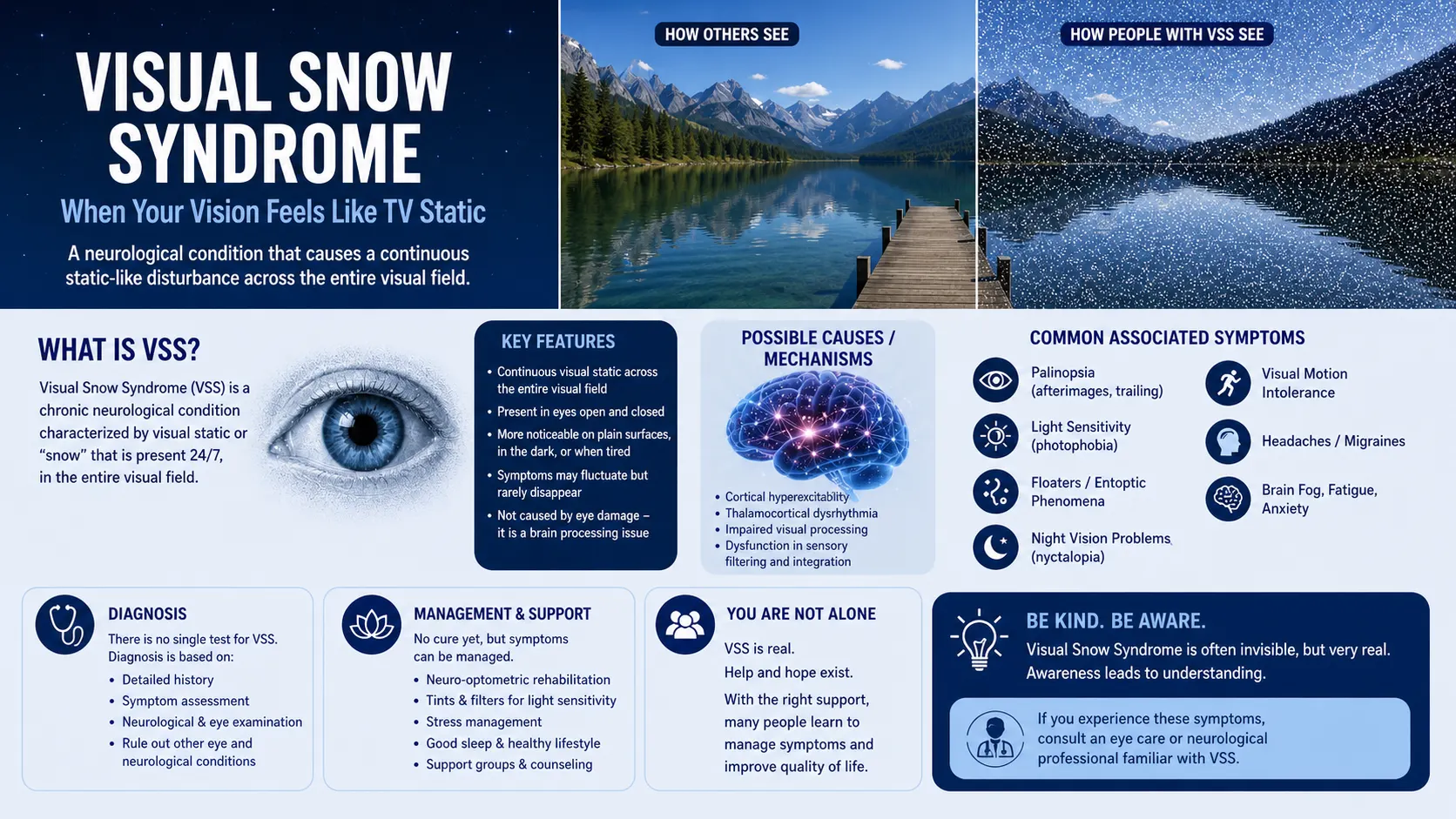
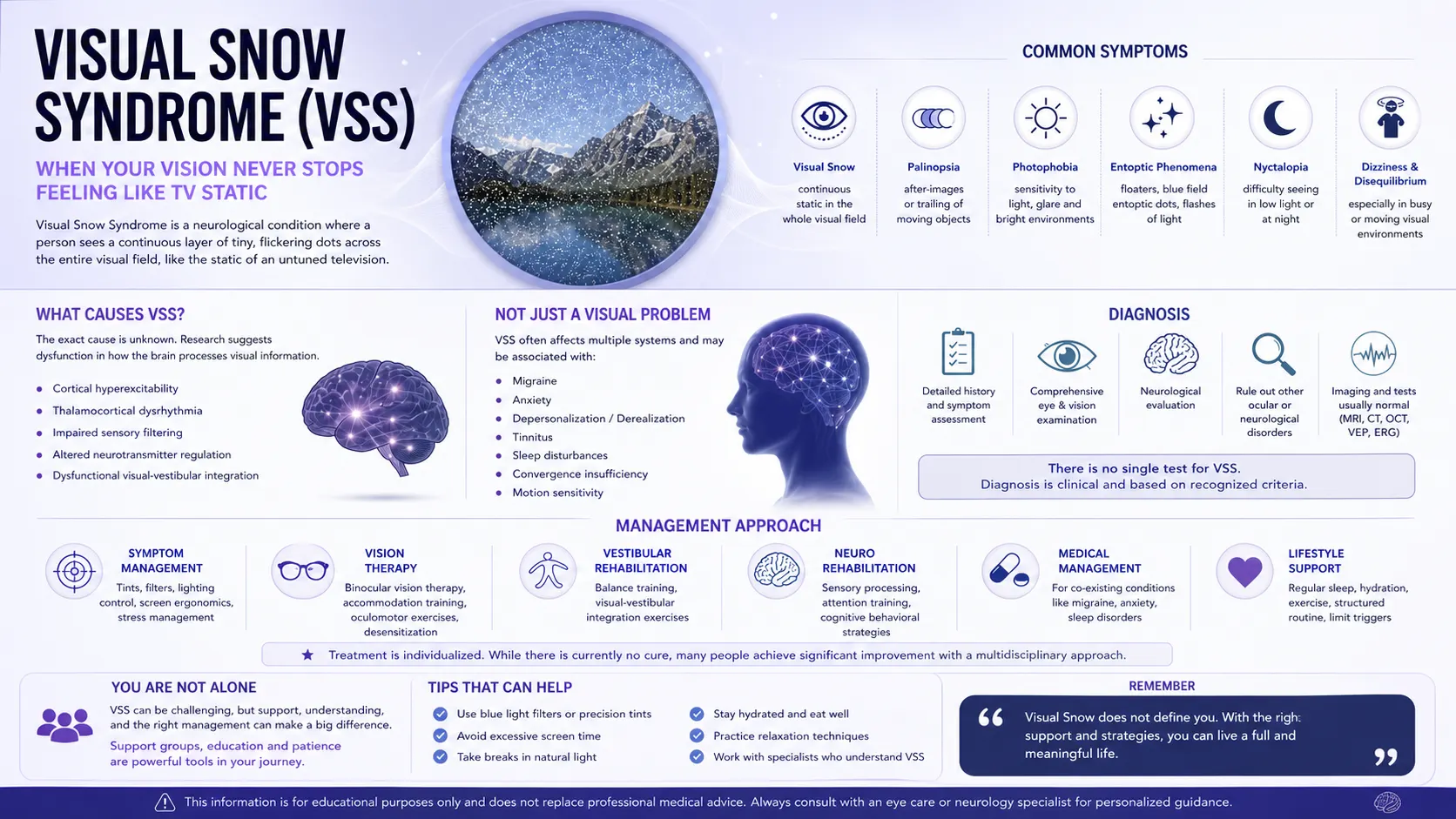
Visual Snow Syndrome (VSS) is a neurological visual processing disorder in which individuals continuously perceive tiny flickering dots across the entire visual field - much like television static or digital noise. What makes this condition particularly challenging is that routine eye examinations often appear completely normal, leaving patients frustrated despite experiencing very real, persistent visual symptoms every single day.
At Caring Vision, we assess the visual consequences of Visual Snow Syndrome through advanced neuro-optometric evaluation and customised rehabilitation strategies designed to improve visual comfort, reading efficiency, balance, motion tolerance, and daily quality of life.
What Does Visual Snow Actually Look Like?
Patients describe their experience in remarkably consistent ways:
- Tiny moving dots across vision during both day and night
- Transparent static overlaying everything they see
- Shimmering pixels or flickering grain across the entire visual field
- Sparkles or vibrating visual textures throughout vision
- Continuous visual disturbance even with eyes closed in some cases
For most individuals, these symptoms are persistent rather than episodic - present from the moment they wake up to when they close their eyes at night.
Common Symptoms Associated with Visual Snow Syndrome
The visual static is only one part of the clinical picture. Most patients experience additional visual and neurological challenges that interfere significantly with daily activities.
Light Sensitivity (Photophobia)
A large proportion of VSS patients become highly sensitive to bright environments. Common triggers include bright sunlight, LED and fluorescent lighting, mobile screens, computer displays, and headlights during night driving. The downstream consequences - eye strain, persistent squinting, headaches, rapid fatigue, and avoidance of bright environments - significantly impact daily life.
Palinopsia - Afterimages and Visual Trailing
Palinopsia refers to the persistence of visual images after the stimulus has moved or disappeared. Patients may notice lingering afterimages, motion trails that follow moving objects, and a delayed disappearance of images after the source is gone. These symptoms affect reading, driving, and general screen use in ways that are difficult to explain to others.
Poor Contrast Sensitivity
Despite normal visual acuity on a letter chart, patients often struggle with low-contrast environments - grey text on white backgrounds, faces in dim lighting, or navigating poorly lit areas. This gap between measured acuity and lived visual function is one of the defining characteristics of Visual Snow Syndrome.
Reading Difficulties
Words may appear unstable or seem to vibrate on the page. Letters blur together after a few minutes, patients lose their place frequently, and reading speed drops while cognitive fatigue sets in quickly. These symptoms reflect disrupted visual processing rather than poor eyesight in the conventional sense.
Visual Motion Sensitivity
Busy visual environments become genuinely overwhelming for many VSS patients. Crowded areas, traffic, supermarkets, escalators, fast-moving video content, and scrolling screens can trigger dizziness, visual overload, anxiety, and significant motion discomfort. Some patients restrict their activities substantially as a result.
Night Vision Problems
Visual snow typically intensifies in darkness. Patients also commonly report halos around lights, glare sensitivity, and difficulty driving at night even when daytime visual function appears acceptable. The combination of increased static and light scatter at night is a particularly impairing experience.
Binocular Vision Dysfunction
A subset of VSS patients also present with binocular vision instability - eye strain, focusing fatigue, convergence insufficiency, intermittent double vision, and difficulty shifting focus between near and far targets. These binocular dysfunctions compound the sensory overload the visual system is already managing.
Why Visual Snow Syndrome Happens
VSS is not caused by damage to the eyeball itself. Current research points to altered visual signal processing within the brain as the underlying mechanism.
Cortical Hyperexcitability
The visual cortex may become excessively responsive, generating persistent background visual noise that the brain's normal inhibitory processes cannot filter out effectively.
Thalamocortical Dysrhythmia
The thalamus normally functions as a sensory gatekeeper. Disruption to the thalamocortical rhythm may allow excessive visual signals to reach conscious perception, resulting in the experience of constant static across the visual field.
Impaired Sensory Gating
The brain's ability to suppress irrelevant visual information may be reduced in VSS, leading to persistent visual overload. Effectively, the brain's noise-cancellation mechanism is not functioning as intended.
Oculomotor and Vestibular Integration Stress
When eye movement control, balance systems, and visual processing are poorly synchronised, symptoms including dizziness, visual instability, and motion intolerance worsen. Rehabilitating these integration deficits is a central focus of Neuro Optometric Rehabilitation Therapy (NORT) at Caring Vision.
Why Routine Eye Exams May Look Completely Normal
Standard eye examinations assess structural eye health and measure refractive error. They are not designed to evaluate visual processing, sensory gating, or the functional integration between visual and vestibular systems. Most VSS patients have a healthy retina, normal optic nerve, minimal refractive error, and good visual acuity on the letter chart.
Because VSS is a functional neuro-visual processing disorder rather than a structural eye disease, a specialised neuro-optometric assessment is the appropriate evaluation pathway - not a routine eye test.
Neuro-Optometric Evaluation at Caring Vision
A comprehensive assessment for suspected Visual Snow Syndrome may include:
- Detailed symptom mapping and clinical history
- Contrast sensitivity testing across spatial frequencies
- Binocular vision analysis including vergence and fusional reserves
- Eye tracking and oculomotor evaluation
- Saccadic accuracy and smooth pursuit assessment
- Accommodation and focusing flexibility testing
- Vestibulo-ocular reflex analysis
- Motion sensitivity and visual-vestibular screening
- Reading efficiency testing
- Light sensitivity analysis and precision tint trials
Treatment Approach for Visual Snow Syndrome
Effective treatment for VSS requires an individualised, structured approach because the condition affects multiple overlapping systems - visual processing, eye movement control, vestibular function, and light sensitivity - that cannot be addressed by a single intervention.
Neuro Optometric Rehabilitation Therapy (NORT)
Neuro Optometric Rehabilitation Therapy is the primary rehabilitation approach for VSS at Caring Vision. Rather than targeting the visual static directly, NORT addresses the dysfunctional underlying systems that amplify symptoms - including saccadic eye movement training, smooth pursuit exercises, convergence rehabilitation, accommodation flexibility training, peripheral awareness exercises, dynamic gaze stabilisation, and visual attention training. Read our full clinical guide to NORT to understand the complete therapy framework.
Precision Therapeutic Tints and Filters
Many VSS patients benefit significantly from precision therapeutic tints - clinically selected optical filters that target the specific wavelengths driving cortical irritation in that individual. Selection is based on clinical testing rather than guesswork. Benefits may include reduced photophobia, better screen endurance, reduced glare, improved contrast perception, and less visual overload in demanding environments.
Visual-Vestibular Rehabilitation Therapy
When dizziness, motion sickness, visual disorientation, or instability in busy environments are prominent symptoms, visual-vestibular rehabilitation addresses the coordination gap between visual and balance systems. Key areas include vestibulo-ocular reflex retraining, head-eye coordination exercises, motion desensitisation, balance integration, and building confidence for movement in challenging environments.
What Results Can Patients Expect?
VSS often requires long-term management rather than a single treatment course. With personalised rehabilitation, many patients report better light tolerance, reduced eye strain and headache frequency, improved reading comfort and stamina, reduced dizziness, better concentration, and improved confidence in public spaces.
Some patients continue to perceive residual visual static, but functional disability - the primary concern for most - often improves substantially. The goal of rehabilitation is not to promise elimination of visual snow, but to reduce its impact on daily life to a manageable level.
Why Early Recognition and Assessment Matters
Many patients with Visual Snow Syndrome spend years being told that everything looks normal while experiencing significant daily symptoms. The visual experience is real, persistent, and deserves proper neuro-optometric evaluation and a structured path toward rehabilitation.
Early assessment allows rehabilitation to begin before compensatory strategies and secondary symptoms become further entrenched. If you or someone you know experiences persistent visual static, light sensitivity, afterimages, dizziness, or motion-related visual discomfort, a neuro-optometric evaluation is the appropriate first step.
Explore More at Caring Vision Therapy
Frequently Asked Questions
What is Visual Snow Syndrome?
Visual Snow Syndrome is a neurological visual processing disorder where individuals continuously perceive flickering dots or static across their entire visual field - similar to television static. The condition is not caused by damage to the eyes themselves but by altered visual signal processing in the brain.
Can Visual Snow Syndrome be cured?
There is currently no universal cure for Visual Snow Syndrome. However, neuro-optometric rehabilitation therapy, precision therapeutic tints, and visual-vestibular rehabilitation may significantly reduce symptom burden and improve daily visual function and quality of life.
Why do eye exams appear normal in Visual Snow Syndrome?
Standard eye examinations assess the structural health of the eye and measure refractive error. Visual Snow Syndrome is a functional neuro-visual processing disorder rather than a structural eye disease, so it is not detectable through routine eye examination. A specialised neuro-optometric evaluation is required.
Can vision therapy help Visual Snow Syndrome?
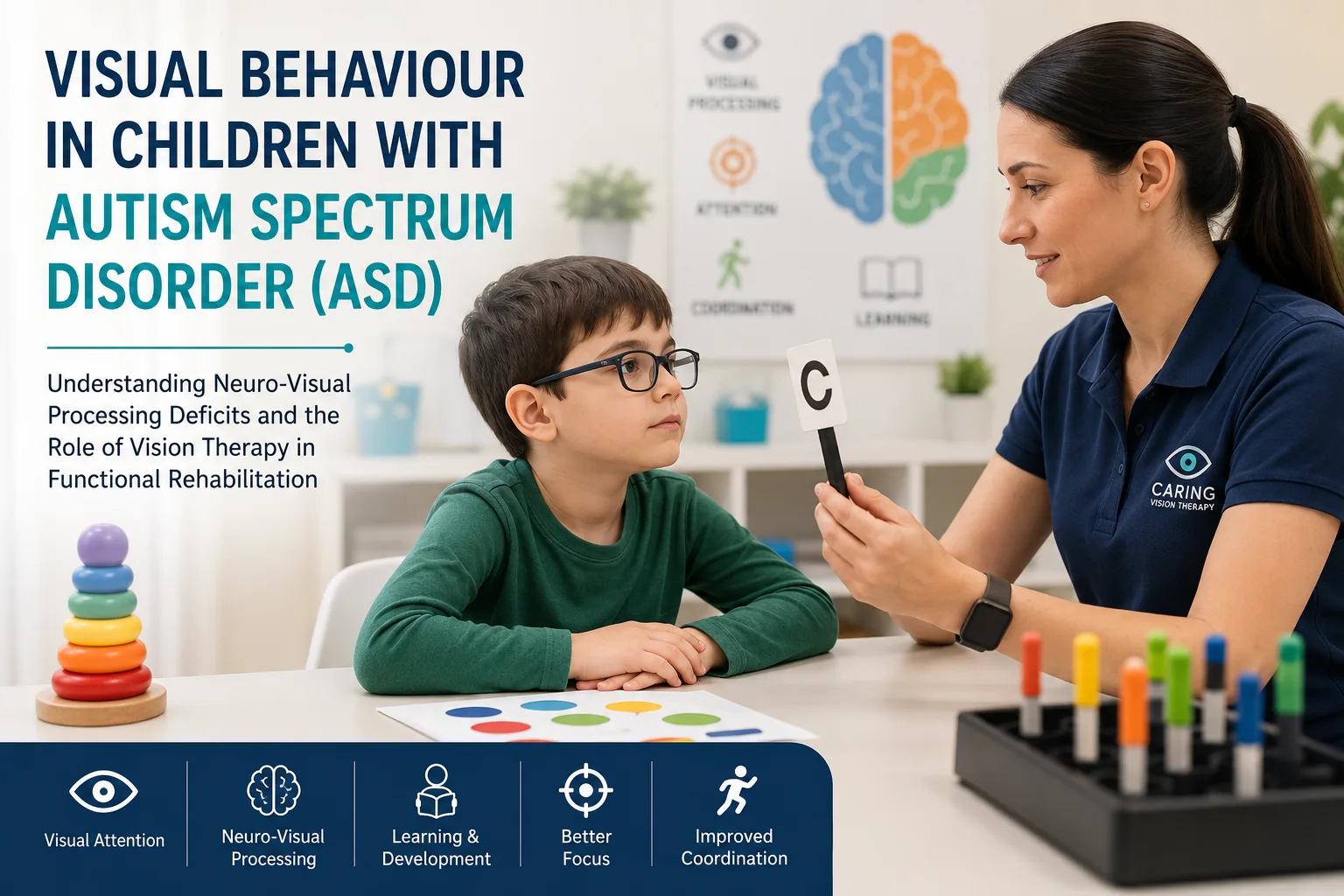
Neuro Optometric Rehabilitation Therapy (NORT) can help some patients with Visual Snow Syndrome by improving eye movement control, visual motion processing, binocular vision function, balance integration, and visual comfort - even if it does not eliminate the visual static entirely.
Does Visual Snow Syndrome cause dizziness?
Yes. Many individuals with Visual Snow Syndrome experience dizziness, motion sensitivity, visual disorientation, and vestibular-related symptoms. These arise from dysfunction in the coordination between the visual and vestibular systems and can be addressed through visual-vestibular rehabilitation.
What type of specialist should I see for Visual Snow Syndrome?
A neuro-optometrist with experience in functional visual processing disorders is the most appropriate specialist. At Caring Vision in Chennai, we conduct comprehensive neuro-optometric evaluations specifically designed to assess the visual system dysfunctions associated with Visual Snow Syndrome.