Convergence insufficiency exercises explained: pencil push-ups and Brock string step by step, what the research shows, and when home practice is not enough.
Do Convergence Insufficiency Exercises Work?
They can, but where you do them matters. In the largest trial in children, 73% improved with office-based therapy plus home practice, against 43% with home pencil push-ups and 35% with placebo therapy. Home exercises may help milder cases once the diagnosis is confirmed and someone is tracking progress.
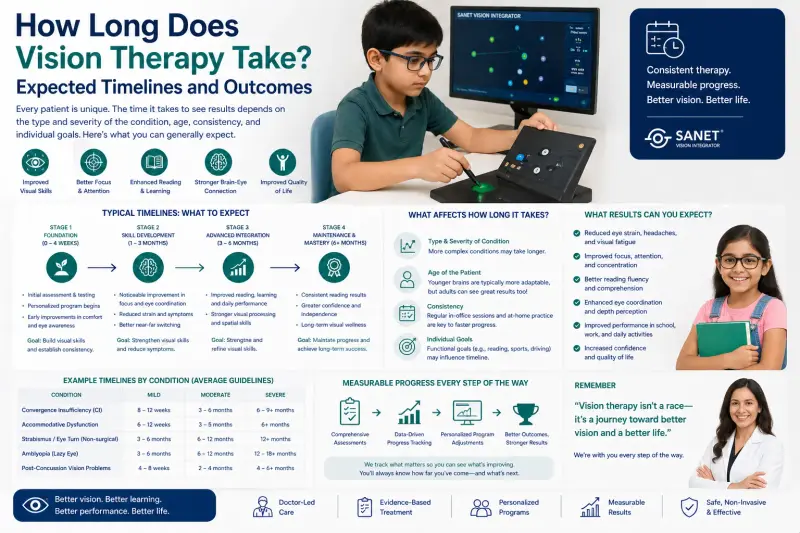
Pencil push-ups are probably the most prescribed eye exercise in the world, since they cost nothing and take a minute to explain. Many people with convergence insufficiency have been sent home with them. Quite a few are still wondering, months later, why nothing has changed.
Below you will find how to do the two best-known exercises properly, what the research found when they were tested, and how to judge whether home practice is enough for you or your child.
Before you start: be sure this is the problem
Convergence is the inward turn of both eyes that keeps a near object single. In convergence insufficiency, the eyes struggle to turn in and hold there. That leads to tired eyes, headaches, words that blur or double, and losing your place during reading.
Other conditions can feel exactly the same, including uncorrected plus power, a focusing problem and a small vertical misalignment. Pushing a pencil at your nose will not help any of those. So if you can, get the near point of convergence and eye muscle reserves measured first. Do not rely on exercises alone if you have a constant eye turn, double vision that came on suddenly, or symptoms after a head injury. These need an examination first.
How to do pencil push-ups
- Sit upright in good light, wearing your usual glasses.
- Hold a pencil at arm's length at eye level, in the middle of your nose line. Choose a small letter or mark on it to look at.
- Bring it slowly towards the bridge of your nose, keeping that mark single and clear.
- Stop as soon as it doubles or blurs. Try to make it single again.
- If it stays double, move the pencil back until it is single, then start again.
- Aim to get a little closer over time. Good convergence usually holds to within a few centimetres of the nose.
Children in the main trial were asked to do about 15 minutes a day, 5 days a week. In practice, two or three shorter sessions are easier to keep up.
Watch out for this: if the pencil never doubles and simply reaches your nose while one eye drifts away, you may not have succeeded. Your brain may have just switched one eye off. Ask someone to watch your eyes. If one stops following the pencil, tell your optometrist. More push-ups in that state only train you to keep switching that eye off.
How to use a Brock string
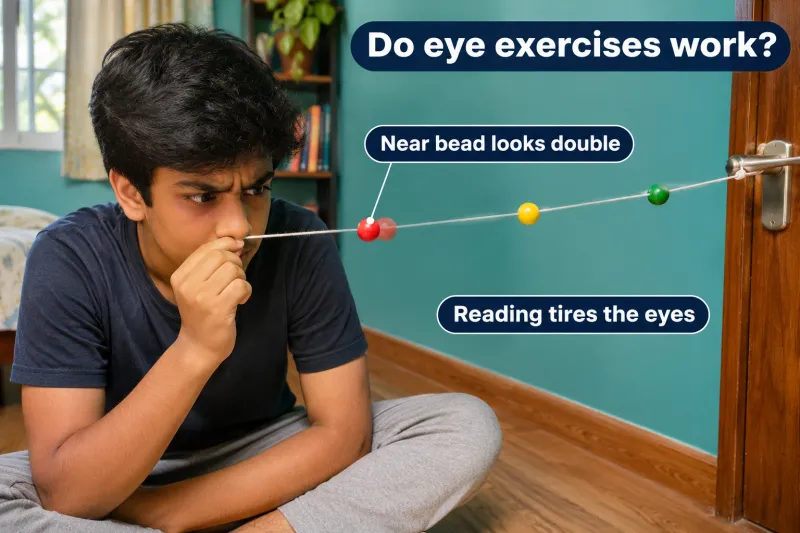
A Brock string is a piece of cord about 2 to 3 metres long with three coloured beads on it. It is a better exercise than the pencil in one way: it tells you what your eyes are doing.
- Tie one end to a door handle at about eye level, and hold the other end against the tip of your nose.
- Put one bead about 40 centimetres from your nose, one in the middle and one near the far end.
- Look at the nearest bead. You should see one bead with two strings forming an X that crosses right at it.
- Hold it for a few seconds, then move your eyes to the next bead and find the X there.
- As it gets easier, slide the nearest bead closer to your nose by a little at a time.
Here is how to read what you see:
- The X crosses at the bead: both eyes are aimed correctly.
- The X crosses beyond the bead: your eyes are not turning in far enough. This is the usual pattern in convergence insufficiency.
- The X crosses before the bead: your eyes are turning in too much.
- One string fades or disappears: your brain is switching that eye off.
A note on effort. A short, mild pull while you work is fine. Stop if you get a headache or dizziness, or if double vision continues after you finish, and tell your optometrist.
What the research actually shows
Convergence insufficiency has some of the best evidence in vision care, because it has been tested in proper randomised trials, including ones with a placebo.
In children. The Convergence Insufficiency Treatment Trial followed 221 children aged 9 to 17 for 12 weeks. The share who were successful or improved was:
| Treatment | Successful or improved |
|---|---|
| Office-based therapy with home practice | 73% |
| Home pencil push-ups | 43% |
| Office-based placebo therapy | 35% |
| Home computer therapy plus pencil push-ups | 33% |
A Cochrane review in 2020 pooled the trials and reached the same view: for children, office-based therapy with home reinforcement works better than pencil push-ups or home computer programmes. The two home-based options did not clearly beat placebo in that analysis.
In young adults. A small trial of 46 adults aged 19 to 30 found that only office therapy made a clinically significant difference to convergence itself. Symptoms cleared in 42% with office therapy, 31% with placebo and 20% with pencil push-ups. Overall, Cochrane calls the adult evidence less clear. Adults can improve, but nobody should promise you a figure.
A surprise about symptoms. A later trial of children aged 9 to 14 found that therapy improved their near point of convergence by 10.4 centimetres, against 6.2 with placebo. But the children reported a similar fall in symptoms in both groups. Feeling better is not enough to prove an exercise is working, so any programme should be measuring your eyes as well as asking how you feel.
We have seen no good trials testing the Brock string as a home treatment by itself. It is widely used within therapy programmes, where it is valuable mainly because of the feedback it gives. So we would not quote you a success rate for it.
Why home practice so often stalls
- It trains one thing. Pencil push-ups work on near convergence. Real reading also needs reserve, stamina, fast changes of focus and good eye movements.
- Nobody moves you on. A therapist makes the work harder as you improve. At home, the exercise stays the same.
- No one catches the errors. Suppressing one eye is easy to do without realising it.
- People stop. One trial saw home practice fall off with time, and completion was lower with pencil push-ups. Doing the same dull task every evening is hard, particularly for a nine-year-old.
How convergence connects to vision development
Children start to turn their eyes in during the first months of life, as they begin looking at hands and toys. But the stamina to hold convergence for an hour of reading comes much later, and it builds on years of looking, reaching, playing and moving. When school demands overtake that stamina, you see the symptoms. That explains why convergence problems often show up in middle school rather than earlier, and why children may hold books very close or read with one eye shut.
It also explains why behavioural vision care looks beyond the eye muscles. Posture, the distance at which your child reads, how they use their hands while looking, and how their vision works with balance and movement all affect how well near work goes.
What supervised vision therapy adds
Office-based vision therapy uses many of the same principles as the exercises above, including push-ups and Brock string work, but it adds several things. Convergence and divergence are both trained. Focusing is trained alongside them, using lenses and targets that can be changed step by step. Stereoscopic targets show whether both eyes stay switched on. Then the skill is carried over to real tasks, with both eyes working together during reading, writing and looking from board to book.
The goal is functional vision, which means being able to read comfortably for as long as your schoolwork or your job requires, without having to think about it.
Why a developmental and behavioural optometrist should confirm the diagnosis
The first job is to confirm that convergence is actually the issue, and then work out how much it is affecting you. Measurements include the near point of convergence, fusional reserves, focusing and a symptom questionnaire. They decide whether home work is reasonable or whether a supervised programme makes more sense, choose exercises that suit your results, and repeat the same tests over time so progress is visible. A developmental and behavioural optometrist will also look at reading habits, posture and how your child uses vision at school, because the numbers only tell part of the story.
So, should you try exercises at home?
Trying them is reasonable if your symptoms are mild, you have no constant eye turn or sudden double vision, and you have had your eyes checked. Give it about 6 to 8 weeks with a measurable target, such as how close the pencil gets before doubling. Measure it once a week.
If nothing has moved by then, or if a child's reading is already suffering, stop repeating the same exercise. Book an eye teaming assessment at Caring Vision Therapy. You will get measurements, a clear plan and a straight answer on whether you need therapy at all.
Explore More at Caring Vision Therapy
Frequently Asked Questions
Do pencil push-ups work for convergence insufficiency?
How many pencil push-ups should I do a day?
How long does it take to see results?
Is a Brock string better than pencil push-ups?
What should I see on a Brock string?
Can adults fix convergence insufficiency with exercises?
Can exercises reduce my glasses power?
Sources
- Randomized Clinical Trial of Treatments for Symptomatic Convergence Insufficiency in Children. Archives of Ophthalmology, 2008.
- Interventions for Convergence Insufficiency: a Network Meta-Analysis. Cochrane Database of Systematic Reviews, 2020.
- Treatment of Symptomatic Convergence Insufficiency in Children Enrolled in the Convergence Insufficiency Treatment Trial, Attention and Reading Trial. Optometry and Vision Science, 2019.
- A Randomized Clinical Trial of Vision Therapy/Orthoptics Versus Pencil Pushups for Convergence Insufficiency in Young Adults. Optometry and Vision Science, 2005.
Reviewed by the Caring Vision Therapy clinical team. Updated November 2026.