
Convergence insufficiency in adults: symptoms, why it worsens with screen work and exams, how it is diagnosed, and vision therapy treatment options.
Book a ConsultationConvergence Insufficiency in Adults: What It Is and How It's Treated
Convergence insufficiency in adults: symptoms, why it worsens with screen work and exams, how it is diagnosed, and vision therapy treatment options.
Reading a report at your desk for twenty minutes starts to blur. A few pages into a novel, you feel a dull ache behind your eyes. You catch yourself rereading the same line three times, or notice that text seems to swim slightly when you are tired. If any of this sounds familiar, and a routine eye test has told you your eyesight is perfectly normal, the underlying problem may not be how clearly you see - it may be how well your two eyes work together up close. This is convergence insufficiency, and in adults it is frequently missed.
What Is Convergence Insufficiency?
Convergence is the inward-turning movement both eyes make when focusing on something close - a phone screen, a laptop, a book. In convergence insufficiency, the eyes have difficulty sustaining this inward turn efficiently during near tasks. The result is a mismatch between what the visual system is being asked to do and what it can comfortably maintain, and symptoms typically build the longer near work continues.
Why It Often Shows Up - or Worsens - in Adulthood
Convergence insufficiency is often discussed as a childhood condition, but the underlying binocular vision problem does not disappear at graduation. Many adults never had a comprehensive binocular vision assessment as children, so a mild or moderate case may have gone unnoticed through school and only become symptomatic once daily visual demands increased - long hours on a laptop, extended screen-based work, postgraduate study, or simply more near work with fewer natural breaks. Other adults develop symptoms later, as visual demands change with a new job, a return to study, or heavier device use. Either way, because distance eyesight can still be 20/20, the problem is easy to dismiss as "just tiredness."
If you are researching this for a child rather than yourself, our companion guide on recognising convergence insufficiency in children covers the paediatric picture in detail.
Common Symptoms in Adults
- Eye strain or a dull ache after reading, studying or computer work
- Headaches that build through the afternoon or after long screen sessions
- Words that blur or appear to move after sustained near work
- Intermittent double vision, especially when tired
- Losing your place or rereading lines while reading reports, emails or books
- Difficulty concentrating on near tasks for as long as colleagues or peers can
- An urge to close or cover one eye during prolonged reading
- Avoiding reading for pleasure, even though you used to enjoy it
None of these symptoms are exclusive to convergence insufficiency, which is exactly why a proper assessment - rather than self-diagnosis - matters.
Convergence Insufficiency Is Not the Same as Poor Eyesight
This is the point most adults miss. You can have perfectly clear 20/20 vision on a standard eye chart and still have significant difficulty with binocular vision. Visual acuity measures how clearly you see; a binocular vision assessment measures how effectively your two eyes work together as a team. An adult can pass a routine eye test with no concerns raised and still struggle to read for more than ten minutes without discomfort, because the two measurements are testing entirely different things.
Why It Often Surfaces During Screen-Heavy Work or Study
Sustained near work is the single biggest trigger for convergence insufficiency symptoms in adults. Laptop and desktop work, extended smartphone use, studying for competitive exams, and long report-writing sessions all place continuous demand on the eyes' ability to converge. Many adults compensate without realising it at first - the visual system simply works harder to hold things together. But compensation has a limit, and after enough consecutive minutes or hours of near work, symptoms surface. This is also why some adults notice their symptoms return specifically during high-pressure periods - exams, audits, project deadlines - when near-work hours increase sharply, even if the same task felt manageable at a lower workload.
How Is Convergence Insufficiency Diagnosed?
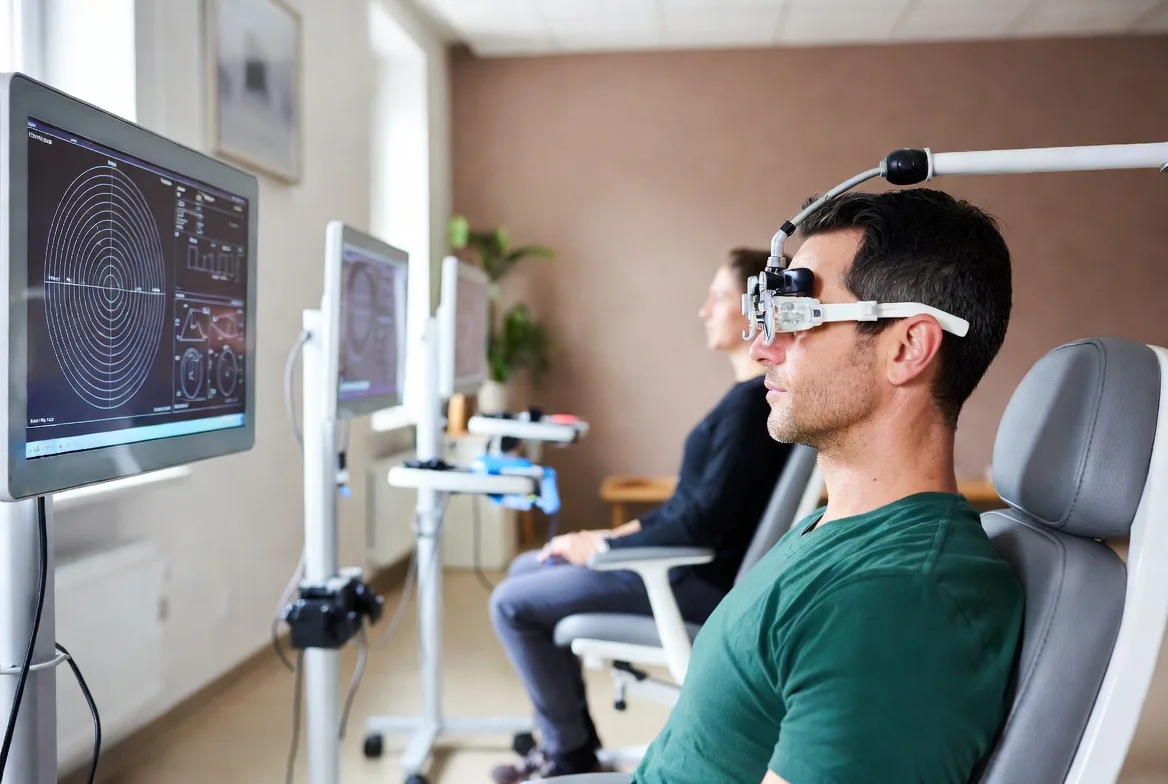
Diagnosis requires more than reading letters on a chart. A comprehensive binocular vision assessment typically evaluates:
- Distance and near visual acuity
- Refraction, to confirm whether glasses or an updated prescription is needed
- Near point of convergence - how closely you can maintain single, comfortable vision as a target moves toward your eyes
- Eye alignment at distance and near
- Fusional vergence - how well the visual system compensates for small alignment differences
- Accommodation (focusing), since convergence and focusing are closely linked
- Eye movements, particularly if reading difficulty is a major complaint
- Your real-world symptoms during near work, interpreted alongside the clinical measurements
Why a Routine Eye Test Often Misses It
A standard eye examination is excellent at detecting refractive errors and screening for ocular disease, but a basic vision screening frequently does not include detailed binocular vision testing. Two adults can both read the smallest line on an eye chart - one can comfortably work at a screen for an hour, the other develops a headache and blurred vision within fifteen minutes. Their visual acuity is identical. Their visual function is not. This is why persistent near-work symptoms deserve a dedicated binocular vision assessment even after being told your eyes are fine.
Treatment Options for Adults
Treatment is not one-size-fits-all and depends on the clinical findings, symptom severity, and how much near work your daily life or profession demands. Depending on the assessment, management may include appropriate spectacle correction, management of any associated focusing problem, structured optometric vision therapy, prescribed vergence exercises, and practical guidance on visual ergonomics for screen-heavy work. The goal is never simply to make the eyes "stronger" - it is to rebuild the visual system's ability to coordinate, sustain and comfortably use both eyes together during real near-work tasks: reading a contract, working through a spreadsheet, studying for an exam.
Does Every Adult Need Vision Therapy?
No. Some adults have mild findings with minimal functional impact and may only need monitoring, ergonomic adjustments or targeted advice. Others, with significant symptoms and measurable deficits on assessment, benefit from a structured programme. The right approach should be determined after a full assessment of the visual profile, not assumed in advance.
Can Convergence Insufficiency Come Back?
Yes. Symptoms can resurface when visual demands increase - a role change that means more screen time, a return to studying, a demanding audit season - particularly if the underlying binocular vision problem was never fully addressed. Periodic follow-up can confirm whether visual skills remain stable or whether near-work demands have simply outpaced them again.
Making Near Work More Comfortable
Alongside clinical treatment where indicated, a few habits reduce day-to-day strain: take a genuine visual break every 20-30 minutes of continuous near work, keep your screen or book at a comfortable working distance rather than unusually close, control glare and use adequate lighting, and maintain a posture that lets you view your screen without craning forward. None of these habits cure convergence insufficiency, but they reduce the load on a visual system that is already working harder than it should.
When to Seek a Binocular Vision Assessment
Consider a comprehensive assessment if you regularly experience headaches after reading or screen work, eye strain during study or long meetings, intermittent blurred or double vision, difficulty sustaining reading you used to manage easily, frequent loss of place in text, or a habit of closing one eye during near tasks. Persistent, unexplained near-work symptoms deserve proper evaluation rather than being written off as tiredness.
At Caring Vision, we assess adults with reading-related and screen-related visual discomfort as a complete clinical picture, not just an eye chart result. If near work has quietly become something you dread rather than something you can simply do, book a comprehensive binocular vision assessment to find out whether convergence insufficiency is part of the reason.
Explore More at Caring Vision Therapy
Frequently Asked Questions
Can adults develop convergence insufficiency, or is it only a childhood condition?
Adults can have convergence insufficiency that was never diagnosed in childhood, or notice symptoms for the first time as near-work demands increase with work or study. It is not exclusively a childhood condition.
Can you have convergence insufficiency with 20/20 vision?
Yes. A person can have normal visual acuity and still have significant difficulty with binocular vision, including convergence, because acuity and binocular coordination measure entirely different aspects of the visual system.
Does convergence insufficiency cause headaches during screen work?
It can. Headaches and eye strain that build during or after prolonged screen use or reading are among the more common adult symptoms.
Why do my symptoms get worse during exams or work deadlines?
High-pressure periods usually mean a sharp increase in continuous near-work hours, which places more demand on an already inefficient convergence system and can make previously manageable symptoms noticeably worse.
Is vision therapy effective for adults, or only children?
Vision therapy can be effective for adults with clinically diagnosed convergence insufficiency. The visual system retains the capacity to adapt into adulthood, though the specific programme should always be based on an individual assessment.
Will glasses alone fix convergence insufficiency?
Not usually on their own. Appropriate spectacle correction may be part of management, particularly if there is an associated focusing or refractive problem, but convergence insufficiency itself is a coordination issue that glasses alone typically do not resolve.
When should an adult get a binocular vision assessment?
If you regularly experience headaches, eye strain, blurred or double vision, or difficulty sustaining reading or screen work despite being told your eyesight is normal, a comprehensive binocular vision assessment is worth pursuing.