Sports vision therapy in Chennai improves ball tracking, depth perception, peripheral awareness and reaction time across sports.
Book a ConsultationWhat Is Sports Vision Therapy and How Does It Improve Athletic Performance?
Sports vision therapy in Chennai improves ball tracking, depth perception, peripheral awareness and reaction time across sports.
Success in sport is rarely decided by muscle alone. Before a batter plays a shot, before a shooter breaks a clay target, before a goalkeeper dives for a save, the brain has already had to receive, interpret and act on visual information - often in a fraction of a second. Roughly 80 percent of the sensory input an athlete uses during competition is visual, which makes vision one of the most trainable, and most overlooked, components of athletic performance.
Sports Vision Therapy is an evidence-informed subspecialty of developmental optometry that evaluates and trains the specific visual skills athletes rely on - skills that a standard 6/6 eye chart reading does not measure at all.
Sports Vision Is Not the Same as 20/20 Eyesight
An athlete can read the smallest line on an eye chart and still struggle to track a fast-moving cricket ball, judge depth accurately under floodlights, or react quickly enough to a shuttlecock or a clay target. These are functional visual skills - how efficiently the eyes move, focus, team together and communicate with the brain - and routine eye examinations are not designed to detect deficits in them. A Sports Vision evaluation looks at the entire visual processing pathway, from the eyes to the brain to the body's motor response.
The Visual Skills That Separate Good Athletes from Elite Ones
Elite athletes typically process visual information a fraction of a second faster than average competitors, and that margin is frequently the difference between a catch taken and a catch dropped, a shot fired true and a shot pulled wide. Sports Vision Therapy targets several distinct visual skills:
Dynamic Visual Acuity
The ability to see a moving object clearly - essential for reading a cricket ball off the bowler's hand, following a tennis serve, or tracking a shuttle in badminton.
Eye Tracking and Saccadic Movements
Smooth pursuit lets the eyes follow a moving ball continuously; saccades are the rapid eye jumps needed to shift attention between multiple targets, such as a fielder watching the ball and the batter's crease simultaneously.
Depth Perception (Stereopsis)
Accurate judgement of distance is critical for catching, for judging the bounce and pace of a cricket ball, and for precision aiming in golf or shooting sports.
Peripheral Awareness
The ability to register movement and players outside central vision, vital in football, hockey and basketball, where the game is rarely confined to where the eyes are pointed.
Accommodation and Vergence
Fast, accurate focusing between near and far targets, and precise binocular alignment, matter directly in shooting sports and archery, where the eyes must lock onto a foresight, a target and back again with no lag.
Visual Reaction Time and Processing Speed
How quickly the brain converts what the eyes see into a motor response is one of the strongest predictors of performance under pressure, whether that pressure is a 140 km/h delivery or a moving clay target that stays airborne for barely a second and a half.
Sports Vision Demands in Cricket
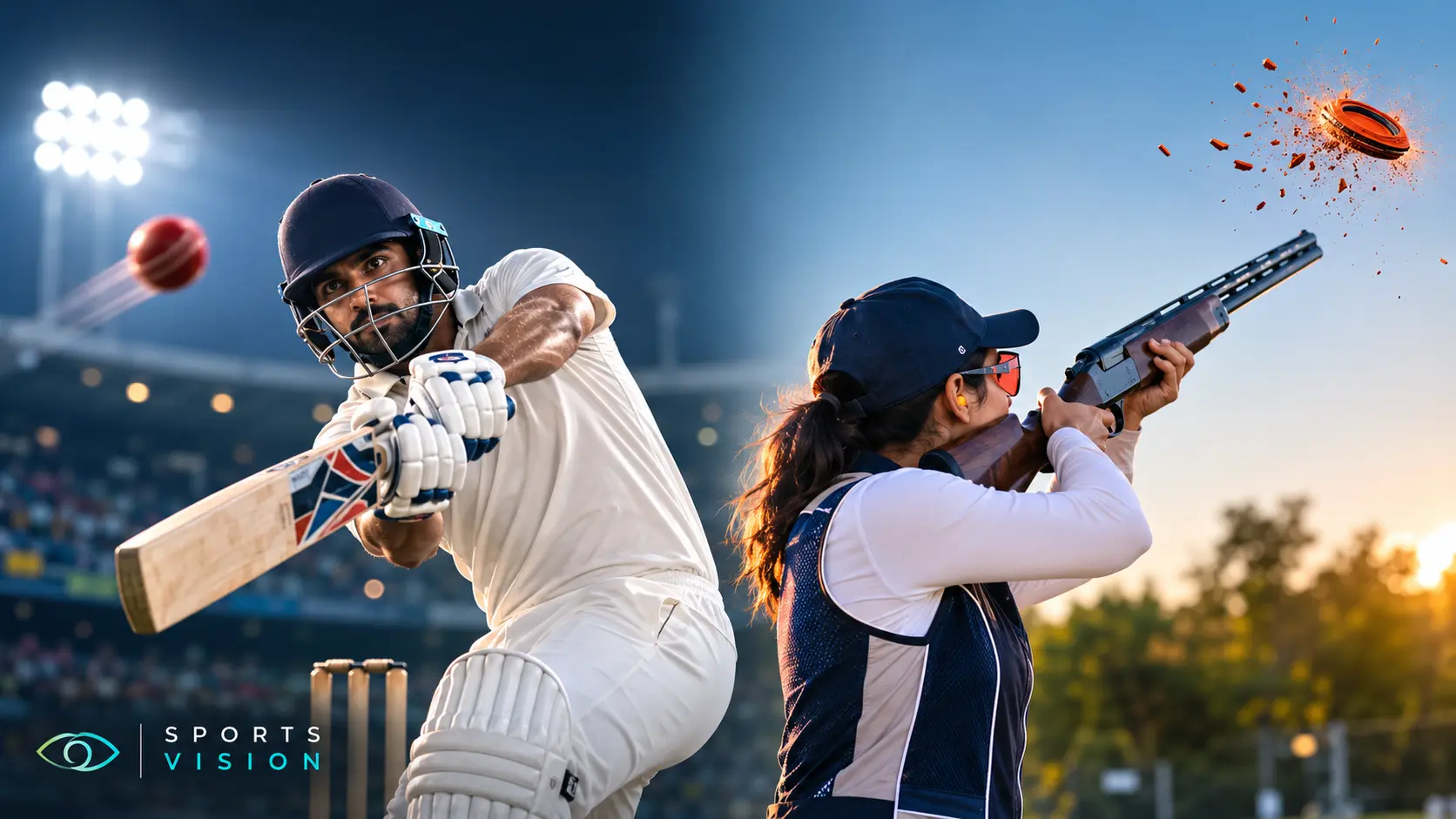
Cricket places extraordinary demands on the visual system. A batter facing a fast bowler has a fraction of a second to pick up the ball's line, length and likely deviation, and must integrate that visual information with a pre-loaded motor pattern to execute a shot. Bowlers rely on visual feedback to control line, length and seam position; fielders and wicketkeepers depend on dynamic visual acuity and depth perception to judge catches, and on rapid saccadic movement to track the ball through variable lighting, including under floodlights where glare sensitivity can become a real limiting factor. Training programmes for cricketers typically focus on ball-tracking drills, spin recognition, catching under fatigue, and anticipation training that shortens the athlete's effective decision time.
Sports Vision Demands in Shooting Sports, Including Trap Shooting
Shooting sports, including trap shooting, ask something different of the visual system - not speed of movement so much as stability, precision and rapid re-focusing. In trap shooting, the shooter must acquire a fast-moving clay target, maintain a stable visual fixation while tracking it, and coordinate eye dominance, accommodation and hand movement within roughly one to two seconds. Deficits in eye dominance, contrast sensitivity or accommodative facility can quietly undermine accuracy in a way the shooter may never trace back to their visual system. Evaluation for shooting athletes typically includes assessment of ocular dominance, fixation stability, contrast sensitivity and glare tolerance, alongside training to improve the speed and accuracy of visual target acquisition.
Other Sports That Benefit from Vision Training
The same principles extend across sport. Tennis and badminton rely heavily on dynamic visual acuity and rapid eye-hand coordination to return serves and track a shuttle at speed. Football and hockey draw on peripheral awareness and fast decision-making across a wide field of play. Basketball demands court awareness and precise depth judgement for shooting. Golf and archery require stable fixation and fine-tuned depth perception. Table tennis and baseball depend on very fast visual reaction time to track a small, fast object at close range. Athletes recovering from a concussion or head injury frequently present with disrupted eye tracking, delayed visual processing, or vestibulo-ocular reflex dysfunction, and often benefit from a structured neuro-visual rehabilitation programme before a safe return to sport.
Signs an Athlete May Benefit from a Sports Vision Evaluation
Certain patterns during competition and training point toward an underlying visual skills deficit rather than a technical or fitness issue:
- Difficulty tracking the ball, shuttle or clay target consistently
- Missed catches, late shot selection, or mistimed contact
- Difficulty judging pace, bounce or distance accurately
- Reduced performance under floodlights or in glare
- Visual fatigue, headaches or eye strain during or after training
- Closing one eye, excessive blinking, or noticeable light sensitivity
- Slower reaction under pressure compared with physical conditioning would predict
General symptoms such as double vision during exertion, poor balance, dizziness, or compensatory head tilting can also signal an underlying binocular vision or oculomotor dysfunction that is limiting performance without the athlete or coach realising vision is the cause.
What a Sports Vision Evaluation and Training Programme Involves
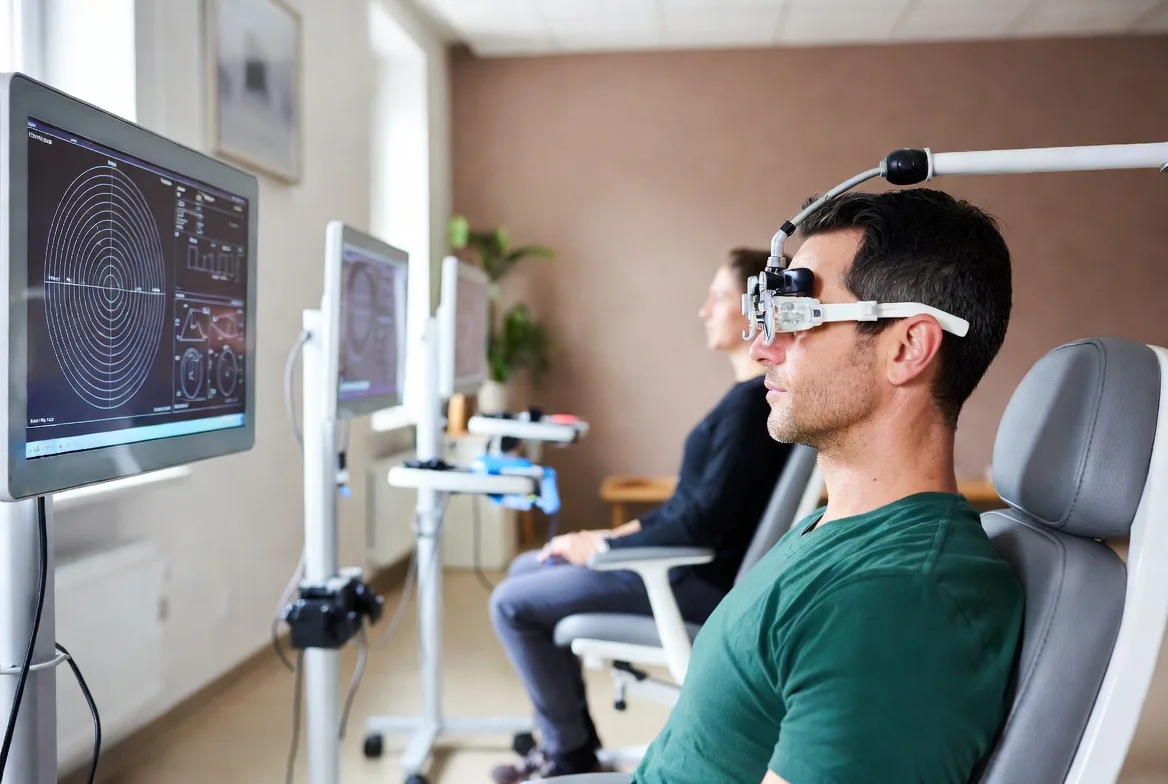
At Caring Vision Therapy, every athlete undergoes an individualised functional evaluation before any training programme is designed - there is no standard package applied uniformly. Depending on the sport, the athlete's age, competitive level and the specific deficits identified, a programme may draw on comprehensive dynamic visual acuity testing, eye tracking and saccadic training, accommodation and vergence therapy, binocular vision rehabilitation, peripheral awareness drills, visual reaction time and processing speed training, eye-hand and eye-foot coordination work, depth perception enhancement, and sport-specific decision-making tasks. Where an athlete is returning from a concussion or head injury, vestibular and oculomotor rehabilitation is integrated into the programme, with progress tracked through objective, repeatable clinical measures rather than subjective impression alone.
Who Should Consider a Sports Vision Assessment
Sports Vision evaluation is appropriate for professional, national and state-level athletes, academy and junior players, school and collegiate competitors, recreational athletes looking to sharpen their edge, and athletes returning to sport after a concussion or other visual disturbance. The evidence base for structured sports vision training supports improvements in eye tracking, visual attention, reaction time and processing speed, though the extent to which these gains translate into on-field results varies by sport, training method and individual. What the evidence consistently supports is that an individualised assessment, rather than a generic programme, is the right starting point.
At Caring Vision Therapy & Neuro Vision Rehabilitation Centre, our FCOVD/FOVDR certified specialists evaluate the full visual pathway - not just eyesight - and build a training plan around what each athlete's eyes and brain actually need. Book a Sports Vision assessment to find out what your visual system may be costing you on the field or at the range.
Explore More at Caring Vision Therapy
Frequently Asked Questions
My child has 20/20 vision - can they still benefit from Sports Vision Therapy?
Yes. A 20/20 or 6/6 result on a standard eye chart only measures clarity of vision at a fixed distance in ideal conditions. It does not assess dynamic visual acuity, eye tracking speed, depth perception, peripheral awareness or visual reaction time - the skills that actually determine performance in fast-moving sport. Many athletes with perfect eye-chart vision have measurable deficits in these functional visual skills.
How is Sports Vision Therapy relevant to shooting sports like trap shooting?
Trap shooting demands rapid visual target acquisition, stable fixation while tracking a fast-moving clay, accurate eye dominance, and quick accommodative shifts between the foresight and the target - all within one to two seconds. Deficits in any of these areas can affect accuracy in ways that look like a technical or timing problem but are actually visual in origin. Evaluation typically includes ocular dominance testing, fixation stability and contrast sensitivity assessment.
Can Sports Vision Therapy actually improve on-field performance, or only visual test scores?
Structured sports vision training has been shown to improve measurable visual skills such as eye tracking, reaction time and visual processing speed. The degree to which these translate into improved on-field results varies by sport, training method and the individual athlete. Current evidence supports an individualised assessment and targeted training approach rather than a one-size-fits-all programme, and we set expectations accordingly during the initial evaluation.
Is Sports Vision Therapy useful after a concussion?
Yes. Concussion and other head injuries frequently disrupt eye tracking, accommodation, binocular coordination and the vestibulo-ocular reflex, even when standard neurological recovery appears complete. Athletes returning to sport after a concussion often benefit from a structured neuro-visual rehabilitation programme addressing these specific deficits before resuming full training or competition.
At what age or level should an athlete get a Sports Vision evaluation?
There is no fixed threshold. School and academy athletes benefit from early evaluation because visual skills are still developing and respond well to training. State, national and professional athletes benefit from precise identification of subtle deficits that could be limiting performance. Recreational athletes seeking an edge, and anyone returning to sport after a visual disturbance or head injury, are also good candidates.