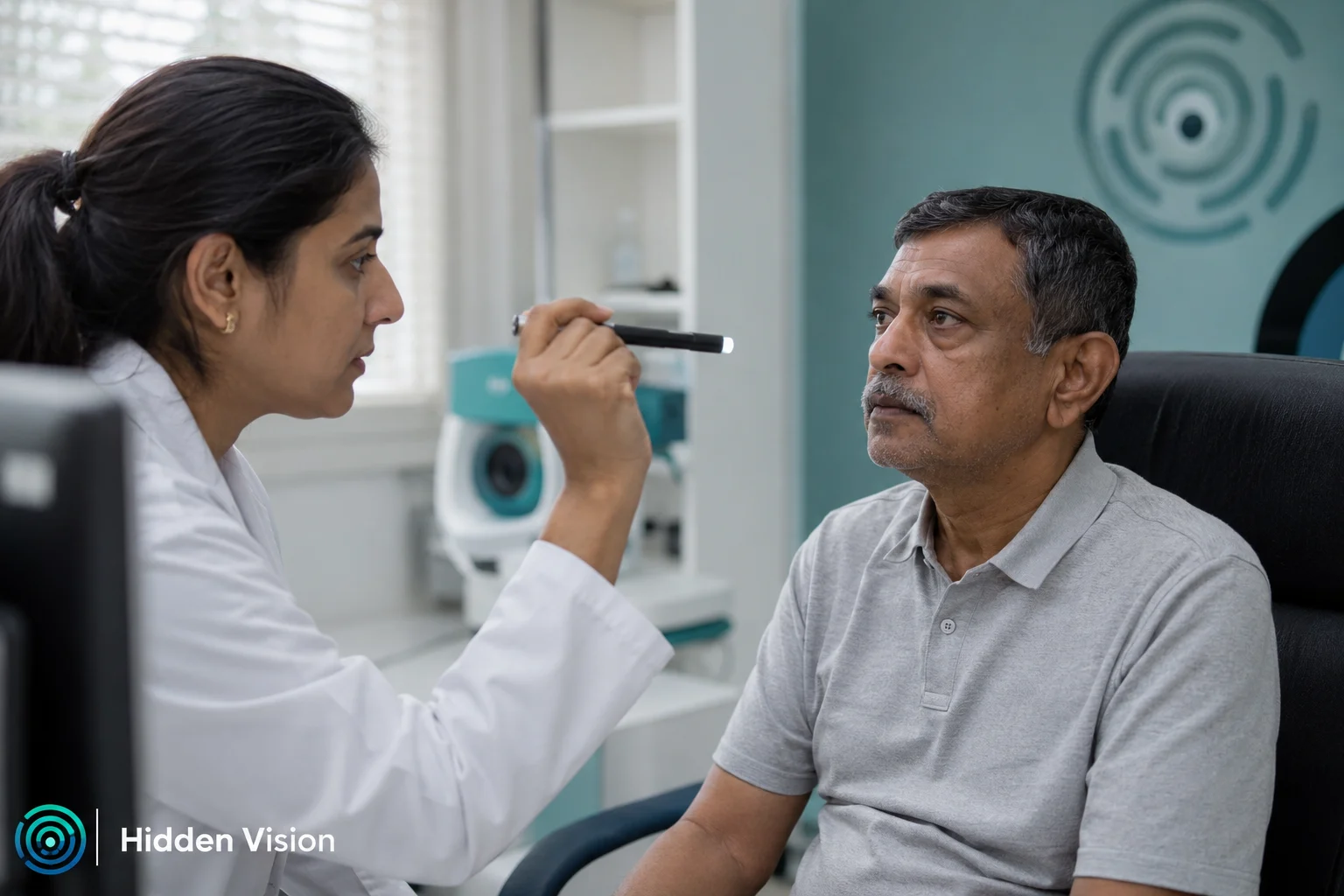
Ten hidden vision problems after stroke - from visual neglect to visual fatigue - that routine eye exams miss, and why every stroke survivor needs a Neuro-Optometric vision assessment.
Book a Consultation10 Hidden Vision Problems After Stroke That Patients and Families Often Miss
Ten hidden vision problems after stroke - from visual neglect to visual fatigue - that routine eye exams miss, and why every stroke survivor needs a Neuro-Optometric vision assessment.
Stroke is one of the leading causes of long-term disability worldwide, affecting millions of individuals every year. While most rehabilitation programmes appropriately focus on restoring movement, speech, balance, and cognitive abilities, one of the most frequently overlooked consequences of stroke is vision impairment.
When people think of vision problems, they often imagine blurred vision or complete loss of sight. However, many stroke survivors have 20/20 eyesight yet continue to struggle with reading, walking safely, driving, recognising people, maintaining balance, or performing everyday activities. The reason is simple: vision is much more than seeing clearly - it is the brain's ability to process and respond to visual information.
Nearly one-third of the human brain is dedicated to processing visual information. A stroke affecting any part of this extensive network can disrupt visual attention, eye movements, visual perception, depth judgement, spatial awareness, and visual processing speed, even when the eyes themselves remain perfectly healthy.
Unfortunately, many of these hidden visual problems are not identified during routine eye examinations or standard neurological assessments. As a result, patients and families may mistakenly attribute these challenges to memory loss, poor concentration, ageing, or lack of motivation.
At Caring Vision, we believe that recognising these hidden visual deficits early is critical for successful rehabilitation. Through comprehensive Neuro-Optometric Rehabilitation and Vision Rehabilitation, we help stroke survivors improve functional vision, regain independence, and enhance their quality of life using evidence-informed clinical approaches. Here are ten hidden vision problems after stroke that patients and families often miss.
1. Visual Neglect - When the Brain Ignores One Side of the World
Visual neglect (also called unilateral spatial neglect) is one of the most disabling consequences of stroke, particularly following right hemisphere injury. Unlike blindness, patients are physically capable of seeing objects on the affected side, but the brain fails to pay attention to them.
Patients may:
- Leave food untouched on one side of the plate
- Ignore family members standing beside them
- Read only half of a page
- Frequently bump into furniture
- Forget to dress one side of the body
- Miss obstacles while walking
Many patients are completely unaware that they are neglecting one side of space, making family observations especially valuable.
2. Eye Movement Disorders
Reading, walking, driving, and exploring the environment all depend on precise eye movements. Stroke can disrupt saccades (rapid eye movements), smooth pursuits (tracking moving objects), fixation stability, convergence, and binocular coordination.
Common symptoms include losing place while reading, slow reading, skipping lines, difficulty following moving objects, eye strain, headaches, and poor visual concentration. Because visual acuity may remain normal, these disorders are frequently overlooked unless a detailed functional eye movement assessment is performed.
3. Visual Field Loss
Stroke frequently damages the visual pathways connecting the eyes to the brain. The most common defect is homonymous hemianopia, where patients lose vision on the same side of both eyes. Many patients compensate unconsciously by turning their head and therefore may not immediately realise that part of their visual field is missing.
Hidden signs include walking into door frames, missing objects on one side, difficulty driving, reading difficulties, falls, and difficulty locating people in crowded places. Formal visual field assessment is essential because field loss significantly affects mobility and independence.
4. Double Vision (Diplopia)
Stroke may affect the nerves controlling eye muscles, resulting in poor alignment between the eyes. Patients may experience two images, tilting of vision, difficulty judging distances, nausea, dizziness, and reading discomfort. Some patients automatically close one eye to reduce symptoms without realising that double vision is the underlying problem.
Appropriate management may include prisms, occlusion strategies, and rehabilitation of binocular vision where clinically appropriate.
5. Reading Difficulties
Many stroke survivors tell us, “I can see the words clearly, but I cannot read.” Reading requires far more than good eyesight - it depends on accurate eye movements, stable fixation, binocular coordination, visual attention, visual memory, language processing, and cognitive integration.
Stroke survivors often experience skipping words, losing place, reading slowly, re-reading lines, reduced comprehension, and reading fatigue. These challenges affect medication management, employment, education, and overall independence.
6. Poor Depth Perception
Accurate judgement of distance depends on coordinated binocular vision and efficient visual processing. Stroke may impair depth perception, causing patients to miss steps, spill drinks, reach inaccurately for objects, misjudge curbs, have difficulty pouring liquids, and feel unsafe while walking outdoors.
These difficulties substantially increase the risk of falls. Because patients often adapt gradually, poor depth perception may go unnoticed until injuries occur.
7. Visual Processing Speed Becomes Slower
After stroke, the eyes may detect visual information normally, but the brain processes that information much more slowly. Patients frequently report feeling overwhelmed in supermarkets, difficulty locating items, problems following conversations in busy environments, delayed responses to visual information, and difficulty multitasking.
Busy visual environments become exhausting because the brain requires significantly more effort to interpret incoming information.
8. Visual Perceptual Problems
Visual perception refers to the brain's ability to recognise and interpret what we see. Stroke may impair object recognition, face recognition, shape discrimination, spatial orientation, visual memory, and constructional abilities.
Patients may recognise a familiar object only after touching it, become lost in familiar surroundings, misidentify household objects, have difficulty assembling simple items, and confuse similar-looking objects. Routine eye examinations often appear completely normal because the problem lies within the brain's interpretation rather than the eyes themselves.
9. Balance and Mobility Problems Related to Vision
Vision contributes significantly to balance and postural control. Stroke survivors with hidden visual dysfunction often experience unsteadiness, poor posture, fear of walking, difficulty negotiating stairs, motion sensitivity, and increased falls.
Visual information must integrate seamlessly with the vestibular and proprioceptive systems. When these systems become poorly coordinated following stroke, mobility deteriorates even if muscle strength has improved. Comprehensive Neuro-Optometric Rehabilitation considers these interactions during treatment planning.
10. Visual Fatigue
One of the most common yet least recognised complaints after stroke is visual fatigue. Patients often describe heavy eyes, difficulty concentrating, reduced endurance, blurred vision after reading, headaches, and needing frequent breaks.
Unlike ordinary tiredness, visual fatigue reflects the increased neurological effort required to process visual information following brain injury. Persistent fatigue frequently limits return to work, reading, computer use, and social participation. Recognising and addressing its underlying causes can significantly improve daily functioning.
Why These Problems Are Frequently Missed
Many hidden visual problems are overlooked because the eyes themselves appear healthy, standard vision charts primarily measure visual acuity, patients may not recognise their own deficits, symptoms are mistaken for memory or concentration problems, and rehabilitation often prioritises mobility and speech before vision.
A patient may read the smallest letters on an eye chart yet still struggle to navigate a supermarket, read a book, recognise faces, or judge distances safely. This highlights the importance of evaluating functional vision, not just eyesight.
The Role of Comprehensive Neuro-Optometric Rehabilitation
Neuro-Optometric Rehabilitation focuses on understanding how the eyes and brain function together after neurological injury. At Caring Vision, every rehabilitation programme begins with a comprehensive assessment that may include functional vision evaluation, eye movement analysis, binocular vision assessment, accommodation testing, visual field assessment, visual attention assessment, visual perception evaluation, reading assessment, balance and visual-motor integration, and functional activities of daily living.
Based on these findings, an individualised rehabilitation programme is developed to address each patient's unique challenges and goals. Depending on clinical findings, rehabilitation may include eye movement rehabilitation, visual scanning training, reading rehabilitation, binocular vision therapy, diplopia management, visual attention training, environmental adaptations, compensatory strategies, home-based rehabilitation programmes, and collaboration with neurologists, occupational therapists, physiotherapists, and speech-language pathologists.
Our objective is not merely to improve clinical test results but to enhance meaningful daily activities such as reading, walking safely, using digital devices, returning to work, and participating confidently in family and community life.
When Should You Seek a Functional Vision Assessment?
Stroke survivors should consider a comprehensive Neuro-Optometric assessment if they experience:
- Difficulty reading despite clear vision
- Frequent falls or collisions
- Double vision
- Headaches during near work
- Poor balance
- Difficulty recognising objects or people
- Reduced concentration while reading
- Missing objects on one side
- Motion sensitivity
- Visual fatigue
Early assessment allows rehabilitation to begin before these hidden problems become long-term barriers to recovery.
Caring Vision: Seeing Better, Living Better
Stroke recovery involves much more than restoring muscle strength or speech. Vision influences virtually every aspect of daily life, including mobility, balance, reading, communication, learning, independence, and overall quality of life. Many stroke survivors unknowingly live with hidden visual problems that significantly affect rehabilitation outcomes - fortunately, with timely identification and evidence-informed intervention, many of these difficulties can be addressed through comprehensive Neuro-Optometric Rehabilitation and Vision Rehabilitation.
At Caring Vision, we are committed to helping stroke survivors and their families recognise these hidden challenges and receive personalised, evidence-based care, because successful stroke rehabilitation means not only seeing better but living better. Book a comprehensive neuro-visual assessment at Caring Vision Therapy for yourself or a loved one recovering from stroke.
Explore More at Caring Vision Therapy
Frequently Asked Questions
Can a stroke survivor have 20/20 vision and still have a hidden vision problem?
Yes. Visual acuity charts only measure how clearly the eyes can see - they do not assess eye movement control, visual attention, visual field, depth perception, visual processing speed, or visual perception, all of which can be disrupted by a stroke even when the eyes themselves are perfectly healthy. This is why many stroke survivors pass a standard eye chart yet still struggle with reading, walking safely, or recognising people.
What is visual neglect and why do patients not notice it themselves?
Visual neglect is a disorder in which the brain fails to pay attention to one side of space, even though the eyes are physically capable of seeing it. Because the deficit affects the very attentional system that would normally allow someone to notice the problem, patients are frequently unaware they are missing objects, food, or people on the affected side - which is why family observations are often the first clue.
Why do routine eye examinations often miss these hidden vision problems after stroke?
Routine eye examinations are designed to assess visual acuity and ocular health - whether the eyes can see clearly and whether the eye structures themselves are healthy. Hidden post-stroke problems such as visual neglect, eye movement disorders, visual processing delays and visual perceptual difficulties originate in the brain, not the eyes, so they require a dedicated functional Neuro-Optometric assessment to identify.
Can poor depth perception and balance problems after stroke really be caused by vision, not just weakness?
Yes. Balance and postural control depend heavily on accurate visual information integrating with the vestibular and proprioceptive systems. When stroke disrupts depth perception or visual processing, patients can remain unsteady, fall-prone, or fearful of walking even after muscle strength has recovered - which is why a comprehensive assessment looks at visual-motor integration alongside physical rehabilitation.
When should a stroke survivor be referred for a comprehensive Neuro-Optometric assessment?
A comprehensive assessment should be considered whenever a stroke survivor has difficulty reading despite clear vision, frequent falls or collisions, double vision, headaches during near work, poor balance, difficulty recognising objects or people, missing objects on one side, motion sensitivity, or visual fatigue. Early assessment allows rehabilitation to begin before these hidden problems become long-term barriers to recovery.