Neuro-optometric rehabilitation after stroke: how visual field loss, diplopia and visual neglect are assessed and treated by FCOVD/FOVDR specialists.
Book a ConsultationHow Stroke Affects Vision and How Neuro-Optometric Rehabilitation Helps
Neuro-optometric rehabilitation after stroke: how visual field loss, diplopia and visual neglect are assessed and treated by FCOVD/FOVDR specialists.
Every year, millions of people survive a stroke, but many continue to struggle with an invisible disability - vision impairment. While weakness of the limbs and speech difficulties are often recognised immediately, visual dysfunction following stroke frequently remains undiagnosed, delaying recovery and reducing independence.
Successful stroke rehabilitation extends far beyond improving physical mobility. Through evidence-based Neuro-Optometric Rehabilitation and Vision Rehabilitation, a multidisciplinary approach helps individuals maximise visual function, improve daily living skills, and regain confidence through scientifically supported rehabilitation strategies.
Understanding Stroke
A stroke occurs when blood supply to part of the brain is interrupted, or when a blood vessel ruptures, leading to damage of brain tissue responsible for motor, sensory, cognitive, and visual functions. There are two major types:
- Ischemic Stroke (approximately 85%) - caused by blockage of blood vessels supplying the brain.
- Hemorrhagic Stroke (approximately 15%) - caused by rupture of a blood vessel leading to bleeding within the brain.
Since nearly one-third of the cerebral cortex is dedicated to visual processing, stroke frequently affects vision even when the eyes themselves are healthy.
Risk Factors Responsible for Stroke
Several medical and lifestyle factors increase stroke risk, including hypertension, diabetes mellitus, high cholesterol, heart disease and atrial fibrillation, smoking, obesity, a sedentary lifestyle, excessive alcohol consumption, a previous transient ischemic attack (TIA), advanced age, family history, chronic kidney disease, and sleep apnea. Many of these risk factors are preventable through early medical intervention and healthy lifestyle modifications.
Signs and Symptoms of Stroke
Early recognition saves lives. The FAST principle remains essential:
- F - Face drooping
- A - Arm weakness
- S - Speech difficulty
- T - Time to seek emergency medical care
Additional symptoms include sudden blurred vision, double vision, sudden loss of vision, visual field loss, dizziness, poor balance, severe headache, difficulty walking, confusion, difficulty reading, and difficulty recognising faces or objects. Visual symptoms alone may occasionally be the first sign of stroke.
How Stroke Affects Vision
Research indicates that over half of stroke survivors experience some form of visual impairment, making full visual assessment an essential component of neurological rehabilitation.
1. Visual Field Defects
Damage to the visual pathways may produce homonymous hemianopia, quadrantanopia, peripheral field loss, or scotomas. These difficulties may result in bumping into objects, reading problems, unsafe mobility, and driving restrictions.
2. Eye Movement Disorders (Oculomotor Dysfunction)
Patients frequently develop poor saccades, reduced pursuits, fixation instability, vergence disorders, and convergence insufficiency. Symptoms include reading fatigue, slow reading, losing place while reading, motion sensitivity, and eye strain.
3. Double Vision (Diplopia)
Damage affecting ocular motor control may produce cranial nerve palsies, strabismus, and other binocular vision disorders. Patients may experience double images, tilting of vision, difficulty judging distances, and falls.
4. Visual Perceptual Disorders
Even when eyesight appears normal, the brain may struggle to interpret visual information. Examples include visual neglect, simultanagnosia, object recognition problems, face recognition difficulties, visual memory deficits, and spatial orientation deficits. These significantly impact independence.
5. Reduced Visual Attention
Stroke survivors often experience difficulty locating objects, poor visual scanning, slower reaction times, and reduced awareness of their surroundings.
6. Reading Dysfunction
Many patients report missing words, skipping lines, slow reading speed, and difficulty maintaining concentration. These problems can persist despite having normal visual acuity.
Neuroplasticity: The Foundation of Recovery
One of the most exciting developments in neuroscience is the understanding of neuroplasticity - the brain's remarkable ability to reorganise neural pathways after injury. Evidence demonstrates that targeted visual rehabilitation can enhance compensatory strategies, improve oculomotor performance, and support functional recovery in many stroke survivors. Current research shows benefits from structured office-based and home-based rehabilitation programmes, although continued high-quality research is encouraged to strengthen the evidence base.
Neuro-Optometric Rehabilitation at Caring Vision
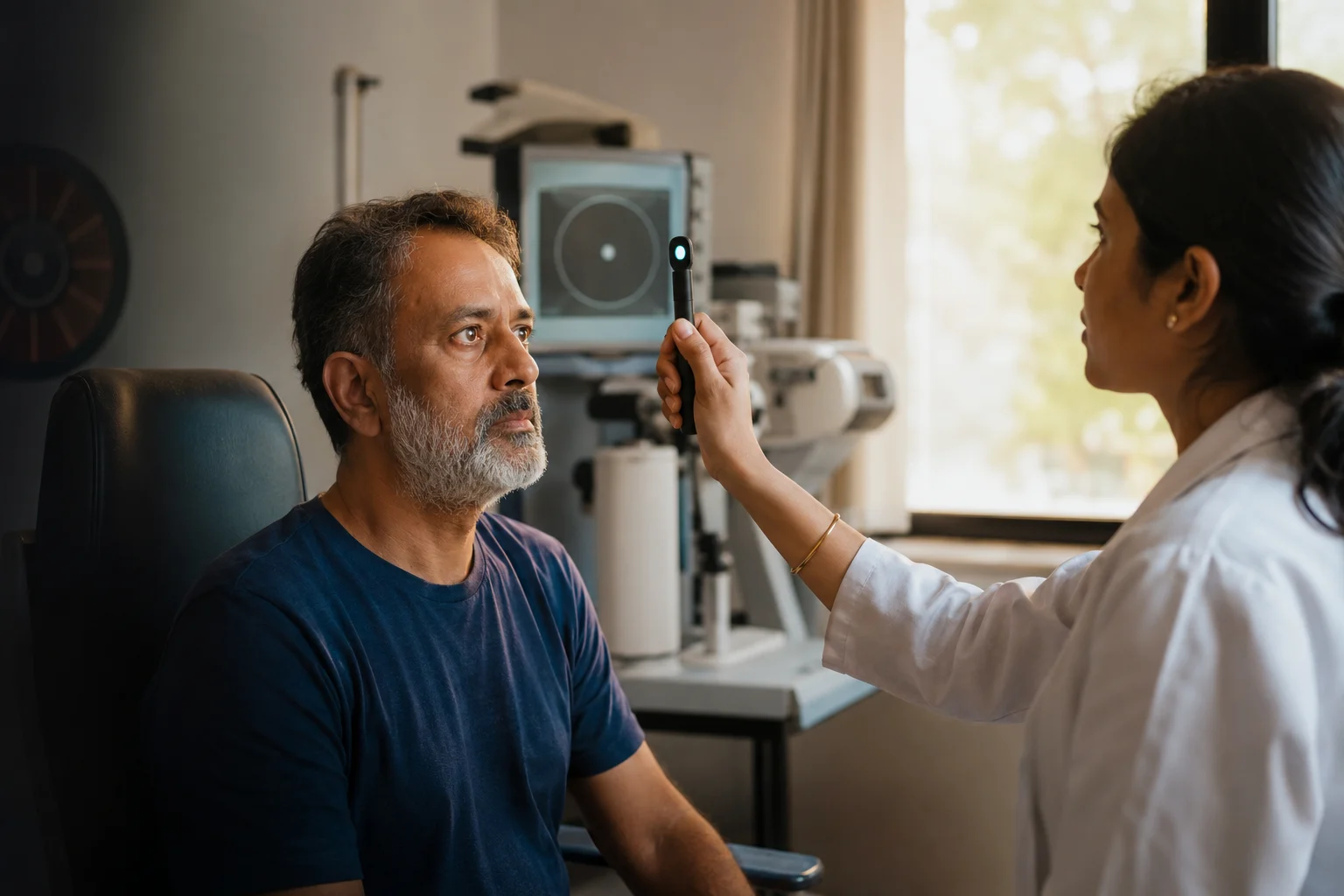
Rehabilitation begins with an extensive evidence-based assessment that evaluates not only eyesight but also how the brain processes visual information. A full evaluation includes functional visual assessment, ocular motility analysis, binocular vision evaluation, visual field assessment, accommodation and vergence testing, visual perception assessment, reading performance, eye movement recording where indicated, and functional activities-of-daily-living evaluation.
Every rehabilitation programme is individualised according to the patient's neurological profile, functional goals, and recovery potential.
Evidence-Based Rehabilitation Approaches
Depending on clinical findings, rehabilitation may include several coordinated strands of care.
Neuro-Optometric Rehabilitation Therapy
Eye movement rehabilitation, vergence therapy, accommodation therapy, visual attention training, visual scanning rehabilitation, and reading rehabilitation.
Vision Rehabilitation
Compensatory scanning techniques, environmental adaptations, functional vision strategies, mobility enhancement, and activities-of-daily-living training.
Neurovisual Integration
Where appropriate, therapy may also integrate balance and posture, eye-head coordination, vestibular integration, visual-motor coordination, and cognitive-visual rehabilitation. Every intervention is selected based on current scientific evidence and the patient's individual needs.
Our Evidence-Based Philosophy
Every rehabilitation programme at Caring Vision is guided by current scientific literature, international clinical guidelines, functional outcome measures, standardised assessments, individualised goal-based rehabilitation, and regular progress monitoring. The commitment is to combine compassionate care with evidence-informed clinical practice rather than relying on a one-size-fits-all approach.
Transforming Lives Beyond Vision
Vision rehabilitation is not simply about helping patients see better. It is about helping them read again, return to work, walk safely, regain confidence, improve independence, participate in family life, reduce visual fatigue, and improve quality of life. For many stroke survivors, successful rehabilitation restores not only vision but also dignity and independence.
Caring Vision: Enhancing Lives Through Science
Our mission is to bridge neuroscience, optometry, and rehabilitation through evidence-based clinical excellence. By integrating Neuro-Optometric Rehabilitation and Vision Rehabilitation into stroke recovery, we strive to help individuals achieve their highest functional potential.
Every patient is different, and every rehabilitation plan is built around that person. Every success reflects the remarkable capacity of the human brain to adapt, recover, and grow. Through scientific assessment, individualised rehabilitation, and compassionate care, Caring Vision continues to enhance lives globally - one patient, one family, and one success story at a time. Book a neuro-visual rehabilitation evaluation to understand what your visual system needs after stroke.
Explore More at Caring Vision Therapy
Frequently Asked Questions
Why does vision get affected after a stroke even if my eyes are healthy?
Nearly one-third of the cerebral cortex is dedicated to visual processing. A stroke damages brain tissue, not the eyes themselves, so the eyes can be structurally normal while the brain struggles to process visual field information, coordinate eye movements, or interpret what is seen - which is why a standard eye test often misses post-stroke visual dysfunction entirely.
How common is visual impairment after stroke?
Research indicates that over half of stroke survivors experience some form of visual impairment, including visual field loss, oculomotor dysfunction, double vision, visual perceptual disorders, or reading difficulties. Because these problems are often overshadowed by more visible motor and speech deficits, they frequently go undiagnosed unless a dedicated neuro-visual assessment is performed.
What is visual neglect, and how is it different from visual field loss?
Visual field loss (such as hemianopia) is a reduction in what the eyes can physically detect. Visual neglect is different - it is a visual perceptual disorder where the brain fails to attend to or process information from one side of space, even when the visual field itself is intact. Both require different assessment and rehabilitation strategies.
Can double vision (diplopia) after a stroke be treated without surgery?
Many cases of post-stroke diplopia respond to non-surgical neuro-optometric rehabilitation, including vergence therapy, prism management, and binocular vision rehabilitation, particularly when the underlying cause is cranial nerve involvement or binocular vision dysfunction rather than a fixed structural misalignment. A full binocular vision evaluation determines the most appropriate approach.
How long after a stroke can Neuro-Optometric Rehabilitation still help?
There is no fixed cut-off. Neuroplasticity - the brain's ability to reorganise neural pathways - continues well beyond the acute recovery phase, and structured office-based and home-based visual rehabilitation has shown benefit for both recent and longer-term stroke survivors. Outcomes depend on the individual's neurological profile, so a personalised evaluation is the appropriate starting point at any stage of recovery.