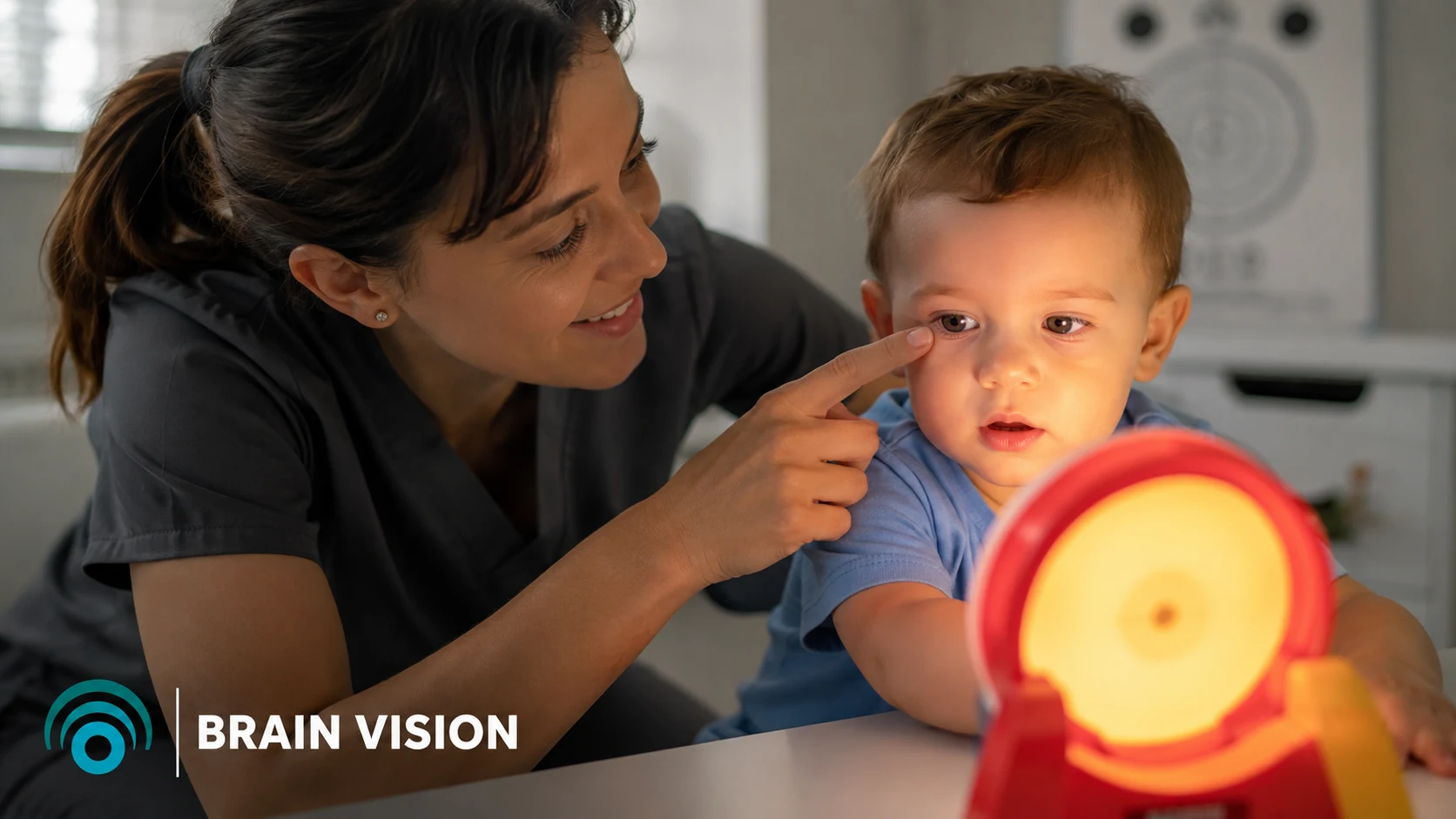
Cortical Visual Impairment (CVI) and Delayed Visual Maturation: causes, signs, and how vision therapy builds functional vision.
Book a ConsultationWhat Is Cortical Visual Impairment (CVI) and How Is It Treated?
Cortical Visual Impairment (CVI) and Delayed Visual Maturation: causes, signs, and how vision therapy builds functional vision.
Related Resources
- Cortical Visual Impairment (CVI) Treatment in India
- Neuro-optometric rehabilitation at Caring Vision
- Visual behaviour in children with Autism Spectrum Disorder
- Neuro Optometric Rehabilitation Therapy (NORT) for Visual Snow Syndrome
- Primitive Reflex Integration in Vision Therapy
- Book a developmental vision evaluation
Vision is far more than healthy eyes. It is a neurological process in which the eyes collect visual information and the brain interprets, organises and gives meaning to what is seen. When the brain's visual processing centres are affected, a child can experience significant visual difficulties even when both eyes are structurally normal - and a standard eye examination alone will not detect it.
Cortical Visual Impairment (CVI), also called Cerebral Visual Impairment, has become one of the leading causes of childhood visual impairment worldwide. A related but distinct condition, Delayed Visual Maturation (DVM), often raises concern among parents during infancy for similar reasons. With advances in neuroscience, neuroplasticity research, developmental optometry and neuro-optometric rehabilitation, many children with CVI and DVM can achieve meaningful improvement when intervention begins early.
What Is Cortical Visual Impairment (CVI)?
Cortical Visual Impairment is a neurological disorder in which visual dysfunction results from damage to, or abnormal development of, the brain's visual pathways and processing centres - not from a problem with the eyes themselves. In CVI, the eyes may appear structurally healthy on examination, yet the brain struggles to interpret the visual information it receives.
The impairment typically originates from injury involving the:
- Occipital cortex
- Optic radiations
- Visual association cortex
- Dorsal visual stream (the "where" pathway)
- Ventral visual stream (the "what" pathway)
- Higher visual processing networks
As a result, children with CVI may struggle to understand and interact with their visual world even when a standard eye examination appears largely normal.
Why Is CVI Becoming More Common?
Advances in neonatal intensive care have significantly improved survival among premature infants and children with neurological complications - which means more children are now surviving with the underlying conditions that affect visual processing. Common contributing causes include premature birth, Hypoxic Ischemic Encephalopathy (HIE), Periventricular Leukomalacia (PVL), neonatal stroke, traumatic brain injury, meningitis or encephalitis, hydrocephalus, cerebral palsy, genetic neurological syndromes, seizure disorders and congenital brain malformations.
What Is Delayed Visual Maturation (DVM)?
Delayed Visual Maturation describes infants whose visual responsiveness develops more slowly than expected. Unlike CVI, children with isolated DVM usually show significant spontaneous improvement over the first several months of life as the visual cortex matures.
DVM should never be dismissed without a thorough developmental and neuro-visual assessment, because it can coexist with prematurity, developmental delay, other neurological disorders, cerebral palsy, CVI or genetic syndromes. Distinguishing DVM from CVI early matters because the two conditions are managed quite differently.
How Does Vision Actually Develop?
Vision develops through continuous interaction between the eyes, the brain, body movement, the vestibular system, proprioception, sensory integration and cognitive development. This development continues rapidly through infancy and early childhood, which is exactly why early intervention matters so much.
Neuroplasticity - the brain's ability to reorganise its neural connections - is greatest during the early years of life. This creates an important therapeutic window in which targeted vision therapy and neuro-visual rehabilitation can have the greatest impact.
Recognising the Clinical Signs of CVI
Children with CVI often present with visual behaviours that differ noticeably from ocular disease. Common signs include:
- Poor visual attention and reduced visual curiosity
- Difficulty recognising faces
- Inconsistent or variable visual responses
- A strong preference for certain colours, especially red or yellow
- Better vision in familiar environments than unfamiliar ones
- Looking away just before reaching for an object
- Delayed visual latency - a lag before the child visually responds
- Difficulty finding objects in clutter or on patterned backgrounds
- Difficulty with visual crowding and visual novelty
- Light gazing
- Difficulty recognising complex scenes or finding their way around a room
- Poor visual-motor integration
- Reading difficulties despite adequate intelligence
The Visual Processing Skills CVI Can Disrupt
CVI affects far more than eyesight. Children frequently experience impairments across several distinct areas of visual processing.
Visual Attention and Figure-Ground Perception
Difficulty maintaining focus on a relevant target, and difficulty picking an object out from a busy or cluttered background.
Visual Discrimination, Memory and Closure
Difficulty differentiating similar letters, shapes or objects; difficulty remembering visual information; and difficulty recognising an object that is only partially visible.
Visual Spatial Skills and Sequencing
Difficulty understanding spatial relationships and following visual order - both of which are essential for reading.
Dorsal Stream vs Ventral Stream Dysfunction
Dorsal stream dysfunction affects movement, reaching, getting around and spatial awareness. Ventral stream dysfunction affects the ability to identify faces, objects, symbols and written words. Many children with CVI show a mixture of both.
Why Early Vision Therapy and Neuro-Visual Rehabilitation Matter
Early intervention makes the most of neuroplasticity and gives functional development the best chance. Goals of intervention typically include enhancing visual attention, improving visual fixation, developing smooth pursuits and saccades, strengthening visual scanning, improving visual processing speed, enhancing visual discrimination and figure-ground perception, developing visual memory, improving spatial awareness, enhancing visual-motor integration, supporting reading readiness, facilitating independent mobility, improving classroom participation, and increasing confidence and engagement.
Vision Development Programmes at Caring Vision
Every child undergoes a full developmental and neuro-visual evaluation before therapy planning begins. Depending on the findings, an individualised programme may include a functional vision assessment, developmental optometric evaluation, neuro-visual rehabilitation, visual processing assessment, eye movement training, binocular vision assessment, accommodation training, oculomotor rehabilitation, visual attention enhancement, visual perceptual therapy, visual-motor integration, reading readiness programmes, primitive reflex integration where clinically indicated, sensory-visual integration, environmental modification guidance, parent coaching, home vision therapy programmes, school recommendations, and progress monitoring using standardised outcome measures.
Every rehabilitation plan is individualised according to the child's neurological diagnosis, developmental level, functional vision, educational needs and family goals.
Why a Multidisciplinary Approach Matters
Optimal outcomes often require collaboration among developmental optometrists, neuro-optometrists, pediatric ophthalmologists, neurologists, occupational therapists, physiotherapists, speech-language pathologists, special educators, psychologists, and parents and caregivers. This coordinated approach helps address the child's overall functional development, not just their vision in isolation.
Measuring Success Beyond the Eye Chart
Improvement is not judged solely by visual acuity. Meaningful functional gains may include better eye contact, improved object recognition, faster visual responses, better classroom participation, improved reading skills, enhanced mobility, greater independence, better handwriting, reduced visual fatigue, improved confidence, and increased participation in daily activities. These functional outcomes often have a profound impact on quality of life.
While outcomes vary depending on the underlying neurological condition, severity of impairment, age at intervention, and associated developmental challenges, early identification and timely rehabilitation provide the best opportunity to optimise functional vision and support long-term development. Book a developmental vision evaluation at Caring Vision Therapy to understand what your child's visual system needs.
Explore More at Caring Vision Therapy
- Cortical Visual Impairment (CVI) Treatment in India
- Neuro-optometric rehabilitation at Caring Vision
- Visual behaviour in children with Autism Spectrum Disorder
- Neuro Optometric Rehabilitation Therapy (NORT) for Visual Snow Syndrome
- Primitive Reflex Integration in Vision Therapy
- Book a developmental vision evaluation
Frequently Asked Questions
Can a child with Cortical Visual Impairment (CVI) actually improve?
Yes. Numerous studies demonstrate that functional vision can improve through neuroplasticity, environmental adaptation, habilitation and individualised neuro-visual rehabilitation - particularly when intervention begins early, during the period when the brain's capacity to reorganise neural connections is greatest.
My child's eyes are healthy on examination - so why do they still have vision problems?
CVI is a brain-based visual disorder, not an eye disease. The eyes can be structurally normal while the brain struggles to interpret the visual information they send. Management therefore focuses on optimising how the brain processes visual information, alongside any co-occurring eye conditions, rather than treating the eyes alone.
Should we just wait and see with Delayed Visual Maturation (DVM)?
Isolated DVM often improves spontaneously over the first months of life, but it should never be assumed without a thorough developmental and neuro-visual assessment, since DVM can coexist with prematurity, developmental delay, CVI or genetic syndromes. Delaying assessment risks missing a window during which early intervention has the greatest impact.
Does Vision Therapy for CVI just mean eye exercises?
No. Modern vision therapy and neuro-visual rehabilitation for CVI addresses visual attention, visual processing, visual perception, visual-motor integration, oculomotor control and functional visual skills through individualised, evidence-informed programmes - not simply eye muscle exercises.
If the underlying brain injury is permanent, can my child's vision still change?
Often, yes. While the underlying brain injury itself may not be reversible, the developing brain has remarkable neuroplasticity. Rehabilitation aims to improve functional visual performance by strengthening neural pathways and teaching compensatory strategies, so that day-to-day visual function can improve even when the original injury remains.