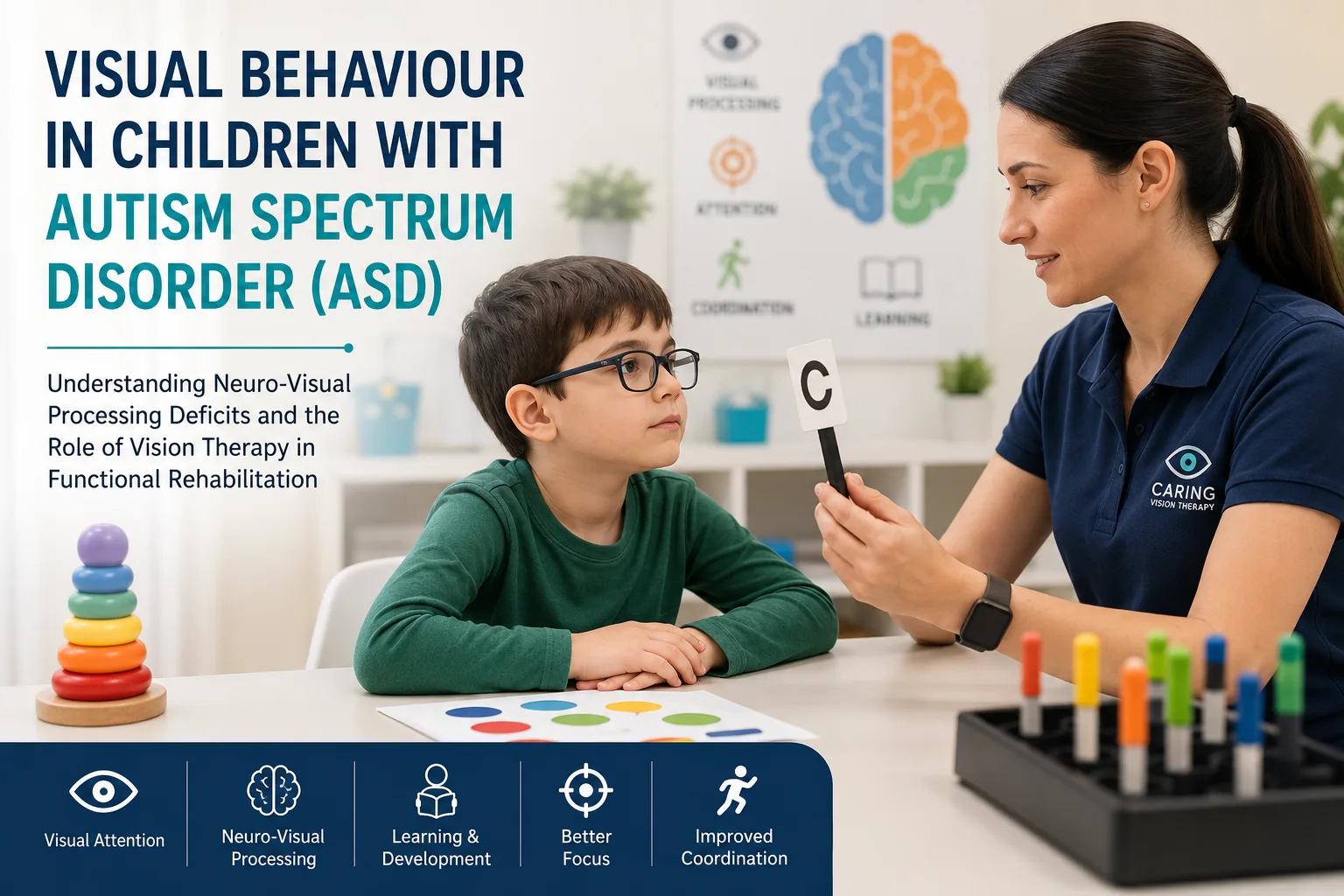
How neuro-visual processing deficits affect children with autism (ASD), and how vision therapy improves attention and coordination.
Book a ConsultationWhat Is Visual Behaviour in Children with Autism Spectrum Disorder?
How neuro-visual processing deficits affect children with autism (ASD), and how vision therapy improves attention and coordination.
Autism Spectrum Disorder (ASD) is a complex neurodevelopmental condition that affects communication, social interaction, sensory processing, behavioural regulation, and motor integration. While many parents focus on speech, behaviour, and learning challenges, visual processing difficulties are often overlooked despite their significant impact on a child's development.
Vision is much more than seeing clearly. Research suggests that approximately 70–80% of sensory information reaching the brain is visual. Effective visual functioning requires the coordinated interaction of eye movements, binocular vision, visual perception, sensory integration, balance systems, motor planning, and higher-level brain processing.
Many children with ASD have normal eyesight during routine eye examinations but still experience significant neuro-visual processing challenges that affect learning, attention, reading readiness, social engagement, and daily functioning.
What Is Visual Behaviour?
Visual behaviour refers to how a child visually interacts with, interprets, and responds to the world around them.
Children with Autism Spectrum Disorder often demonstrate unique visual behaviours due to differences in sensory integration and neurological processing.
Common Visual Behaviour Characteristics in ASD
- Reduced or inconsistent eye contact
- Preference for peripheral viewing
- Difficulty maintaining visual fixation
- Excessive visual self-stimulation
- Fascination with lights or moving objects
- Difficulty shifting visual attention
- Visual overstimulation in busy environments
- Reduced facial recognition efficiency
- Poor environmental scanning
These behaviours are often neurological responses rather than intentional behavioural choices.
Understanding Neuro-Visual Processing Dysfunction in Autism
The visual system is an integrated neurological network. Research indicates that children with ASD may experience challenges involving:
- Magnocellular visual processing
- Dorsal visual stream integration
- Oculomotor control
- Visual attention pathways
- Sensory gating mechanisms
- Vestibulo-ocular integration
- Visual-spatial processing
These neurological differences can affect how visual information is interpreted and used for learning and movement.
Signs and Symptoms of Neuro-Visual Dysfunction in ASD
1. Functional Vision Challenges
Functional vision allows children to visually attend to and interact with their environment. Common indicators include:
- Poor visual attention
- Delayed visual engagement
- Limited fixation stability
- Difficulty shifting gaze
- Reduced eye contact
- Visual sensory defensiveness
- Difficulty filtering visual information
- Postural instability during visual tasks
2. Visual Efficiency Problems
Visual efficiency refers to the performance of the eye-brain system during sustained visual activities. Children may experience:
- Oculomotor dysfunction
- Poor eye tracking
- Deficient pursuit movements
- Reduced convergence ability
- Accommodative instability
- Binocular vision dysfunction
- Visual fatigue
- Motion sensitivity
3. Visual Perceptual Processing Difficulties
Visual perception helps the brain organize and understand visual information. Common deficits include:
- Poor visual discrimination
- Weak visual memory
- Figure-ground difficulties
- Spatial awareness challenges
- Directionality confusion
- Difficulty recognizing patterns
- Reduced visual reasoning abilities
These challenges can directly affect reading, writing, mathematics, and classroom performance.
4. Visual-Motor Integration Difficulties
Visual-motor integration coordinates what children see with how they move. Children with ASD may demonstrate:
- Poor handwriting
- Fine motor delays
- Clumsiness
- Poor balance
- Weak bilateral coordination
- Motor planning difficulties
- Delayed graphomotor development
Primitive Reflex Retention and Autism
Primitive reflexes are automatic movement patterns present during infancy. These reflexes should integrate as the nervous system matures. In many children with ASD, retained primitive reflexes may interfere with visual attention, postural control, balance, bilateral coordination, sensory regulation, reading readiness, and spatial awareness.
Commonly Retained Reflexes
- Moro Reflex
- ATNR (Asymmetrical Tonic Neck Reflex)
- STNR (Symmetrical Tonic Neck Reflex)
- TLR (Tonic Labyrinthine Reflex)
- Spinal Galant Reflex
Addressing retained reflexes can be an important component of developmental rehabilitation.
How Vision Therapy Helps Children with Autism
Vision Therapy is a structured neuro-optometric rehabilitation program designed to improve how the visual system functions and integrates with sensory, motor, and cognitive processes. The goal extends beyond eyesight correction and focuses on improving visual performance and neurological organization.
Potential Benefits of Vision Therapy
- Improved visual attention
- Better eye contact
- Enhanced sensory regulation
- Improved reading readiness
- Better visual processing
- Stronger coordination
- Improved balance
- Better motor planning
- Enhanced classroom participation
- Increased confidence and independence
Multi-Stage Neurodevelopmental Vision Therapy Approach
Stage 1: Functional Vision Rehabilitation
Focus areas include visual attention stabilization, sensory regulation, vestibular activation, primitive reflex integration, fixation development, and environmental orientation.
Stage 2: Visual Efficiency Development
Focus areas include eye tracking, saccades and pursuits, convergence training, accommodation therapy, binocular vision integration, and visual endurance.
Stage 3: Visual Perceptual Development
Focus areas include visual memory, visual discrimination, pattern recognition, spatial processing, sequential processing, and visual reasoning.
Stage 4: Visual-Motor Integration
Focus areas include hand-eye coordination, bilateral integration, fine motor development, gross motor planning, postural control, and functional task execution.
Neuroplasticity and Long-Term Development
The developing brain possesses remarkable neuroplasticity. Through structured and repetitive therapeutic activities, Vision Therapy may help support improved sensory-motor integration and functional development.
Families often report improvements in attention span, eye contact, posture, coordination, reading performance, handwriting, self-regulation, academic participation, and daily living skills.
The developing brain demonstrates significant neuroplasticity during childhood. Early identification of neuro-visual processing difficulties and initiation of targeted developmental vision therapy may help build stronger neurological foundations for learning, attention, coordination, and independence. Book a developmental vision assessment to learn more about how vision therapy can support your child.
Explore More at Caring Vision Therapy
Frequently Asked Questions
Can a child with autism have normal eyesight but still struggle visually?
Yes. Many children with ASD pass standard eye exams yet experience difficulties with visual processing, eye tracking, attention, and sensory integration. A comprehensive developmental vision evaluation is needed to assess these functional visual skills.
Does Vision Therapy cure autism?
No. Vision Therapy does not cure Autism Spectrum Disorder. It aims to improve visual function and neuro-visual processing skills that may support learning, coordination, and daily activities for children with ASD.
What age is best to begin Vision Therapy for a child with ASD?
Early intervention often provides the greatest opportunity for developmental progress, although therapy can be beneficial at different ages depending on the child's individual needs and developmental profile.
How do I know if my child with autism needs a developmental vision evaluation?
If your child demonstrates poor eye contact, visual attention difficulties, reading challenges, coordination problems, sensory-related visual behaviours, or difficulty with near visual tasks, a developmental vision assessment may be beneficial.