Visual neglect after stroke: symptoms, diagnosis and evidence-based vision rehabilitation for spatial neglect, from FCOVD/FOVDR-certified specialists.
Book a ConsultationWhat Is Visual Neglect After Stroke and How Is It Treated?
Visual neglect after stroke: symptoms, diagnosis and evidence-based vision rehabilitation for spatial neglect, from FCOVD/FOVDR-certified specialists.
Stroke remains one of the leading causes of long-term neurological disability worldwide. While paralysis, speech impairment, and cognitive dysfunction are widely recognised by healthcare professionals and the public, one of the most functionally disabling consequences of stroke often remains underdiagnosed - visual neglect, also known as unilateral spatial neglect (USN).
Visual neglect is not an eye disease, nor is it simply a problem of blurred vision or visual acuity. Instead, it is a disorder of spatial attention, where the brain fails to acknowledge or respond to information from one side of the environment, despite the eyes being capable of detecting it. Patients may appear to ignore people, objects, or even parts of their own body on the affected side. This condition profoundly affects mobility, reading, self-care, safety, social participation, and overall quality of life.
Research consistently identifies visual neglect as one of the strongest predictors of prolonged rehabilitation, reduced functional independence, increased caregiver burden, and poorer long-term outcomes after stroke. Without timely recognition and targeted rehabilitation, its impact can persist for months or even years.
Successful stroke rehabilitation extends beyond restoring visual acuity. Through full functional vision assessment and evidence-informed neuro-optometric rehabilitation, the goal is to identify hidden visual deficits and support patients in achieving meaningful improvements in daily living - working collaboratively with neurologists, rehabilitation physicians, ophthalmologists, occupational therapists, physiotherapists, speech-language pathologists, and psychologists to deliver patient-centred care based on current scientific evidence.
What Is Visual Neglect?
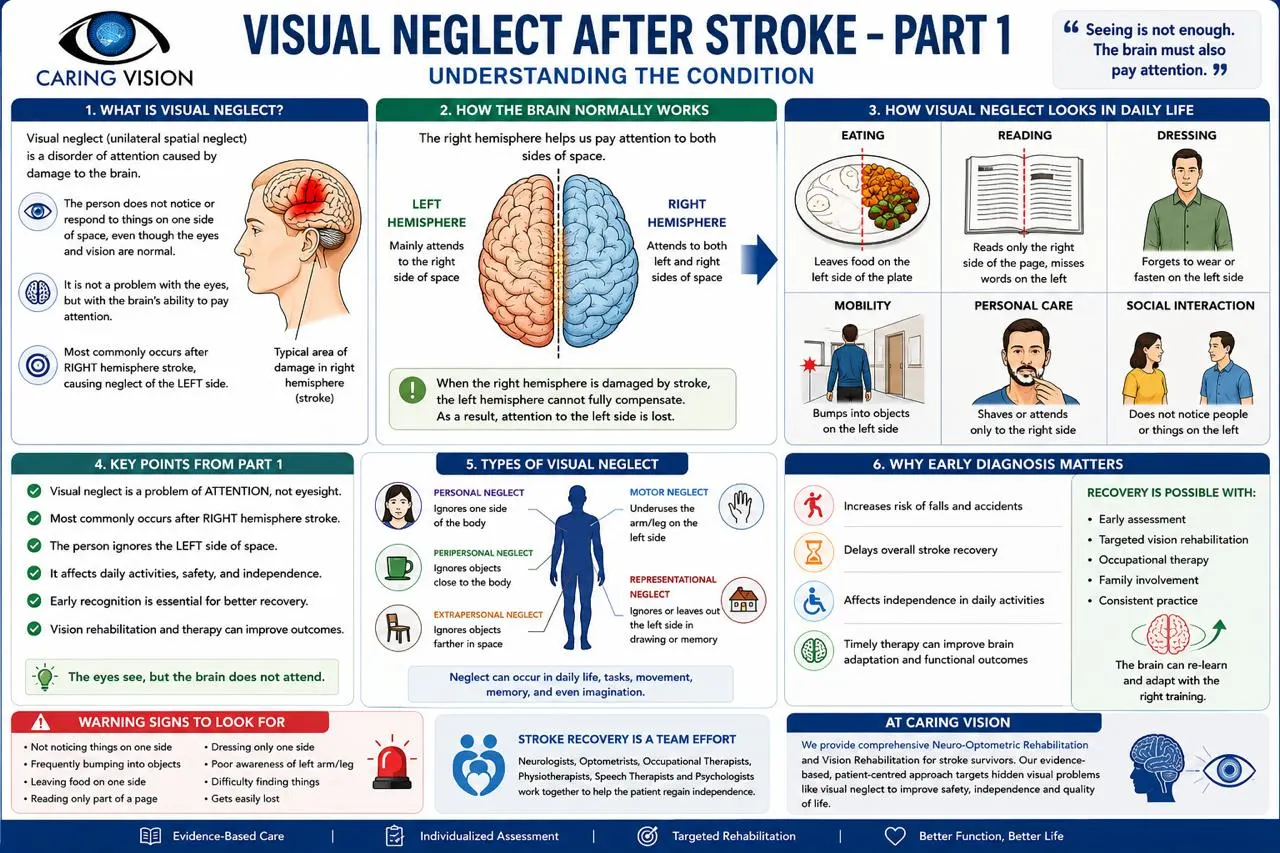
Visual neglect is a neuropsychological syndrome resulting from damage to brain networks responsible for attention and spatial awareness. The hallmark feature is a reduced ability to detect, respond to, or orient toward stimuli on the side opposite the brain lesion, even though primary visual pathways may remain intact.
For example, a person with right-hemisphere stroke may consistently fail to notice objects or people on the left side, leave food untouched on the left half of a plate, read only the right side of a page, or collide with furniture positioned on the neglected side. Importantly, these behaviours are not explained solely by visual field loss - they arise because the brain fails to allocate attention appropriately to part of the surrounding environment.
Why Is Visual Neglect Frequently Missed?
Visual neglect is often described as an invisible disability. Patients may not realise they have the condition because impaired self-awareness (anosognosia) commonly accompanies neglect. Family members may interpret symptoms as confusion, poor concentration, memory problems, or lack of motivation rather than recognising an attentional disorder.
Traditional eye examinations primarily evaluate visual acuity and ocular health. While these assessments are essential, they may not detect deficits in visual attention, scanning behaviour, spatial perception, or functional vision. Consequently, neglect can remain undiagnosed unless healthcare professionals perform structured neurological and functional assessments. Early recognition is particularly important because untreated neglect is associated with increased falls, delayed rehabilitation, prolonged hospital stays, and reduced independence in activities of daily living.
Epidemiology
Visual neglect is among the most common cognitive-perceptual disorders following stroke. Published studies indicate that approximately 20% to 40% of all stroke survivors experience neglect during the acute phase, although reported prevalence varies depending on lesion location, assessment methods, and timing of evaluation. The condition is considerably more common after right cerebral hemisphere stroke, particularly when the right parietal and frontal attention networks are involved.
Although left-sided neglect following right hemisphere stroke is the classic presentation, right-sided neglect may also occur after left hemisphere injury. Neglect is also observed following traumatic brain injury, brain tumours, intracranial haemorrhage, and other neurological disorders affecting attentional networks. Recovery patterns differ considerably between individuals - some patients show substantial improvement within weeks, while others continue to experience persistent functional limitations months or years after the initial event, emphasising the need for ongoing assessment and rehabilitation.
The Neuroscience Behind Visual Neglect
Visual perception depends on far more than healthy eyes. The brain integrates sensory input through extensive neural networks that coordinate attention, eye movements, body awareness, memory, and executive control. Several interconnected cortical and subcortical structures contribute to spatial attention, including:
- Posterior parietal cortex
- Temporoparietal junction
- Superior temporal gyrus
- Frontal eye fields
- Dorsolateral prefrontal cortex
- Cingulate cortex
- Basal ganglia
- Thalamus
- Superior colliculus
- White matter pathways connecting these regions
Damage to any component of this network can disrupt the brain's ability to construct an accurate representation of surrounding space. Contemporary neuroimaging studies suggest that neglect is best understood as a network disorder rather than injury to a single anatomical structure - disruption of communication between attention networks impairs the patient's ability to voluntarily explore or respond to stimuli on the affected side.
Types of Visual Neglect
Visual neglect is clinically heterogeneous. Understanding its different forms helps clinicians develop targeted rehabilitation strategies.
Personal Neglect
Patients fail to attend to the affected side of their own body. They may shave only one side of the face, neglect one arm during dressing, or fail to wash part of the body without prompting.
Peripersonal Neglect
This affects the space within reaching distance. Individuals may ignore objects on one side of a table, leave food on one side of a plate, or overlook utensils placed beside them.
Extrapersonal Neglect
Patients fail to attend to objects located beyond arm's reach. They may collide with door frames, miss approaching people, or fail to recognise hazards while walking.
Motor Neglect
Despite adequate muscle strength, patients underuse the affected limbs because of impaired attentional engagement rather than primary weakness alone.
Representational Neglect
The deficit extends to mental imagery. Patients may omit landmarks or details from the neglected side when describing familiar places from memory.
Recognising these different manifestations is essential because they influence daily activities in distinct ways and often require individual rehabilitation approaches.
Why Does the Right Hemisphere Play Such a Critical Role?
The right cerebral hemisphere has a dominant role in directing attention toward both sides of space, whereas the left hemisphere primarily directs attention toward the right side. Consequently, right hemisphere damage leaves the left hemisphere unable to compensate fully for left-sided attention, resulting in the classic presentation of left unilateral neglect. This neurophysiological asymmetry explains why left-sided neglect is generally more severe, more persistent, and more functionally disabling than right-sided neglect.
Clinical Features
Patients with visual neglect may present with a wide range of symptoms depending on lesion location, severity, associated neurological deficits, and stage of recovery. Common observations include:
- Colliding with objects positioned on one side
- Difficulty locating personal belongings
- Ignoring people standing on one side
- Reading only part of a page
- Missing words at the beginning or end of sentences
- Leaving food uneaten on one side of the plate
- Difficulty finding the way in unfamiliar places
- Reduced awareness of one side of the body
- Trouble steering a wheelchair or walking around obstacles
- Frequent falls
- Reduced visual exploration
- Difficulty returning to driving where legally permitted and medically appropriate
Importantly, the severity of neglect observed during structured clinical testing may not always reflect its impact during real-world activities. Functional assessment remains a vital component of complete rehabilitation.
Why Early Diagnosis Matters
Failure to identify visual neglect has consequences far beyond vision. The condition affects mobility training, occupational therapy, physiotherapy, communication, medication management, and community reintegration. Patients with untreated neglect are more likely to experience falls, reduced independence, prolonged hospitalisation, and slower functional recovery. Early identification allows rehabilitation teams to implement targeted interventions, educate caregivers, and adapt the environment to improve safety and participation.
Visual neglect should therefore be considered a core component of complete stroke rehabilitation rather than an optional assessment performed only when symptoms become obvious.
Evaluating Visual Neglect at Caring Vision
Because standard eye examinations do not detect neglect, a dedicated functional and neuro-visual evaluation is essential. Assessment typically includes structured neglect testing such as line bisection, cancellation and clock-drawing tasks, alongside a full functional vision assessment, visual field evaluation, ocular motility and scanning analysis, and direct observation of the patient performing real-world tasks such as reading, eating, dressing, and mobility. This combination of standardised testing and functional observation is important because bedside test performance does not always predict how much neglect limits a patient in daily life.
Evidence-Based Rehabilitation for Visual Neglect
There is no single treatment that resolves visual neglect in every patient. Rehabilitation is individualised and typically draws on several evidence-informed strategies used in combination, including visual scanning training to build a systematic left-to-right search strategy, limb activation and sensory cueing to draw attention toward the neglected side, prism adaptation approaches, optokinetic and visual stimulation techniques, mental imagery and mirror-based strategies, and structured environmental modification and caregiver training to improve safety at home. These approaches are integrated with occupational therapy, physiotherapy, and the broader rehabilitation team so that gains made during visual scanning practice carry over into mobility, self-care, and community participation.
Caring Vision: Restoring Awareness, Safety, and Independence
At Caring Vision, every stroke rehabilitation programme begins with recognising that impaired awareness of space is just as disabling as impaired movement or speech - and just as treatable with the right approach. By combining structured neglect assessment with individualised, evidence-informed vision rehabilitation, the goal is to help patients rebuild a reliable, functional awareness of their whole environment, not simply pass a bedside test.
Every patient's recovery pattern is different, and outcomes depend on lesion location, severity, and time since stroke - but early identification and consistent, targeted rehabilitation give patients and their families the best opportunity to regain safety, confidence, and independence. Book a neuro-visual rehabilitation evaluation at Caring Vision Therapy to understand whether visual neglect may be affecting a loved one's recovery.
Explore More at Caring Vision Therapy
Frequently Asked Questions
Is visual neglect the same as vision loss or blindness on one side?
No. Visual neglect is a disorder of spatial attention, not a loss of eyesight. The eyes and visual pathways are often capable of detecting information from the affected side, but the brain fails to direct attention toward it or acknowledge it as relevant. This is different from visual field loss (such as hemianopia), where the visual pathway itself cannot register information from part of the field - although the two conditions can also coexist after stroke.
Why doesn't my family member realise they have visual neglect?
Impaired self-awareness, known as anosognosia, commonly accompanies visual neglect. Because the deficit affects the very attentional system that would normally allow someone to notice and correct the problem, patients frequently do not recognise that they are missing information on one side - which is why family observation and structured clinical testing are both important for diagnosis.
How common is visual neglect after a stroke?
Studies indicate that approximately 20% to 40% of stroke survivors experience visual neglect during the acute phase, with the condition considerably more common after right-hemisphere stroke. Prevalence estimates vary depending on lesion location, the assessment tools used, and how soon after the stroke testing is performed.
Can visual neglect improve with treatment, or does it get better on its own?
Recovery patterns vary widely - some patients show substantial spontaneous improvement within weeks, while others experience persistent limitations for months or years without targeted intervention. Evidence-informed strategies such as visual scanning training, limb activation, sensory cueing and environmental modification, delivered as part of a coordinated rehabilitation programme, are associated with better functional outcomes than waiting for spontaneous recovery alone.
Why would a stroke patient need a vision specialist if their eyes are healthy?
Because visual neglect and related post-stroke visual attention problems originate in the brain, not the eyes, a standard eye examination that only checks visual acuity and ocular health will typically miss it. A dedicated functional and neuro-visual evaluation - including structured neglect testing and observation of real-world tasks - is needed to identify the deficit and guide targeted rehabilitation.