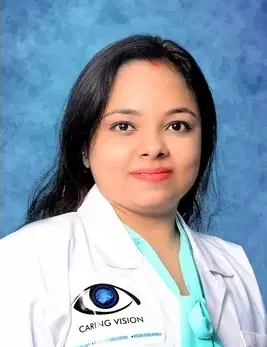
Priya Pandey
- Vision Therapy Clinical Director, Chennai
Priya Pandey co-founded Caring Vision Therapy in Chennai 17 years ago with a transformative clinical conviction: that vision is not merely optical clarity, but a complex neurological function that directly influences learning, behaviour, development, and quality of life. Holding M.Optom, MCOptom (UK), FCSO (USA), and (PhD) credentials, she has built a structured, evidence-informed institution and supported more than 10,000 patients with binocular vision disorders, learning-related visual dysfunctions, and neurological visual impairments. She is the first - and currently the only - Indian optometrist awarded the FCSO fellowship (2023).
Who Is Priya Pandey?
Priya Pandey co-founded Caring Vision Therapy 17 years ago with a transformative vision: to redefine how functional and neuro-optometric care is understood and delivered in India. Her founding belief is rooted in a powerful clinical insight - vision is not merely optical clarity, but a complex neurological function that directly influences learning, behaviour, development, and overall quality of life. Guided by this vision, she has built and led Caring Vision Therapy as a specialised centre for paediatric vision therapy, binocular vision rehabilitation, and neuro-functional vision care.
With over 17 years of clinical experience, she has advanced a neuroscience-driven understanding of visual function, focusing on the intricate relationship between the eyes and the brain. Her expertise lies in how disruptions in eye tracking, convergence, focusing, and visual integration can significantly impact learning ability, attention regulation, motor coordination, and cognitive development. Through her leadership, she has supported more than 10,000 patients with binocular vision disorders, learning-related visual dysfunctions, developmental visual delays, and neurological visual impairments - distinguished by clinical depth, diagnostic precision, and a strong emphasis on tailored rehabilitation strategies that address each patient's unique functional needs.
She holds M.Optom, MCOptom (UK) (Member of the College of Optometrists, United Kingdom), FCSO (USA) (Fellow of the College of Syntonic Optometry), and (PhD), and is affiliated with NORA and the Indian Optometric Association (IOA). In recognition of her contribution to behavioural and functional vision care, she was awarded the FCSO fellowship at the 90th International Conference on Light and Vision, 8 June 2023, Rapid City - making her the first and currently the only Indian optometrist to receive this distinguished international fellowship. She works closely with paediatric occupational therapists, educational psychologists, and special educators to support children in school settings.
She has co-authored five peer-reviewed publications in Vision Development & Rehabilitation, including a research article on the development and validation of a quality of life questionnaire for ASD patients undergoing vision therapy - a tool now used in clinical practice beyond Caring Vision Therapy.
"Children do not always know how to describe what they are experiencing. Our job is to notice the signs they cannot articulate, and then explain what we found in language their parents actually understand."
Clinical Specialisations
Priya Pandey's clinical focus is almost entirely on children and young adults. She takes all new paediatric cases involving learning-related vision problems and has particular depth in the intersection of vision, development, and school performance.
Learning-Related Vision Problems
The most common referral reason in her practice: a child reading below expected level, losing place, skipping lines, avoiding books - and being told the eyes are fine. She uses the full functional evaluation battery (DEM, TVPS-4, MVPT, NSUCO) to map the specific deficits driving the difficulty and designs a programme around them.
Convergence Insufficiency in Children
The most common binocular vision disorder in school-age children - and among the most misdiagnosed. Priya was an early adopter of the CITT protocol standards in India. Her treatment approach follows the published evidence: office-based vision therapy with specific vergence activities, measured against NPC and PFV targets at every milestone session.
Vision Therapy for Autism & Neurodevelopmental Conditions
Has treated hundreds of children with autism spectrum disorder, sensory processing disorder, and developmental coordination disorder. Co-developed a validated quality of life questionnaire for ASD patients undergoing vision therapy (published VDR 2019). Works in multi-disciplinary teams with occupational therapists and educational specialists.
Paediatric Amblyopia
Manages amblyopia across the full range - refractive, strabismic, and organic - using patching combined with active vision therapy to achieve better binocular outcomes than patching alone. Co-authored a 2022 peer-reviewed case study on multi-modal amblyopia treatment including syntonics phototherapy.
Cortical Visual Impairment (CVI)
CVI is now the leading cause of childhood visual impairment in high-income countries. Priya uses the CVI Range scoring system (Christine Roman-Lantzy) to place each child in the appropriate intervention phase and coordinates recommendations for parents, occupational therapists, and schools. CVI assessments include direct observation, environmental complexity testing, and colour preference mapping.
Primitive Reflex Integration
Retained primitive reflexes - including the ATNR, STNR, and Moro - interfere with eye movement control, postural stability, and attention in ways that are commonly mistaken for learning disabilities or ADHD. Priya identifies retained reflexes as part of the standard neurodevelopmental screening and incorporates reflex integration activities into vision therapy programmes where indicated.
Published Clinical Research
All publications are in the journal Vision Development & Rehabilitation (VDR) - the peer-reviewed publication of the College of Optometrists in Vision Development. Priya Pandey is lead author on the 2022 publication and co-author on all others.
Multi-modal Treatment Approach Incorporating Vision Therapy and Syntonics for Combined Organic and Functional Amblyopia
Authors: Priya Pandey, Rabindra Kumar Pandey, Rituparna Ghoshal. Documents measurable improvements in acuity, binocular function, and quality of life using a combined vision therapy and syntonic phototherapy protocol for a patient with combined organic and functional amblyopia.
View Case Report (PDF)Motor Axonal Neuropathy (OR) Guillain-Barre Syndrome - Neuro-Optometric Rehabilitation & Vision Therapy
Authors: Rabindra Kumar Pandey, Priya Pandey. COVD Quality of Life score improved from 44 to 18; Visual Symptoms Survey Score from 72 to 20 following structured neuro-optometric rehabilitation and syntonics for a rare motor-selective GBS variant.
View Case Study (PDF)A Combined Approach of Syntonic Phototherapy along with Vision Therapy in Treatment of Rod-Cone Dystrophy: A Ray of Hope
Authors: Rabindra Kumar Pandey, Priya Pandey, Rituparna Ghoshal, Rajeev Prasad, Mantu Akon. Significant improvements in visual field and contrast sensitivity for a degenerative retinal condition using a combined protocol.
View Case Study (PDF)A Multi-Modality Treatment Approach in Vision Therapy for a Patient with Form Deprivation Adult Strabismic Amblyopia and Nystagmus
Authors: Rabindra Kumar Pandey, Priya Pandey. Meaningful functional vision improvements in complex adult amblyopia with strabismus and nystagmus - traditionally considered untreatable.
View Case Study (PDF)Development and Validation of a Questionnaire to Assess Parent Reported Quality of Life Pre and Post Vision Therapy in a Population with Autism Spectrum Disorder
Authors: Rabindra Kumar Pandey, Priya Pandey, Hira Nath Dahal. Development and validation of a novel parent-reported quality of life questionnaire for ASD patients in vision therapy - a key clinical tool now used beyond the originating clinic.
View Research Article (PDF)See the full list of publications at our Academic Contributions page.