Sudden squint in a child or adult? Learn the common causes, the link with phone use, the warning signs that need same-day care and how it is treated.
What Should You Do If a Squint Appears Suddenly?
Get it examined promptly, within a day or two. Go the same day if it comes with severe headache, vomiting, a drooping eyelid, a large pupil, weakness, balance problems or a recent head injury. Many sudden squints have a harmless cause, such as uncorrected power or heavy phone use, but nerve and brain causes must be ruled out first.
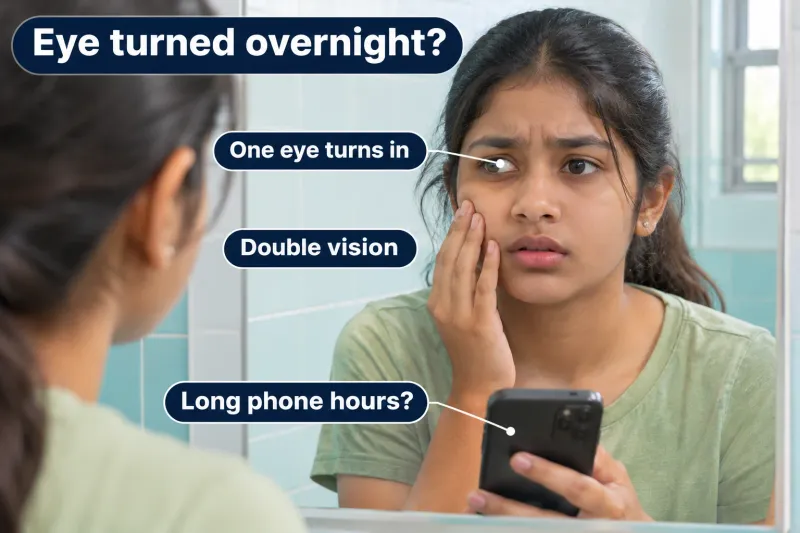
On Monday your child's eyes looked fine. By Thursday, one is turning in, and it is on every photo you take. Or perhaps you are the one affected: you looked up from your phone and saw two of everything.
A squint that appears suddenly is different from one that has been there since early childhood. It has a cause that started recently, and that cause needs to be found. Often it turns out to be something simple. Sometimes it does not, and that is why this is one of the few eye problems we would ask you to act on this week and not next month.
Go the same day if you notice any of these
- Severe or unusual headache, especially with vomiting or on waking
- A drooping eyelid, or one pupil larger than the other
- Weakness, numbness, slurred speech, confusion or facial droop
- Poor balance, clumsiness or a new way of walking
- Eyes that shake or jerk
- A recent head injury or fall
- Fever with neck stiffness or unusual drowsiness
- A white or pale pupil in a child
In these situations, go to a hospital emergency department or an eye casualty. Do not wait for an optometry appointment, including one with us.
Common causes in children
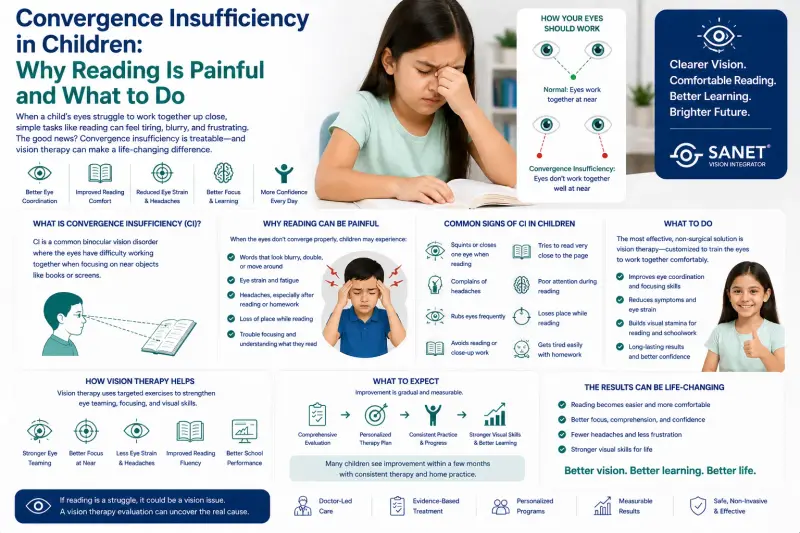
- Plus power that was never picked up. A long-sighted child has to focus hard, and focusing pulls the eyes inward. This is accommodative esotropia, and it often seems to appear overnight even though it has been building up. It is most common between about 1 and 4 years, and glasses often correct much of it.
- A control that has broken down. Many children have a hidden tendency for the eyes to drift, which they hold straight with effort. A fever, an illness, tiredness or a big increase in near work can be enough to let it show. Parents often connect it with a recent viral illness.
- Poor vision in one eye. An eye that cannot see well may start to drift. The squint is the sign that gets noticed, and the real problem may be a cataract or a retinal or optic nerve condition.
- A nerve palsy. One of the nerves that move the eye stops working properly, sometimes after a viral illness, or from something more serious that needs ruling out.
- A problem in the brain. Raised pressure or a growth is uncommon, but it is the reason for the checklist above. Clumsiness, morning vomiting and worsening headaches are the signs that matter most.
In a 3 year old, a sudden squint is usually one of the first two causes. Even so, it needs an examination.
Common causes in adults
- Nerve palsies. Diabetes and high blood pressure are common reasons in older adults, and many of these recover over some months. A third nerve palsy with a droopy lid or a large pupil is an emergency, since it can come from a bulging blood vessel.
- Thyroid eye disease. Swollen eye muscles limit movement, often with staring or puffy eyes.
- Myasthenia gravis. Double vision and a droopy lid that get worse as the day goes on or with tiredness.
- Stroke or head injury. Usually with other symptoms too, though not always.
- A long-standing tendency breaking down. The eyes held together for years, and then age, stress, illness or a change in work tips the balance.
- High myopia. Very long eyes can slowly turn inward, with double vision at distance first.
Can phones and screen time cause a sudden squint?
They may contribute in some people, particularly teenagers and young adults. The condition has a name: acute acquired comitant esotropia. The eye turns in fairly suddenly, by about the same amount in every direction, and the person sees double, usually at distance first.
In a series of adolescents with this, all had been using a smartphone for more than 4 hours a day for several months. Researchers think long hours at a very short viewing distance may overwork the convergence and focusing systems. These are mostly small studies, though, and they do not prove that phones cause it. Plenty of people use phones for far longer and never get it.
Cutting down helps some people, but not everyone. A Japanese study followed 156 people aged 5 to 35 who were told to reduce handheld device use. After 3 months, 6% were cured and 37% improved, while 43% stayed the same and 14% got worse. Those who managed to halve their use, had a smaller angle and had better depth perception did best. Coming in within 3 months of the squint starting was also linked with better results.
Please do not assume it is the phone. In one hospital series of 30 patients, most causes turned out to be benign, but one had a Chiari malformation at the base of the brain. The authors recommended scans for anyone with headache, nystagmus or signs of a balance problem. Your doctor will decide whether you need one.
How to tell what kind of squint it is
Doctors first check whether the turn is the same size in every direction of gaze.
- The same in all directions (comitant). This more often points to a focusing cause, a tendency that has broken down, or the phone-related type.
- Much worse in one direction (incomitant). One eye may not move fully, which points towards a nerve or muscle problem.
You can make a useful observation at home. If you have double vision, cover one eye. If the double image disappears, the two eyes are out of line. Then note whether the images are side by side or one above the other, and whether it is worse when looking in a particular direction. This helps your doctor a great deal.
Why age changes everything: the vision development angle
Adults with a new squint see double, and they tell you straight away. Their visual system is mature and it cannot just turn one image off.
Young children are different. Up to around 7 or 8 years, the visual brain is still being wired. When two images disagree, it can simply start ignoring one, sometimes within weeks. The double vision disappears, and the child may never complain at all. You may notice them closing one eye in sunlight or tilting their head. The cost of that adaptation is the risk of a lazy eye and loss of depth perception, skills that are harder to rebuild later.
So a child with a new squint and no complaints may need attention sooner than the lack of fuss suggests, not later. The earlier the eyes are back together, the better the chance of keeping two-eyed vision.
What to do first
- Check the list at the top of this page. If anything fits, go now.
- Take clear photos of the eyes looking straight ahead and to each side, and note the date you first saw it. Old photos are helpful too, because they show when it began.
- Write down any recent illness, fall, new medicine or big change in screen hours.
- Book an eye examination that includes measuring the power with drops.
- Hold off on patches and online exercises until you know the cause.
How it is treated once serious causes are excluded
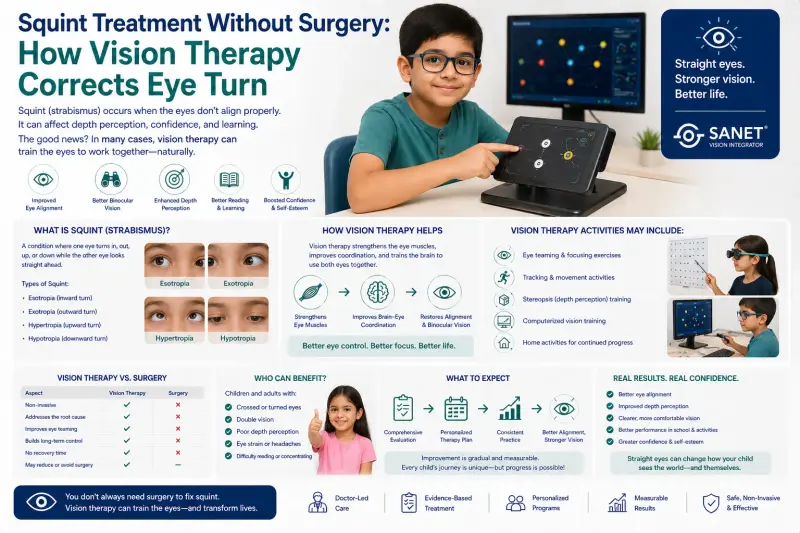
Treatment follows the cause. It may be glasses for plus power, cutting down on near screen use, temporary prisms to remove double vision while a nerve recovers, or surgery if a stable turn remains after a period of monitoring. Trials of treatments for these sudden-onset cases are limited, and in the hospital series above most patients eventually had surgery, with good results.
Behavioural vision care and vision therapy come in when the medical side is clear. They do not treat a nerve palsy or a brain problem. They can help when a child or adult has eyes that could work together but no longer do so comfortably. That means building fusion and the range over which both eyes stay together, retraining focusing, removing suppression, and working out healthy habits for near work. After surgery, therapy can help the brain use the newly straight eyes as a pair. Our article on surgery or vision therapy for squint explains which types tend to respond.
Who does what: your doctor and your developmental and behavioural optometrist
Think of this as teamwork. An ophthalmologist or neurologist finds out why it happened and treats anything that is dangerous. A developmental and behavioural optometrist measures the turn in detail, prescribes lenses or prisms, checks how the two eyes work together, and plans the rehabilitation. For a child, they also keep a close eye on how vision is developing, so that a lazy eye is caught early. For an adult, the focus is usually on getting rid of double vision so that work and driving feel safe and normal again.
If you have already been told there is nothing dangerous going on but the squint or double vision is still there, book a squint assessment at Caring Vision Therapy. Bring your reports and photos, and we will work out what can be done next.
Explore More at Caring Vision Therapy
Frequently Asked Questions
What causes a sudden squint in a child?
What causes a sudden squint in adults?
Can screen time cause a squint?
Can a fever cause a squint in a child?
Will a sudden squint go away on its own?
Is a sudden squint an emergency?
Can vision therapy fix a sudden squint?
Sources
- Acute Acquired Comitant Esotropia: Etiology, Clinical Course, and Management. Clinical Ophthalmology, 2021.
- Neurological Pathologies in Acute Acquired Comitant Esotropia.
- Acute Acquired Comitant Esotropia Related to Excessive Smartphone Use. BMC Ophthalmology, 2016.
- Factors Affecting Outcome of Acquired Comitant Esotropia With Restricted Use of Digital Devices: ACEDD Study 3. BMJ Open Ophthalmology, 2024.
- Strabismus. StatPearls, NCBI Bookshelf.
Reviewed by the Caring Vision Therapy clinical team. Updated November 2026.