Lazy eye treatment success rates by age, from age 3 to adulthood: what recovery looks like, how long it takes and why vision can slip back.
Book a ConsultationHow Successful Is Lazy Eye Treatment at Each Age?
Lazy eye treatment success rates by age, from age 3 to adulthood: what recovery looks like, how long it takes and why vision can slip back.
How Likely Is Recovery? The Short Answer
YES. Lazy eye (amblyopia) IS curable in children, especially when detected and treated early. With proper vision therapy and treatment, 70-85% of children with lazy eye show significant improvement or complete recovery of vision in the weaker eye. The key is early detection and starting treatment before the critical period of visual development closes (around age 7-8).
What is Lazy Eye (Amblyopia)?
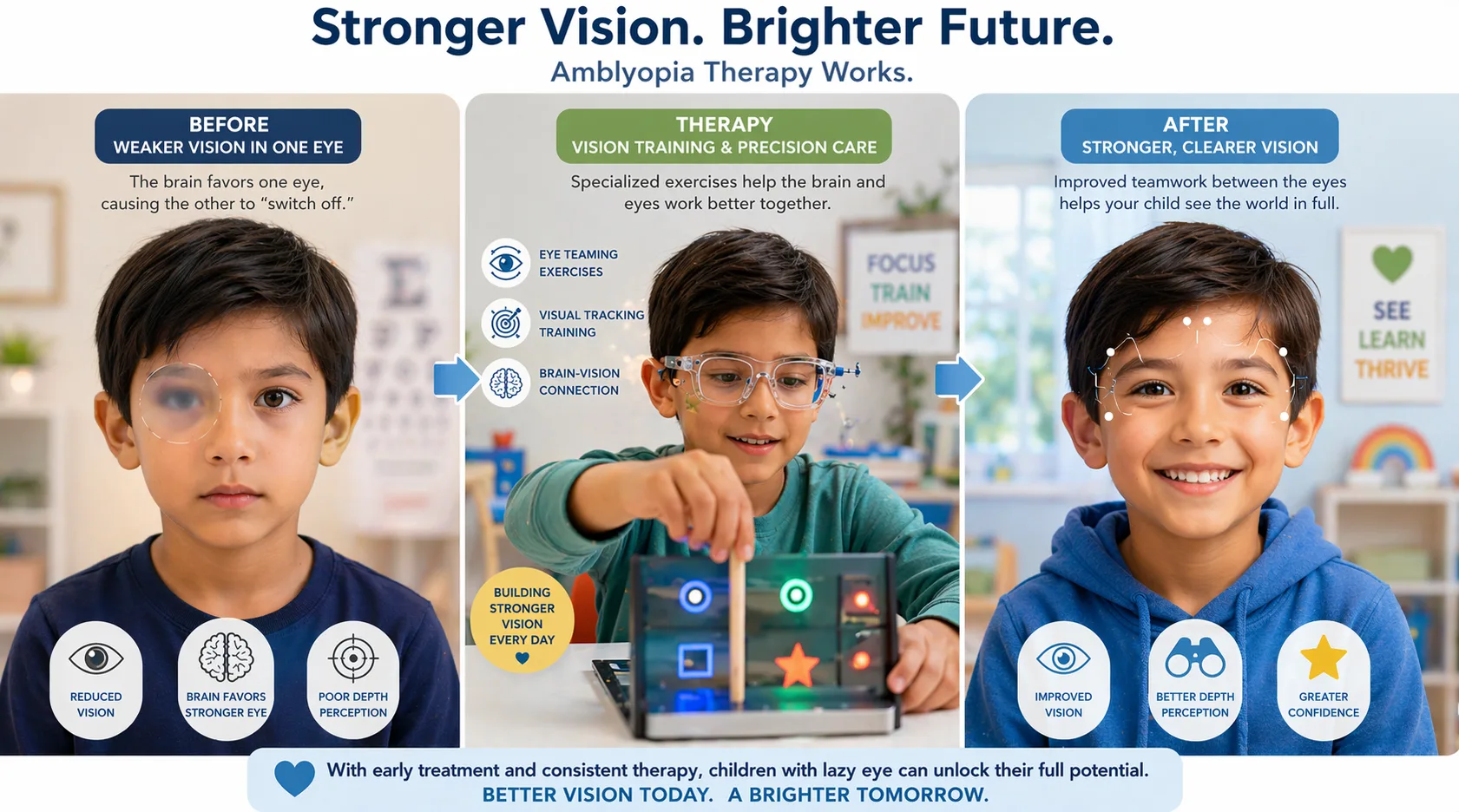
Amblyopia, or lazy eye, occurs when one eye doesn't develop clear vision during childhood. The brain receives unequal images from each eye and gradually suppresses the image from the weaker eye, causing that eye's vision to remain underdeveloped. Unlike refractive errors (needing glasses), lazy eye is a functional vision problem - the eye's structure is normal, but it's not being used properly.
Common Causes of Lazy Eye in Children
- Strabismus (Eye Turn): When eyes misalign, the brain receives conflicting images and suppresses one
- Refractive Error Difference: When one eye has a significantly different prescription than the other (anisometropia)
- Astigmatism or Myopia: When blurred vision in one eye causes suppression
- Visual Obstruction: Cataracts, ptosis, or other conditions blocking vision in one eye
Can Lazy Eye Be Cured? Treatment Success Rates
Research shows that with proper treatment, lazy eye recovery rates are very encouraging:
- Ages 3-7: 70-85% show significant improvement with structured treatment
- Ages 7-13: 50-70% achieve meaningful vision improvement
- Adolescents & Adults: Even older patients can achieve visual gains, though slower and more challenging
Success depends on early detection, compliance with treatment, and choosing evidence-based therapy methods.
Traditional vs Modern Vision Therapy Treatment
Traditional Approach: Patching Alone - Covering the stronger eye to force the weaker eye to work. While this can help, it's incomplete.
Modern Vision Therapy Approach: Combines multiple treatment methods:
- Binocular (both eyes) integration therapy
- Monocular (single eye) training with guided activities
- Focusing and tracking exercises
- Syntonics phototherapy (specialized light therapy)
- Hand-eye coordination development
How Long Does Lazy Eye Treatment Take?
Treatment duration varies by age and severity:
- Young children (ages 3-7): 12-24 weeks typically shows results
- School-age children: 24-36 weeks for meaningful improvement
- Teenagers & adults: 36-52 weeks or longer
Why Early Treatment is Critical
The brain's visual system develops most rapidly before age 6-7, entering a "critical period" where visual pathways are still forming. Children treated early have the best outcomes because their brains retain neuroplasticity - the ability to form new neural connections. After age 8, lazy eye becomes increasingly difficult (but not impossible) to treat.
At Caring Vision Therapy in Chennai, we specialize in treating amblyopia at all ages, with the best results in younger children when detected early.
Explore More at Caring Vision Therapy
Frequently Asked Questions
Can lazy eye be cured completely?
Yes, especially in children under age 8. With modern vision therapy, 70-85% of young children with lazy eye achieve normal or near-normal vision in the weaker eye. Older children and adults can also improve significantly, though treatment takes longer.
What's the success rate for lazy eye treatment?
Treatment success depends on age at diagnosis. Children diagnosed before age 7 have 70-85% success rate. Ages 7-13 show 50-70% improvement. Even teenagers and adults can achieve visual gains through modern vision therapy.
Is patching the only treatment for lazy eye?
No. While patching (occluding the stronger eye) is a traditional approach, modern evidence-based treatment uses a multimodal approach including structured vision therapy, binocular integration exercises, and phototherapy for better outcomes.
At what age is lazy eye treatable?
Lazy eye is most effectively treated before age 7-8, but treatment can help at any age. Early detection and intervention yield the best results due to the brain's neuroplasticity during critical developmental periods.
How do I know if my child has lazy eye?
Common signs include poor depth perception, one eye appearing to turn inward or outward, head turning to favor one side, or poor performance in sports or hand-eye coordination activities. A full functional vision evaluation is the only way to confirm lazy eye.