Ocular migraine, migraine aura or visual snow? Compare symptoms, how long each lasts, a simple cover test, warning signs and how each one is managed.
How Do Ocular Migraine, Migraine Aura and Visual Snow Differ?
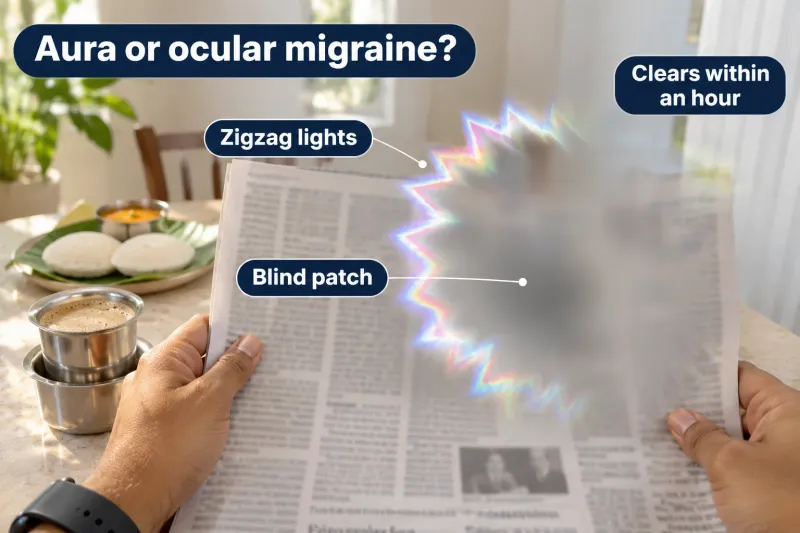
Migraine aura affects your view through both eyes, spreads over minutes and clears within an hour. True ocular migraine, called retinal migraine by doctors, affects one eye only and is rare. Visual snow is constant static across your whole view for months. New vision loss in one eye needs same-day care.
A shimmering zigzag appears beside the word you are reading. Twenty minutes later it has gone, you have a headache or you don't, and someone tells you it was an ocular migraine. Maybe it was. In everyday use the term covers several different things, and only one of them is what doctors mean by it.
Three conditions get mixed up here: migraine aura, retinal migraine and visual snow. They come from different places and need different responses, and you can usually tell them apart with the questions below. Your doctor makes the diagnosis, of course, but going in with good notes helps a lot.
The three at a glance
| Migraine aura | Retinal (true ocular) migraine | Visual snow | |
|---|---|---|---|
| What you see | Zigzag lines, shimmering arcs, a blind patch that grows | Dimming, a dark patch, blindness or sparkles | Fine flickering dots, like TV static, over everything |
| Which eye | Seen with either eye. It sits in one side of your view. | One eye only | Both eyes, whole view |
| How long | Spreads over at least 5 minutes, each symptom lasting 5 to 60 minutes | 5 to 60 minutes | All or most of the time, for more than 3 months |
| Headache | Often follows, but not always | Usually comes with or soon after | Not part of it, though many people also have migraine |
| Where it starts | The visual part of the brain | Thought to involve blood flow to one eye | How the brain processes visual signals |
| How common | Common | Rare | Less well known, and probably under-recognised |
Try the cover test during an episode
This is the most useful thing you can do, and most people have never been told about it. While the shimmer or dark patch is there, cover your right eye and look. Then cover your left eye and look.
- You can see it with either eye covered. The disturbance is coming from the brain, so this points to aura. People often say it was in their left eye, when what they mean is the left side of their view.
- It is only there with one eye open. The problem is in that eye or its blood supply. This is the one to treat as urgent.
Note the time it started and ended, and if you can, draw what you saw. Doctors find a simple sketch surprisingly helpful. The formal criteria for retinal migraine actually ask for a one-eye field defect to be confirmed by testing or by the patient's drawing during an attack.
Migraine aura: what most people are describing
The classic aura begins as a small bright spot near the centre of your view and spreads outward over a few minutes as a flickering, jagged crescent. Behind it may be a patch where you simply cannot see. You might lose part of a word on the page. Some people also get tingling in a hand or around the mouth, or trouble finding words.
Headache often follows, but aura can come on its own, especially with age. Some people with this have never had a bad headache, which is why it can be so frightening the first time.
Retinal migraine: rare, and a diagnosis made last
Retinal migraine causes repeated, fully reversible attacks of visual loss or sparkles in one eye, linked with migraine. It is much rarer than the name's popularity suggests. Reviewers of the medical literature have found mostly case reports, and some doctors question how often it truly happens.
Doctors do not label this straight away, because other causes of one-eye visual loss are more dangerous. These include a mini stroke affecting the eye, an inflamed artery in older adults, and a retinal tear or detachment. These need to be ruled out first.
Visual snow: the one that does not go away
Visual snow looks like fine static across the whole of your view, in bright light and in the dark. It does not come and go in attacks the way aura does. To meet the criteria it has to last more than three months, along with at least two of these: afterimages or trails, more floaters and bright squiggles against the sky, light sensitivity, and poor night vision.
In the largest published series of 1,100 people, the average age was 29, and about 40% had had symptoms for as long as they could remember. Migraine and tinnitus were common, and both went with more severe symptoms. So migraine and visual snow can exist in the same person, but they are different things. We cover this in more depth in our article on living with visual snow.
Where vision development fits in
Everything here concerns how the brain handles what the eyes send it, more than the health of the eyes themselves. Eye scans are usually normal. That matters for families, because the visual system goes on maturing through childhood, and children have migraine too. A child may not have the words for aura. They may say a part of the picture went missing, or stop playing and want to lie down. Asking them to draw it often works better than asking them to describe it.
Since so many people with visual snow say they have always had it, some children simply assume everyone sees static. Asking a child directly, in a neutral way, can bring this out years earlier than it otherwise would.
Children who also have weak eye teaming or focusing skills have to work harder at near tasks, and that added load can make visual discomfort harder to live with. We would not claim it causes migraine. A review of the optometric evidence found the link between migraine and binocular vision or spectacle power to be weak. The stronger link was with pattern glare, an unusual discomfort from striped patterns such as lines of text.
What behavioural vision care can and cannot do
Let's be clear about the limits first. Vision therapy does not stop aura, and it is not a cure for migraine or visual snow. Migraine treatment belongs with your physician or neurologist, who can talk through triggers, preventive medicines and how to treat attacks.
What behavioural vision care can do is deal with the vision problems that sit alongside these conditions and make daily life harder:
- Correcting any power that was missed, and fixing an uncomfortable screen and lighting setup
- Testing eye teaming, focusing and eye movements between attacks, and treating real weaknesses with vision therapy
- Trying tinted lenses in a structured way if light or patterns bother you. Some people with migraine find them helpful, though the results vary from person to person.
- For visual snow, working on the things that interfere most, such as reading comfort and coping in busy or bright places, through neuro-optometric rehabilitation
The role of a developmental and behavioural optometrist
Your neurologist looks after the migraine. A developmental and behavioural optometrist looks at how your visual system functions the rest of the time. They will take a careful history of what you see, go through the same differences set out above, and test skills that a standard eye check does not cover. If something does not fit, such as one-eye symptoms or a new pattern after 50, they will send you back to a doctor before doing anything else. For a child, they can also check whether visual skills are developing on track for their age and how those skills hold up in class.
Symptoms that cannot wait
Go to an emergency department or see an eye doctor the same day for:
- Sudden loss of vision in one eye, even if it has come back
- A first ever episode of visual disturbance, especially if you are over 50
- A curtain or shadow across your view, or a sudden shower of floaters and flashes
- Visual symptoms lasting more than an hour, or that begin suddenly with no gradual spread
- Weakness, numbness, confusion or trouble speaking that does not fit your usual pattern
- The worst headache of your life
If you have aura, also tell your doctor if you smoke or take a contraceptive pill containing oestrogen, because aura can change the advice you are given about stroke risk.
Once serious causes have been ruled out, you may still be left with static, light sensitivity or tired eyes. That part is worth looking at properly. Book a neuro-optometric assessment at Caring Vision Therapy and we will measure how your visual system is coping.
Explore More at Caring Vision Therapy
Frequently Asked Questions
What is an ocular migraine?
How long does an ocular migraine last?
Can you have a migraine aura without a headache?
Is an ocular migraine dangerous?
Is visual snow a type of migraine?
Can glasses or vision therapy treat ocular migraine?
Can children get migraine aura or visual snow?
Sources
- Migraine With Typical Aura. International Classification of Headache Disorders, 3rd edition.
- Retinal Migraine. International Classification of Headache Disorders, 3rd edition.
- Differential Diagnosis of Visual Phenomena Associated With Migraine: Spotlight on Aura and Visual Snow Syndrome. Diagnostics, 2023.
- Visual Snow Syndrome: a Clinical and Phenotypical Description of 1,100 Cases. Neurology, 2020.
- The Optometric Correlates of Migraine. Ophthalmic and Physiological Optics, 2004.
Reviewed by the Caring Vision Therapy clinical team. Updated November 2026.