Eye strain headache location explained: forehead, temples or behind the eyes, how it differs from migraine, the warning signs, and when vision is the cause.
Where Is an Eye Strain Headache Felt?
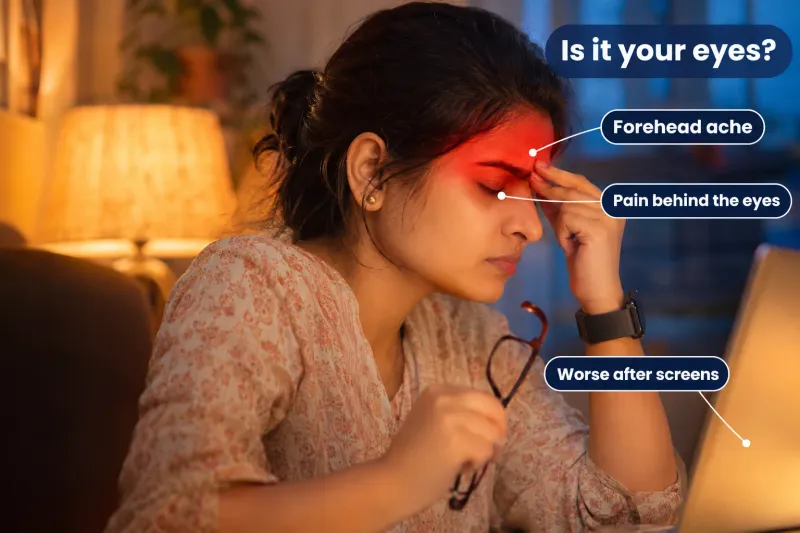
Usually across the forehead, around or behind both eyes, and sometimes at the temples. It builds during reading or screen work and eases after you stop. A one-sided, throbbing headache with nausea is more likely to be migraine. A headache with sudden vision loss or a red, painful eye needs urgent care.
Ask someone with an eye strain headache where it hurts and they will usually draw a line with one finger: across the forehead, just above the eyebrows, sometimes dipping in behind the eyes. It starts as a dull pressure in the afternoon, gets worse through the evening's reading, and has gone by morning.
That pattern is a good clue, but it proves nothing by itself, because tension headaches and migraine can sit in the same places. So let's look at where the pain is, when it comes on, and how to find out whether your eyes are really behind it.
Where it hurts and what that may point to
| Where you feel it | What tends to come with it | What it may point to |
|---|---|---|
| Forehead and brow, both sides | Builds during reading or screens, eases with rest | Focusing or eye teaming strain, or power that has not been corrected |
| Around or behind both eyes | Heavy, tired eyes, and words that blur or double after a while | A convergence or focusing problem |
| Temples | A tight band feeling, stress, clenched jaw | Tension-type headache, often mixed with eye strain |
| Back of the head and neck | Worse at the desk, and you lean in or tilt your head | Posture, screen height or badly fitted progressives. A small vertical eye misalignment can also make people tilt. |
| One side, throbbing | Nausea, light hurts, sometimes zigzag lights | Migraine |
| In or around one eye, severe | Red eye, blurred vision, halos around lights | An eye emergency such as acute glaucoma. Go the same day. |
We could not find a good study that maps headache location to its cause, so treat this table as a guide drawn from clinical descriptions. Published accounts of focusing problems do mention frontal pain and pain around the eyes during near work, which fits what patients tell us. The location narrows things down, and the timing tells you more.
Timing usually says more than location
An eye strain headache follows the work your eyes are doing. Ask yourself these questions:
- Do you wake up clear and get the headache later in the day?
- Does it start after 20 to 60 minutes of reading, phone or laptop use?
- Is it milder on holidays, or on days you spend outdoors?
- Does closing your eyes for a while take the edge off?
- Do you also notice blur, words moving, or having to reread lines?
Several yes answers make your eyes a fair suspect. A headache that is there when you wake up, or that has nothing to do with what you were looking at, points elsewhere.
What your eyes are doing when near work hurts
Reading a phone asks your eyes to do two jobs at once. The focusing muscle inside each eye has to keep tightening so the print stays clear. The muscles outside the eyes have to keep both eyes turned inward so they land on the same word. At distance, both systems get to relax. At 30 centimetres, they work for as long as you keep looking.
If one of them is only just coping, you can still read. It simply costs more effort, and that effort is what tends to turn into an ache by evening. Common reasons include:
- Plus power or a small cylinder that was never corrected. Distance vision can look fine because young eyes focus through it, at a price.
- Reading glasses that are overdue. Many people notice this from around 40.
- Convergence insufficiency, where the eyes struggle to turn in and hold there.
- Focusing that tires, known as accommodative insufficiency.
- Dry eye from blinking less at screens, which feels more like burning and grit than an ache.
Digital eye strain is very common, with estimates of 50% or more among computer users. The international headache classification also lists headache from refractive error and from eye misalignment as recognised types. Still, eyes get blamed more often than they deserve. In one study of schoolchildren, 70% had had a headache in the past year, and their spectacle power explained only a small part of it. A new pair of glasses will not fix every headache, and any clinic that promises it will is overselling.
Why it so often begins at school age
Eye teaming and focusing are skills that develop through childhood. Babies learn them first by looking at faces and reaching for things, then by crawling, playing and drawing. A child can get through the early years with these skills only partly in place, because the demands are small: big print, short tasks, plenty of movement.
Things change around class 3 or 4. The print shrinks, the homework grows, and now there may be an hour on a tablet as well. This is often when a weakness that nobody noticed starts to show. Children rarely say their eyes are straining. They say their head hurts, or they rub their eyes, lean close, lose their place, or find a reason to stop doing homework. Adults can have the same gap in skills and only feel it when a desk job adds eight hours of screens to their day. Our guide to sore eyes after screen time in children covers what parents can watch for.
What a developmental and behavioural optometrist checks
A routine eye test answers one question: what power gives you the clearest letters on a chart for a few seconds? A developmental and behavioural optometrist asks a different one: how well does your visual system hold up over a working day? That means measuring things like these:
- How close your eyes can turn in before the image doubles, and how easily they recover
- How much reserve your eye muscles have when reading
- How strong your focusing is, and how quickly it can shift from near to far
- Whether your eye movements stay accurate along a line of print
- Whether one eye is sitting slightly higher than the other
- How you actually work: your distance from the page, posture, light and screen position
They will also tell you when the answer is not visual. If the eye findings are normal and the headache pattern does not fit, you should be seeing a physician or neurologist, and a good optometrist will say so.
How behavioural vision care and vision therapy help
Treatment depends on what the testing finds, and it is often simpler than people expect. It may be a small change of power, a separate pair of lenses for near work, a low reading addition or a small prism, along with changes to how the desk is set up.
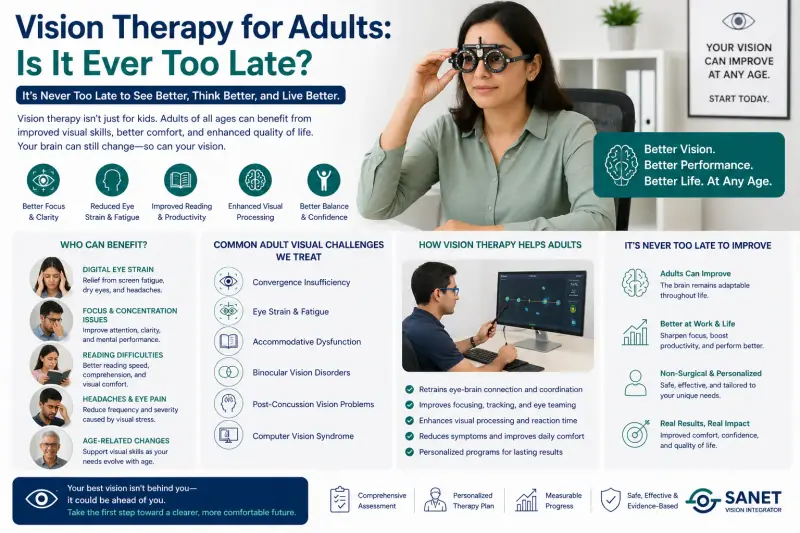
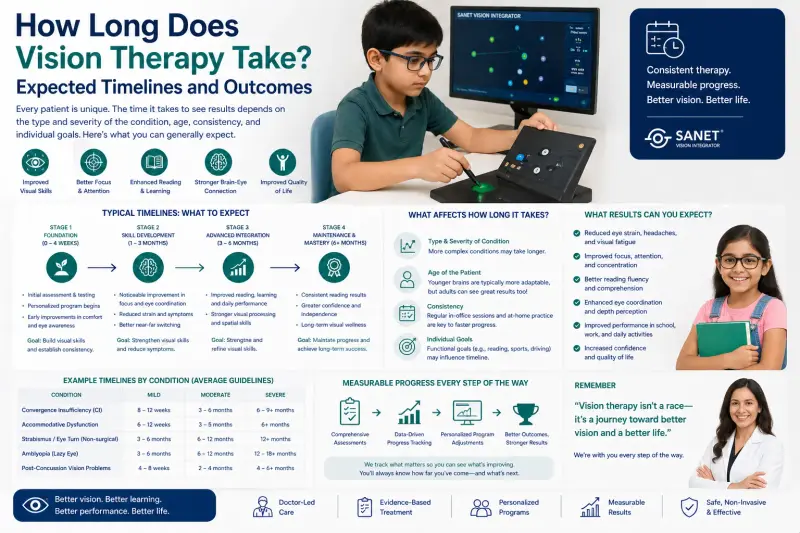
When the problem is a weak skill, vision therapy trains it. The aim is functional vision: eyes that team, focus and move well enough that a full day of reading stops being hard work. The best evidence is in children with convergence insufficiency, where office-based therapy with home practice clearly beat home pencil push-ups and placebo therapy. In adults the research is thinner and less clear, so we would rather tell you that upfront. Progress should be measured with the same tests at each review, so you can see whether things are changing.
Things worth trying this week
- Look up from near work every 20 minutes or so and rest your eyes on something far away for a little while.
- Keep your laptop about an arm's length away, with the top of the screen near eye level.
- Hold your phone further away than feels natural, and make the text a size larger.
- Match the brightness of the screen to the room, and do not work in the dark.
- Blink on purpose during long stretches, especially in air conditioning.
- Keep a note for a week of when each headache starts and what you were doing.
That diary is more useful to a clinician than almost anything else you can bring. If the headaches ease with these changes, good. If they keep coming back, your eyes may be working harder than they should, and an assessment can measure that.
When a headache is not eye strain
Get urgent medical help for a headache that comes with any of these:
- Sudden, very severe pain that peaks within a minute or so
- Sudden loss of vision, a curtain across your view, or new double vision
- A red, painful eye with halos around lights
- Weakness, numbness, confusion or trouble speaking
- Fever with a stiff neck
- A recent head injury
- Waking with headache and vomiting, particularly in a child
- New temple pain over the age of 50, especially with jaw pain when chewing or a tender scalp
For everything else, it helps to know what kind of headache you are dealing with. If yours follows your reading and screen hours and nothing has helped so far, book a functional vision assessment at Caring Vision Therapy, in Chennai, in Hyderabad or online.
Explore More at Caring Vision Therapy
Frequently Asked Questions
Where is an eye strain headache located?
How long does an eye strain headache last?
How do I know if my headache is from my eyes?
Can wrong glasses cause headaches?
Can a child get eye strain headaches?
Can vision therapy stop eye strain headaches?
Is an eye strain headache the same as a migraine?
Sources
- Digital Eye Strain: Prevalence, Measurement and Amelioration. BMJ Open Ophthalmology, 2018.
- Headache Attributed to Disorder of the Eyes. International Classification of Headache Disorders, 3rd edition.
- Relationship Between Habitual Refractive Errors and Headache Complaints in Schoolchildren. Optometry and Vision Science, 2007.
- Accommodative Insufficiency. StatPearls, NCBI Bookshelf.
- Convergence Insufficiency and Accommodative Insufficiency in Children. BMC Ophthalmology, 2019.
- Interventions for Convergence Insufficiency: a Network Meta-Analysis. Cochrane Database of Systematic Reviews, 2020.
Reviewed by the Caring Vision Therapy clinical team. Updated November 2026.