The 17 visual skills children need for school readiness, reading and learning, from focusing and eye movements to binocular vision and visual processing.
Book a Consultation17 Visual Skills Every Child Needs for School Readiness
The 17 visual skills children need for school readiness, reading and learning, from focusing and eye movements to binocular vision and visual processing.
School readiness is usually measured by whether a child knows the alphabet, can count, hold a pencil, or follow instructions. But there is another piece of readiness that is easy to overlook entirely: vision. Seeing clearly is only the starting point. A child needs a wide range of visual skills to sit comfortably in a classroom, look at the board, copy information into a notebook, read a book, find things on a busy page, follow moving objects, judge distances and sustain visual attention through an entire school day - and a child can have 20/20 vision and still struggle with several of these skills, because good functional vision involves far more than reading letters off an eye chart.
Here are 17 visual skills that support school readiness, learning and reading, why each one matters, and what parents can watch for if a child is struggling.
Why Vision Matters So Much for School Readiness
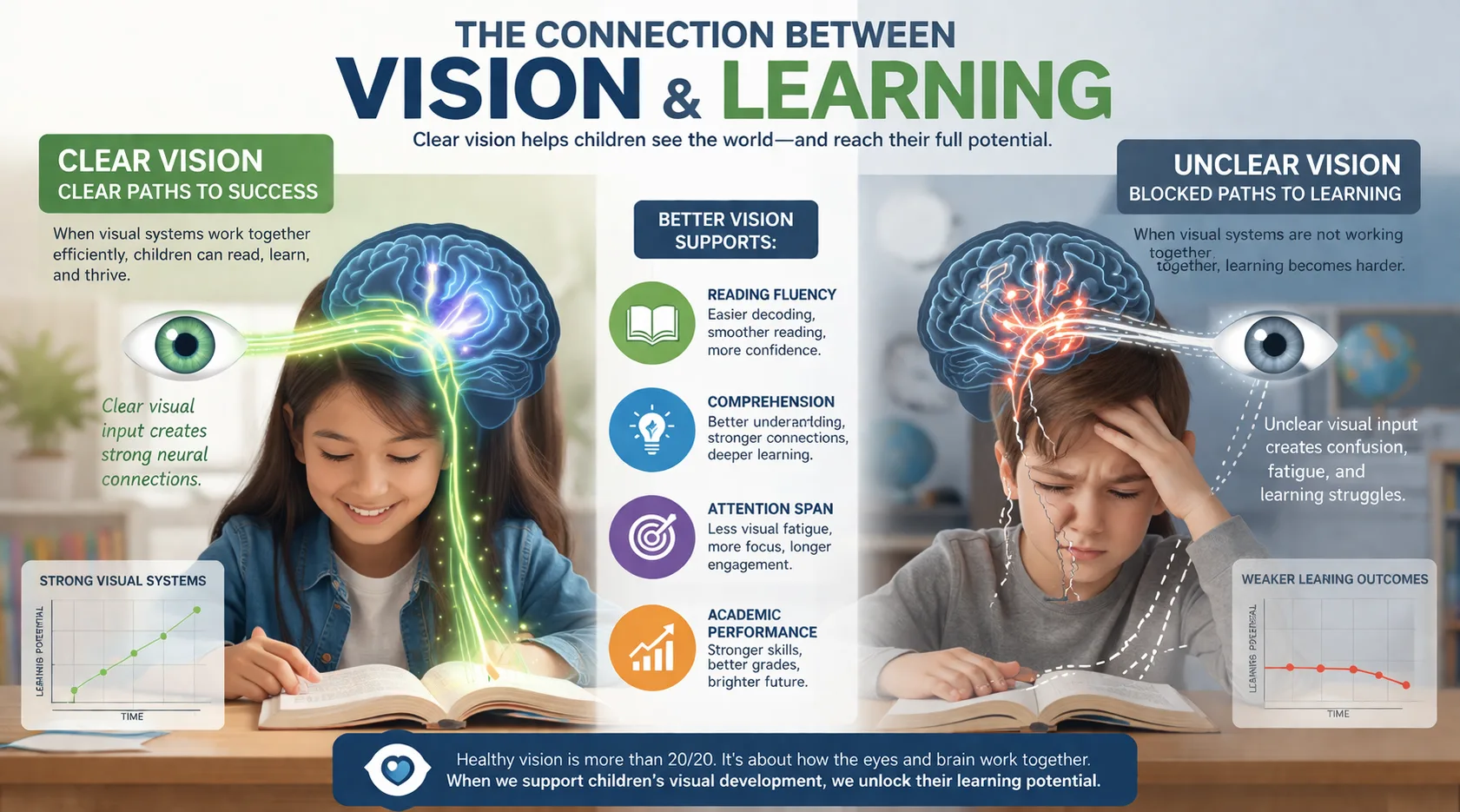
A large part of classroom learning is visual: looking at the teacher, looking at the board, copying from the board into a notebook, reading a textbook, finding information on a page, following a line of text, writing within a defined space, shifting between near and far targets, recognising letters and shapes, remembering what was seen, organising visual information, and moving safely around the classroom. All of it depends on different aspects of visual function, and when a particular skill is inefficient, a child may simply have to work much harder than classmates to complete the exact same task. That effort sometimes gets mislabelled as inattention, dislike of reading, slowness with homework, or carelessness, when a visual factor may actually be contributing.
The 17 Visual Skills
1. Visual Acuity - Seeing Clearly
Visual acuity, the ability to see fine detail clearly, is what a traditional eye chart measures. A child needs adequate acuity, at both distance and near, to recognise letters, numbers, words, pictures and classroom information, but acuity is only one part of the overall visual system, and a child can have excellent acuity while still struggling with everything else on this list.
2. Focusing Ability (Accommodation) - Keeping Words Clear
The focusing system needs to focus accurately, maintain focus, relax it, and change it as viewing distance changes - shifting from the teacher to a notebook and back again. When focusing is inefficient, a child may experience blurred vision, eye strain, headaches, difficulty sustaining near work, frequent breaks, and reduced reading stamina.
3. Focusing Flexibility - Changing Focus Efficiently
Children constantly shift gaze between distances - board, notebook, teacher, book, board again - and the focusing system has to keep up, a skill called accommodative flexibility. A child who struggles here takes longer to regain clarity every time they change distance, which makes ordinary classroom activity more tiring than it should be.
4. Convergence - Bringing Both Eyes Together
When a child reads, both eyes need to aim accurately at the same point on the page - the inward-turning movement called convergence. Difficulty with convergence can be associated with eye strain, headaches, blurred or double vision, reading avoidance, losing one's place, and poor reading stamina.
5. Binocular Coordination - Using Both Eyes as a Team
Seeing with two eyes is not simply having two functioning eyes - the brain has to combine information from both into one coordinated visual experience, or binocular vision. Good binocular coordination supports comfortable reading, depth perception, spatial awareness, eye-hand coordination and efficient visual attention; when it is inefficient, visual fatigue and difficulty with near work tend to follow.
6. Eye Tracking - Following a Moving Target
Eye tracking, or pursuit ability, lets the eyes smoothly follow a moving object - a ball, a teacher's demonstration, anything moving in a dynamic environment - and contributes to efficient interaction with the physical, moving world both in and outside the classroom.
7. Saccades - Moving the Eyes Quickly Between Targets
Saccades are the rapid eye movements that shift the eyes from one target to the next, and during reading, the eyes jump, stop, process, jump, stop, process, continuously. Inefficient saccadic control can contribute to losing one's place, skipping words, rereading lines, difficulty copying from the board, and slow reading, though reading difficulty has many possible causes, and eye movement assessment is only one part of a full evaluation.
8. Visual Fixation - Staying on the Target
Before the brain can interpret what the eyes are seeing, the eyes need to hold accurate, stable fixation on a target. During reading, that means a series of brief, controlled fixations that support letter and word recognition and sustained attention; poor fixation control can contribute to visual instability or difficulty maintaining attention on visual tasks.
9. Depth Perception - Understanding Distance
Depth perception helps a child judge how far away something is and how objects relate to each other in space - important for catching a ball, climbing stairs, playground activities, sports, handwriting, drawing and simply navigating a classroom safely. Binocular vision contributes significantly to stereoscopic depth perception specifically.
10. Visual-Spatial Skills - Understanding Where Things Are
Concepts like above, below, beside, between, behind, in front, left and right rely on visual-spatial skills, which matter directly when children learn letter orientation, number placement, geometry, maps and shapes, and how to organise their own writing on a page.
11. Visual Discrimination - Telling Similar Things Apart
Visual discrimination is what lets a child reliably tell b from d, p from q, 6 from 9, or + from ×, helping them identify letters, numbers, words, shapes and objects accurately. Occasional letter reversals alone do not automatically indicate dyslexia or a visual disorder - developmental variation here is common, particularly during early learning.
12. Visual Memory - Remembering What Was Seen
Visual memory is the ability to retain and recall visual information - the shape of a letter, a word, a number sequence, a pattern, where something was located - and contributes directly to learning, recognition and efficient recall, including the gradual familiarity a child builds with a word's visual form through repeated exposure.
13. Visual Sequential Memory - Remembering Visual Information in Order
This is a more specific skill: remembering not just visual information, but the order it appeared in - a number sequence like 3-8-5-2, for example. Sequential visual memory supports spelling, reading, number sequences, copying, following visual instructions and remembering patterns.
14. Visual Attention - Knowing What to Look At
Classrooms contain enormous amounts of visual information, and a child needs to identify what actually matters - the relevant question on a worksheet, say - while filtering out pictures, other text, movement and classroom activity nearby. Efficient visual attention underpins both classroom participation and task completion.
15. Visual Figure-Ground - Finding Important Information
Figure-ground perception is the ability to pick out a relevant object or piece of information against a busy background - a specific word on a page, a book on a crowded shelf, a toy among many others, or the right question on a visually cluttered worksheet. Persistent difficulty with visually cluttered material can be worth further assessment.
16. Visual-Motor Integration - Coordinating Vision With Hand Movement
Children do not learn only by looking - they use what they see to guide their hands, which is visual-motor integration, and it matters for handwriting, drawing, colouring, cutting, copying shapes, writing within lines, and constructing objects. A child may understand exactly what a shape looks like and still struggle to reproduce it accurately - visual-motor skill is often the missing link.
17. Visual Form Perception and Processing - Understanding What Is Seen
Finally, children need to interpret and make sense of visual information - recognising letters, shapes, symbols, objects, patterns and spatial relationships, often described broadly as visual perception or visual processing. Seeing a group of lines is different from recognising that they form the letter A; seeing several symbols is different from understanding that together they form a meaningful word. Visual processing is closely tied to learning at every stage.
How These 17 Skills Work Together
None of these skills work in isolation. Reading draws on clear vision, focusing, convergence, binocular coordination, fixation, saccades, visual attention, visual processing, language and comprehension together. Writing draws on visual acuity, spatial awareness, visual-motor integration, eye-hand coordination and visual feedback. Even playing sport draws on tracking, saccades, depth perception, peripheral awareness, spatial processing and eye-hand coordination. Classroom learning places demands on the visual system throughout the entire school day, not just during reading time.
Why 20/20 Vision Does Not Tell the Whole Story
This is one of the most important messages for parents: a child can have 20/20 vision and still have real difficulty with focusing, convergence, binocular coordination, eye movements, visual attention, visual-spatial processing or visual-motor integration. A traditional eye chart answers one question - how clearly can the child see? A functional vision assessment asks a broader one - how efficiently is the child actually using vision? Both matter.
Signs a Child May Be Struggling Visually
Parents and teachers may notice avoidance of reading, slow reading, frequently losing their place, skipping words or lines, rereading, headaches after school, eye rubbing, covering one eye, holding books unusually close, poor reading stamina, difficulty copying from the board, difficulty catching a ball, disorganised handwriting, difficulty with puzzles, trouble finding objects in visual clutter, tiredness during homework, or complaints that words are blurry or moving. None of these signs automatically means a visual problem is present, but persistent or multiple symptoms together deserve attention.
What a School Readiness Vision Assessment Involves
A school readiness assessment goes well beyond checking visual acuity. Depending on the child's age and concerns, it may evaluate distance and near vision, refraction, accommodation, convergence, binocular vision, eye movements, visual fixation, depth perception, visual-spatial skills, visual attention, visual perception and visual-motor integration, tailored to the child's developmental level rather than a fixed checklist applied to everyone.
When Should Parents Consider an Assessment?
An assessment can be particularly useful when a child is starting school, struggling with reading, having difficulty copying from the board, complaining of headaches during homework, avoiding near work, struggling to sustain attention on visual tasks, frequently losing their place while reading, struggling with handwriting, showing coordination or spatial difficulties, has a known binocular vision problem, or has a history of developmental or neurological concerns. An assessment does not mean a child necessarily needs treatment - it helps identify whether visual factors are actually contributing to what parents and teachers are seeing.
Can Vision Therapy Improve School Performance?
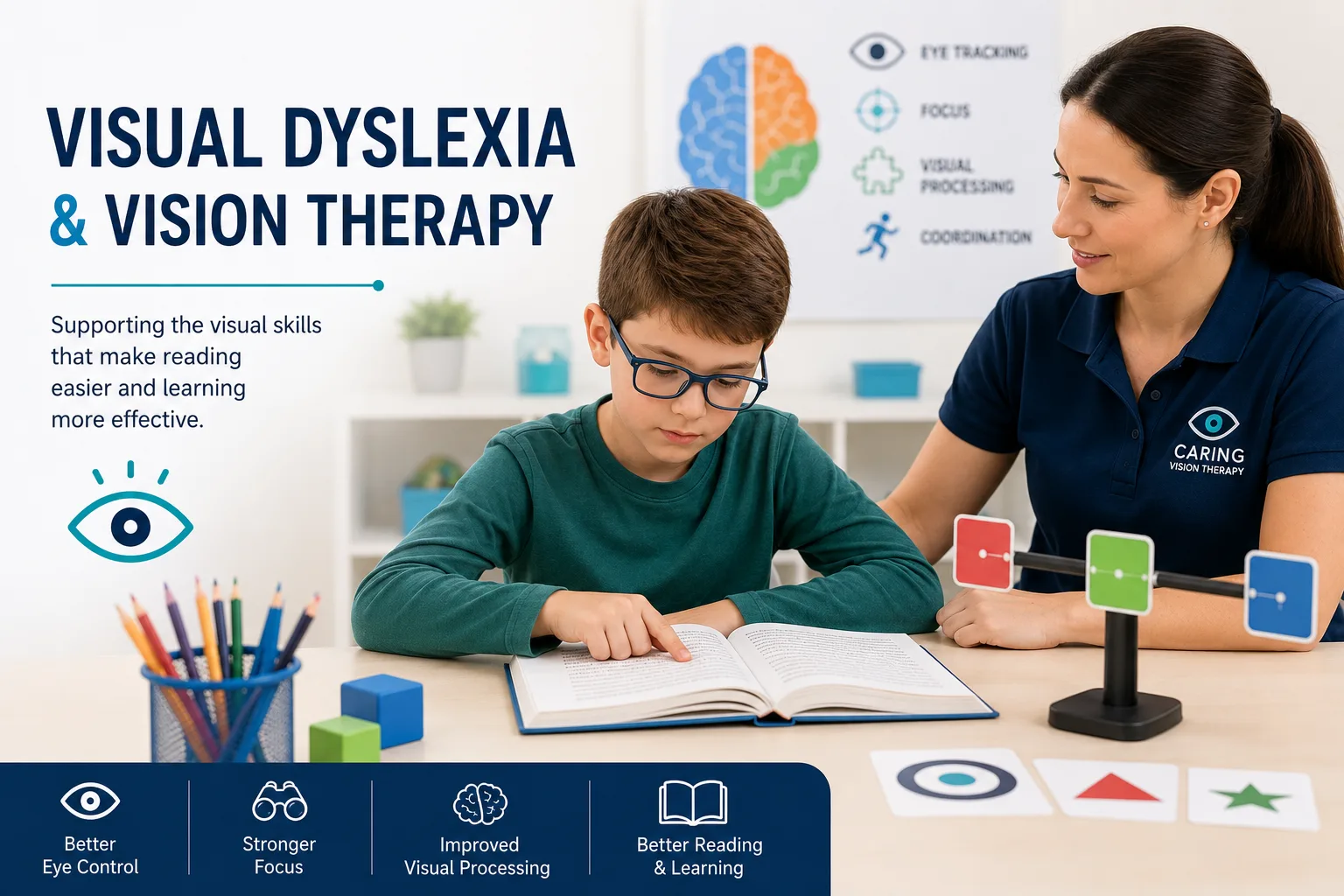
Vision therapy should never be presented as a universal fix for academic difficulty, but it may be appropriate for specific, clinically identified visual problems in selected children, targeting convergence, binocular coordination, accommodation, eye movements or visual-motor skills specifically. If a child has dyslexia, language difficulties, ADHD, an intellectual disability or another learning challenge, those conditions need their own dedicated assessment and management alongside, not instead of, any visual support.
Looking at the Whole Child
If a child struggles at school, it is tempting to search for one single explanation. Learning is genuinely complex, and difficulty can stem from vision, hearing, language, attention, memory, motor development, emotional factors, sleep, learning differences, or the classroom environment itself - sometimes several at once. The point of a good assessment is never to label a child; it is to understand what is actually making learning harder, and what support would genuinely help.
Supporting Healthy Visual Development at Home
Parents can support visual development through everyday, age-appropriate activities: regular reading in a comfortable setting, drawing and colouring for visual-motor coordination, puzzles for visual discrimination and spatial reasoning, age-appropriate ball games for tracking, depth perception and eye-hand coordination, building and construction play for spatial awareness, outdoor play for using vision across varied distances, and simply making sure a child gets adequate rest and breaks during visually demanding tasks.
What About Screen Time?
The goal is not necessarily to eliminate screens but to build healthy visual habits around them - a comfortable viewing distance, appropriate brightness, good posture, regular breaks, adequate room lighting, and minimal glare. If a child develops persistent headaches, blurred vision, double vision, or significant discomfort during screen use, that is worth a proper assessment rather than being written off as normal screen fatigue.
A Child's Vision Is More Than an Eye Chart
When a child walks into a classroom, their visual system is doing an enormous amount of continuous, often invisible work - finding, focusing, aiming, tracking, shifting, remembering, interpreting and responding, over and over, all day. When the system works efficiently, most of this happens automatically. When one or more of these 17 skills is inefficient, ordinary schoolwork becomes unnecessarily demanding.
Not every child will struggle with these skills, and difficulty with one does not automatically mean a learning disorder is present. But when a child repeatedly struggles with reading, writing, copying, visual attention or classroom tasks generally, it is worth asking a simple question: could vision be contributing? At Caring Vision, we look at children's vision in the context of their real, everyday classroom lives, not only by how many letters they can read off a chart, because school readiness is ultimately about being able to look, focus, coordinate, process, understand and respond. Book a school readiness vision assessment at Caring Vision Therapy to find out whether your child has the visual foundations they need.
Explore More at Caring Vision Therapy
Frequently Asked Questions
Is 20/20 vision enough for school readiness?
No. 20/20 vision is an important measure of visual clarity, but school activities also require focusing, binocular vision, eye movements, visual attention, spatial skills, visual processing and visual-motor abilities.
What visual skills does a child need for reading?
Reading uses several visual skills, including visual acuity, focusing, convergence, binocular coordination, fixation, saccades, visual attention and visual processing.
Can a child have normal eyesight but struggle with reading?
Yes. A child can have normal visual acuity but have difficulties with other aspects of functional vision. Reading difficulties can also have non-visual causes, so comprehensive assessment is important.
What are signs of visual problems in school children?
Possible signs include headaches after reading, eye strain, reading avoidance, losing place, skipping lines, rereading, difficulty copying from the board, blurred or double vision and reduced visual stamina.
Why are eye movements important for reading?
Reading requires accurate eye movements, particularly saccades and fixation. Efficient eye movements help the eyes move through text in an organised manner.
What is visual-motor integration?
Visual-motor integration is the ability to use visual information to guide hand movements. It is important for handwriting, drawing, copying and many classroom activities.
Does every child need a school readiness vision assessment?
Not necessarily. However, an assessment may be useful when a child is entering school or when there are concerns about reading, visual attention, handwriting, copying or other visually demanding activities.
Can vision therapy help children with learning difficulties?
Vision therapy may be appropriate for selected children who have specific, clinically identified visual problems. It should not be considered a universal treatment for learning disabilities or academic difficulties.