10 signs your child needs a vision therapy evaluation: headaches, losing place while reading, covering one eye, poor grades despite effort.
Book a ConsultationWhat Are the Signs Your Child Needs Vision Therapy?
10 signs your child needs a vision therapy evaluation: headaches, losing place while reading, covering one eye, poor grades despite effort.
The most important thing to understand about children's vision problems is this: a standard eye test at school or at the optician checks one thing - whether your child can see clearly at a distance. It does not check whether their eyes work together properly, whether they can sustain focus during reading, or how efficiently their brain processes visual information.
So a child can pass the eye chart test with flying colours and still have a significant functional vision problem that is making school genuinely hard. We see this regularly in our clinic. The parents are bewildered because they were told their child's eyesight is fine. But there is a real difference between eyesight (clarity) and vision (how the visual system functions as a whole).
Here are ten signs worth taking seriously.
1. Headaches After Reading or Schoolwork
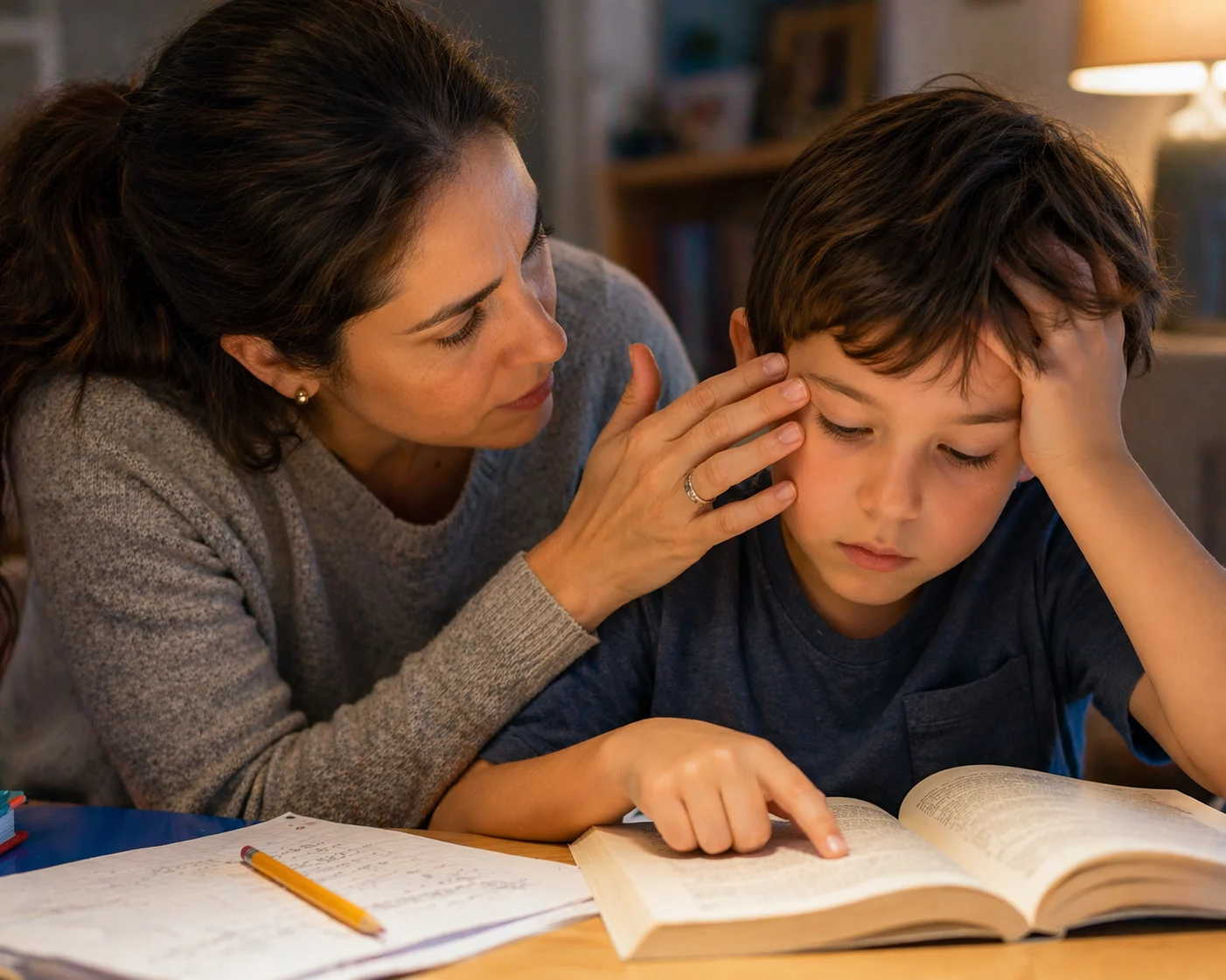
Frontal or behind-the-eyes headaches that appear during or after near tasks are a classic sign of a focusing or binocular vision problem. Many children just assume this is normal and stop mentioning it. Ask specifically - do not wait for them to bring it up.
2. Losing Place or Skipping Lines While Reading
If your child frequently loses their place, re-reads the same line, or uses their finger to track text even after learning to read fluently, their eye movements may not be accurate enough to support reading efficiently. This is a very common and very treatable problem.
3. Covering or Closing One Eye
Children rarely do this for no reason. When both eyes cannot work comfortably together, closing one eye removes the conflict. It is a reliable indicator of a binocular vision problem and worth investigating properly.
4. Avoids Reading or Homework
Children who find reading physically uncomfortable will avoid it. They will not always say it hurts - they may just seem disinterested, easily distracted, or frustrated. Before assuming it is attitude or attention, consider whether reading is genuinely uncomfortable for them.
5. Complains That Words Blur or Move on the Page
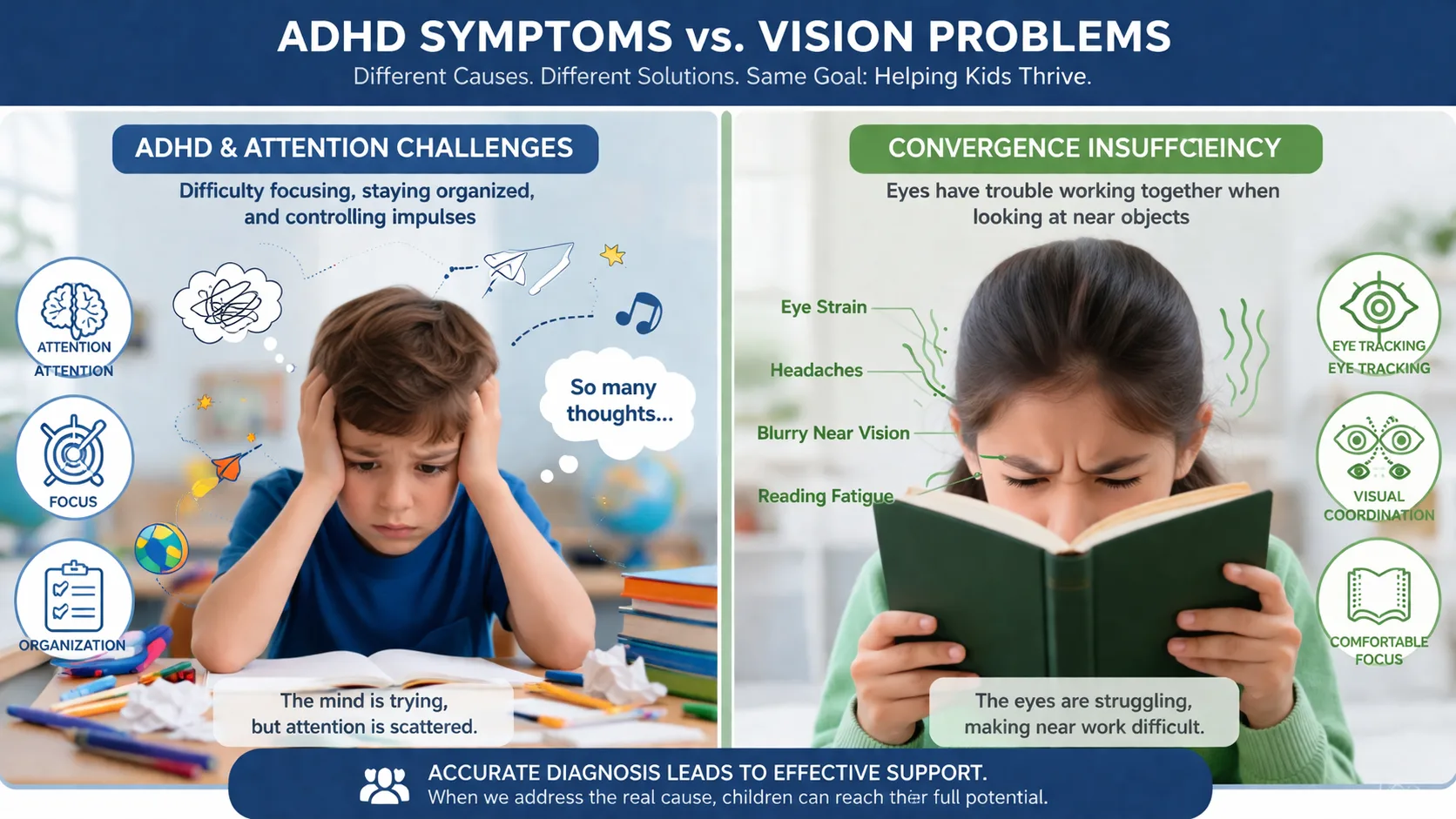
Words that float, blur after a few sentences, or seem to jump around are strong signs of a focusing problem (accommodative dysfunction) or convergence insufficiency. These are functional conditions that do not show up on a standard refraction test.
6. Short Attention Span Only for Near Tasks
This is a pattern worth noticing. If your child can focus for hours on physical play, screens, or conversations but falls apart after five minutes of reading or writing, the problem is often visual, not attentional. Vision fatigue during near work is real and exhausting, and it looks very similar to ADHD from the outside.
7. Holds Reading Material Very Close or Very Far Away
Unusual reading distance is often a compensatory behaviour. A child holding a book very close may be trying to make the text larger to compensate for poor acuity in one eye, or they may be trying to reduce the demand on their focusing system. Both are worth exploring.
8. Poor Handwriting or Difficulty Copying from the Board
Copying from the board requires the eyes to shift focus between far and near repeatedly. If that shift is slow or inaccurate, the child loses context, makes copying errors, or takes much longer than peers. Poor handwriting that does not improve with practice can also point to visual-motor integration difficulties.
9. Gets Tired Quickly During Visual Tasks
Visual fatigue that comes on quickly - not after hours but after 15-20 minutes of reading or close work - suggests the visual system is working much harder than it should. Healthy binocular vision should be comfortable and sustainable. If your child routinely wants to stop after a short time, something is making vision effortful.
10. Passed the Eye Test but Still Struggles
This is possibly the most important sign on the list. If your child has been assessed by an optician, told their vision is fine, and yet is still struggling academically or complaining of visual discomfort, please do not accept that as a final answer. A standard eye test is not a functional vision evaluation. The two things are different, and one cannot substitute for the other.
What Happens at a Functional Vision Evaluation?
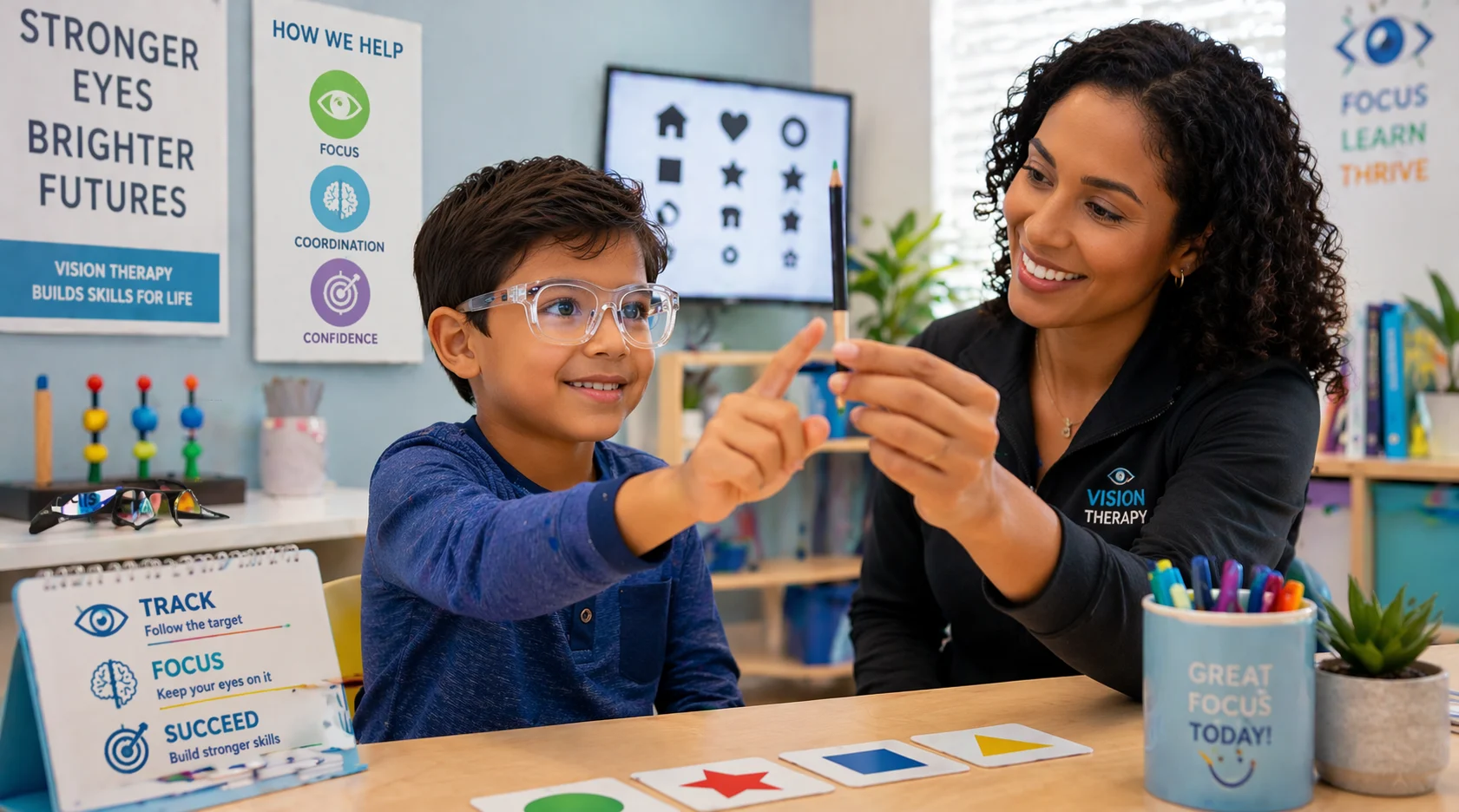
A full functional vision evaluation takes 60-90 minutes and tests things a standard exam does not: eye teaming at near and far, vergence ranges, accommodative flexibility and stamina, eye tracking precision, and visual processing. It gives a complete picture of how the visual system actually performs under real-world demands.
If your child shows several of the signs above, the next step is a proper evaluation - not just another trip to the optician for an eye chart check.
Browse the full list of symptoms we assess or book a functional vision evaluation for your child at our Chennai or Hyderabad clinic.