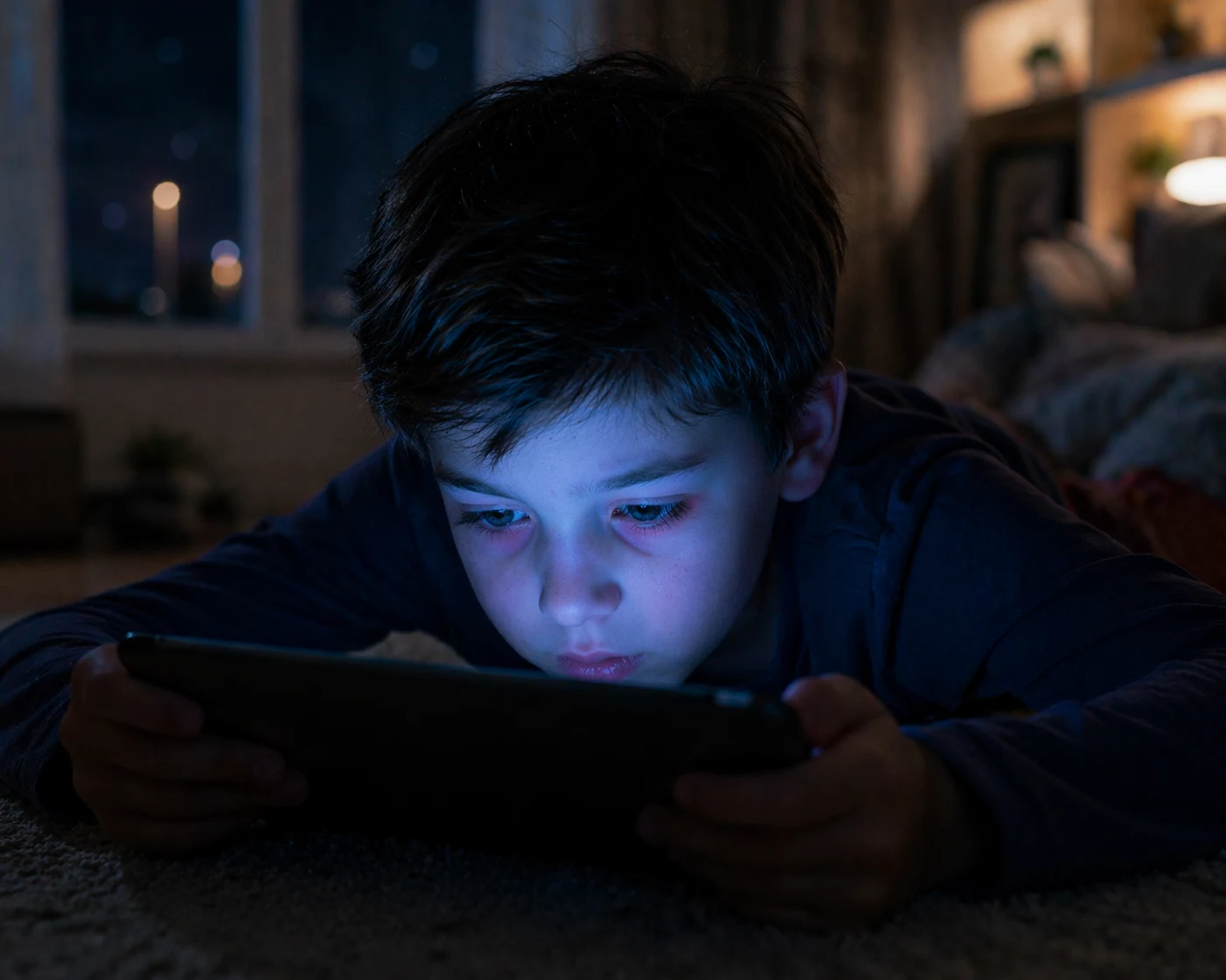
Screen time and children's eye health: how excessive device use affects myopia, eye teaming, and visual development. Evidence-based advice from vision therapy specialists in Chennai.
Book a ConsultationWhat Does Screen Time Really Do to Children's Vision?
Screen time and children's eye health: how excessive device use affects myopia, eye teaming, and visual development. Evidence-based advice from vision therapy specialists in Chennai.
Related Resources
- Learn more about convergence insufficiency treatment - the most common binocular vision condition in children
- Explore lazy eye (amblyopia) treatment for kids and adults - evidence-based vision therapy options
- Vision therapy in Chennai - our in-clinic specialist services
- Check all vision symptoms in children - 80+ signs of binocular vision dysfunction
- Book a comprehensive vision evaluation - Chennai, Hyderabad & global telehealth
Every parent today is navigating the same tension: screens are everywhere, children need them for school, and yet there is a growing sense that something is not quite right with how much time young eyes are spending on devices. The concern is valid. But it is also worth separating what the research actually supports from what is just general anxiety about technology.
Here is what we know, what it means practically, and what you can actually do about it.
What Screen Time Does to a Developing Visual System
The Myopia Epidemic Is Real
Myopia (short-sightedness) is one of the fastest-growing health concerns globally. In parts of East Asia, myopia rates in young adults have reached 80-90%. In India, we are seeing a sharp rise in childhood myopia in urban centres, including Chennai. Screen time is a contributing factor, but the research suggests the more powerful driver is reduced time outdoors and a shift toward sustained near work.
Natural outdoor light appears to play a protective role in healthy eye growth. Children who spend at least 1-2 hours outdoors each day have significantly lower rates of myopia progression. It is not just about the absence of screens - it is about the absence of distance viewing and natural daylight.
Near Work and Convergence Strain
Every time the eyes focus on a near target, they must converge (turn inward) and accommodate (change focus). Doing this for hours on end, especially on small screens held close, places significant demand on the eye teaming system. Over time, this can create or worsen convergence insufficiency - a condition where the eyes struggle to maintain accurate alignment during near tasks.
Convergence insufficiency from prolonged near work is something we see increasingly in school-age children. The symptoms - headaches, eyestrain, words blurring or doubling after a few minutes of reading - are often misattributed to stress or needing glasses, when the real cause is a binocular vision problem brought on or aggravated by excessive near demand.
Reduced Blink Rate and Dry Eyes
The average blink rate drops by roughly 60% during screen use. Blinking is what spreads the tear film across the eye surface and keeps it lubricated. When children stare at screens for extended periods with reduced blinking, they often develop dry, irritated, gritty-feeling eyes. This is not dangerous by itself but it contributes to visual fatigue and discomfort that makes all visual tasks harder.
Disrupted Sleep and Circadian Rhythm
Blue light from screens in the evening suppresses melatonin production and delays sleep onset. Poor sleep has a knock-on effect on everything including visual performance, attention, and learning the next day. This is less a vision problem directly and more a whole-system problem, but it is worth mentioning because the cumulative effect of poor sleep on a child's ability to concentrate during visual tasks is significant.
What the Research Does Not Fully Support
A few things worth noting to keep the picture balanced:
- There is no strong evidence that screen time directly causes permanent structural damage to the eyes in typical usage scenarios.
- The link between screen time and myopia is real but indirect - it is mediated largely by reduced outdoor time and increased near work, not by screens specifically.
- Not every child will develop problems from screen use. Children with already compromised binocular vision or focusing systems are more vulnerable.
Practical Steps That Are Actually Evidence-Based
The 20-20-20 Rule
Every 20 minutes of near work, look at something at least 20 feet away for 20 seconds. This gives the convergence and focusing system a brief rest and reduces cumulative strain. It is simple, free, and backed by solid reasoning if not perfectly controlled trials. We recommend it to every patient.
At Least 1-2 Hours of Outdoor Time Daily
This is probably the single most evidence-backed intervention for myopia prevention. Getting children outside - even just playing in the garden or walking to school - appears to provide meaningful protection. The exact mechanism is still being studied, but the association is consistent across multiple large studies.
Screen Distance and Posture
Screens should be held at a proper distance - at least 30-40 cm for phones and tablets, and further for monitors. Slouching and holding devices very close adds to both visual and postural strain. Worth building as a habit early.
No Screens in the Final Hour Before Bed
Straightforward and genuinely useful for sleep quality and by extension for everything that depends on adequate sleep.
Get a Functional Vision Evaluation If Symptoms Appear
If your child is complaining of headaches, blurred vision, or fatigue during near work, do not assume it is just too much screen time and leave it there. These are also the symptoms of a functional binocular vision problem, and the appropriate response is a proper evaluation to find out which it is. Telling a child with convergence insufficiency to simply use screens less does not fix the underlying visual system problem.
The Bottom Line
Screens are part of modern childhood. Completely eliminating them is neither realistic nor necessary. The goal is making sure your child's visual system is equipped to handle the demands being placed on it - and catching any developing problems early enough to address them properly.
If you have noticed any of the signs of visual strain in your child, a functional vision evaluation is the right starting point. It takes about 90 minutes and gives you a complete picture of how their visual system is coping.
Check the symptoms to look out for or book an evaluation at our Chennai or Hyderabad clinic.
Explore More at Caring Vision Therapy
- Vision therapy clinic in Chennai - in-clinic specialist appointments, evaluation process & location
- All vision therapy and neuro-optometric treatments - full list of conditions we treat for children & adults
- Convergence insufficiency treatment - the leading cause of reading difficulties in children
- Vision symptom checker for children - 80+ symptoms that may indicate a binocular vision problem
- Book a comprehensive functional vision evaluation - Chennai, Hyderabad & global telehealth available