Eye coordination exercises for kids: a parent guide to supporting visual development at home, and when professional therapy is needed.
Book a ConsultationWhat Are the Best Eye Coordination Exercises for Children?
Eye coordination exercises for kids: a parent guide to supporting visual development at home, and when professional therapy is needed.
As a parent, you may notice your child squinting, losing their place while reading, or complaining of tired eyes - and wonder whether there is anything you can do at home to help. The answer is: yes, to a point. Some simple activities can support healthy visual development. But it is equally important to know when home exercises are not enough and professional vision therapy is needed.
This guide explains what eye coordination is, why it matters for reading and learning, which activities support it at home, and the signs that indicate a clinical evaluation is needed.
What Is Eye Coordination and Why Does It Matter?
Eye coordination - also called binocular vision or eye teaming - is the ability of both eyes to work together as a precise, synchronised pair. When you read, your eyes must converge (turn inward) to the near distance of the page, track smoothly from word to word, and maintain a single clear image even as your eyes move across text and your head position changes.
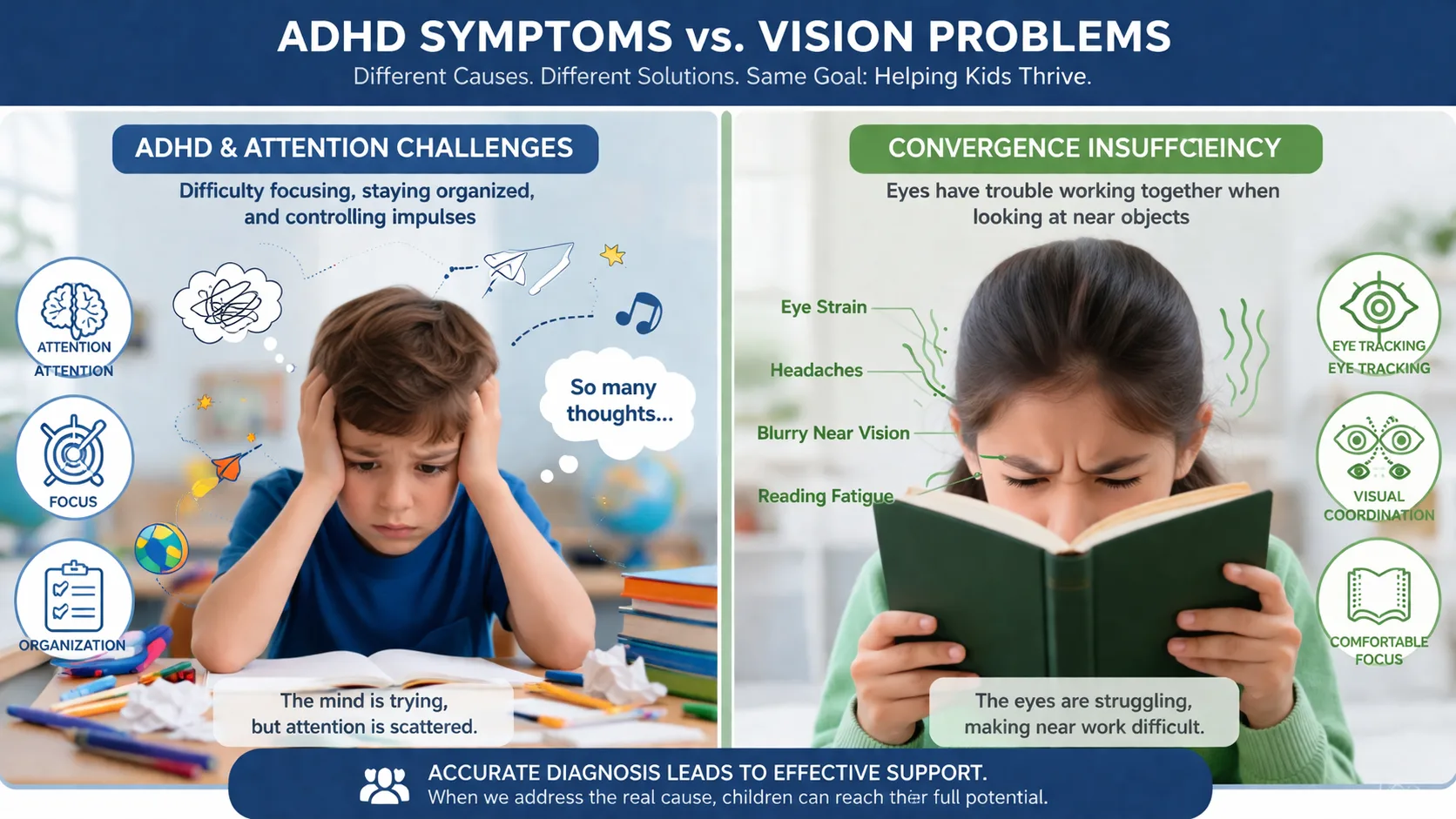
When eye coordination breaks down - as in convergence insufficiency - the visual effort required to maintain this coordination becomes exhausting. Reading feels like work. Children avoid it, lose their place, re-read lines, or simply give up after a short time.
Home Activities That Support Eye Coordination Development
1. Pencil Push-Ups (Near-Point Convergence Practice)
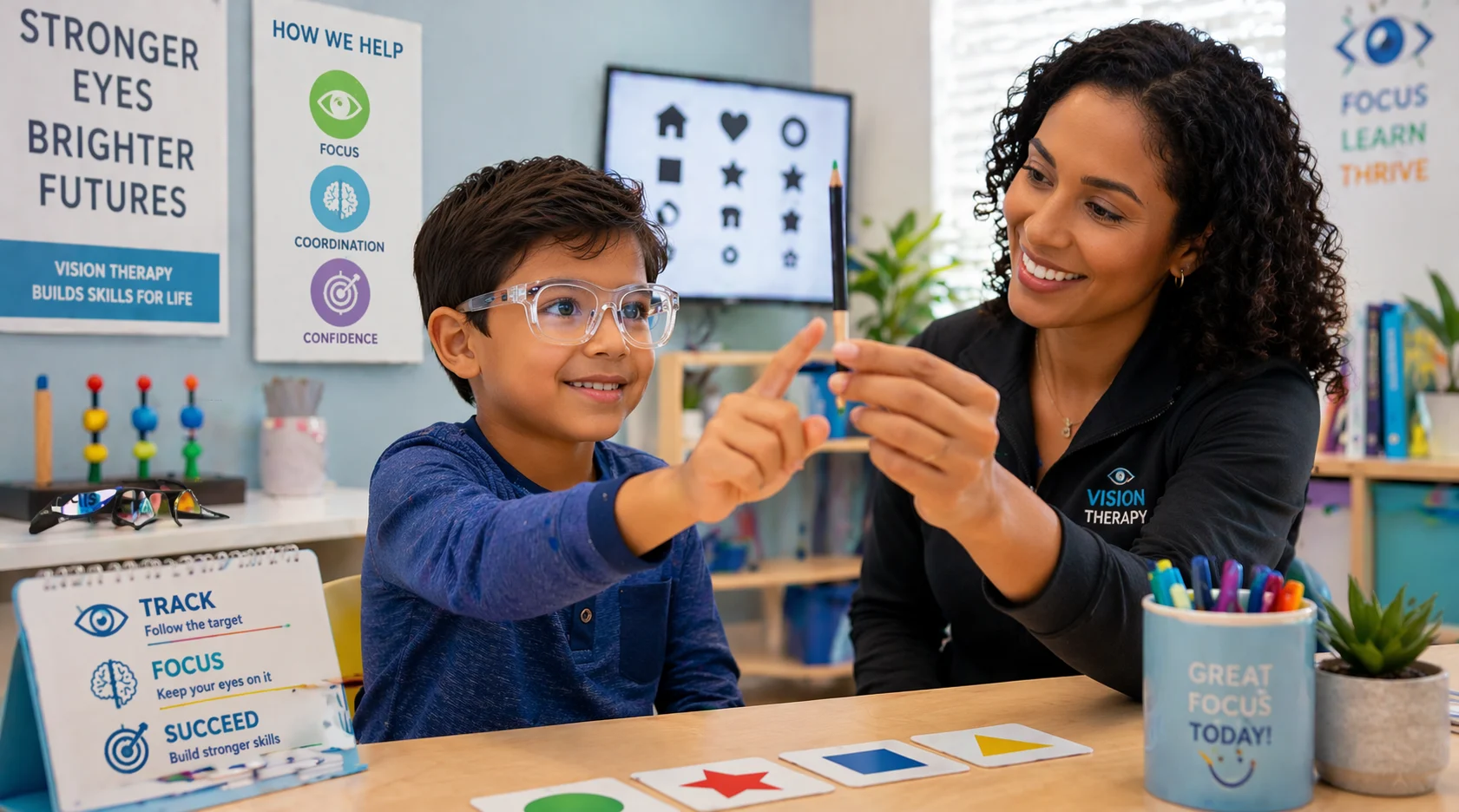
Hold a pencil at arm's length, pointing the eraser toward your child's nose. Slowly move the pencil toward the nose while your child keeps both eyes on the tip. When they see double, that is the break point. Hold for 5 seconds, then move it back out. Repeat 5–10 times per session, twice daily.
This trains the convergence system - the ability to turn both eyes inward for near tasks like reading. It is one of the most studied home activities for convergence insufficiency, though it is most effective as a supplement to in-office therapy.
2. Smooth Pursuit Tracking
Hold a small target (sticker on a pencil, finger, or small toy) at arm's length. Move it slowly in a wide figure-eight pattern or large circle while your child follows it with their eyes only - not by moving their head. Start with large, slow movements and reduce the size as their tracking improves. Do this for 1–2 minutes per session.
This develops smooth pursuit eye movements - the type of tracking needed to follow a line of text across a page without losing your place.
3. Jumping Between Targets (Saccadic Eye Movements)
Place two small stickers on opposite sides of the room at eye level. Have your child look rapidly from one to the other on your command, keeping their head still. Practise in sets of 10–15 jumps. This can also be done with two stickers on a page held at reading distance - closer targets require more precise binocular control.
Saccadic movements are the fast jumps the eyes make when moving from word to word while reading. Poor saccadic accuracy causes skipping of words and lines.
4. Brock String
A Brock string is a simple, inexpensive therapy tool - a long string with three coloured beads that attaches to a fixed point (wall or doorknob). Your child holds the other end to their nose and focuses on each bead in turn. When focused on the middle bead, they should see the string appear to form an X at that bead, with one string appearing to come from the left and one from the right.
The Brock string provides clear biofeedback on whether both eyes are working together - if the X is not visible, or appears only partially, one eye is suppressing. It is widely used in clinical vision therapy and is a genuinely useful home supplement.
5. Outdoor Play and Ball Skills
Do not underestimate the value of unstructured outdoor play. Catching a ball requires the visual system to rapidly track a moving object, judge its speed and trajectory, and co-ordinate a physical response. Ball games, especially those with small, fast-moving objects, provide excellent natural training for dynamic visual tracking and visual-motor integration.
Important Limitations of Home Activities
Home activities can support healthy visual development and are a useful supplement to clinical care. They are not a substitute for professional vision therapy when a clinical problem is present.
Structured vision therapy in a clinical setting provides:
- Precise diagnostic testing to identify the exact nature and severity of the problem
- Clinician-guided progression through graded activities that home exercises cannot replicate
- Biofeedback instruments that provide real-time objective data on visual performance
- Objective progress monitoring to confirm improvement and guide treatment adjustments
When to Seek a Professional Evaluation
If your child shows any of the following, home activities are unlikely to be sufficient and a full functional vision evaluation is recommended:
- Persistent headaches during or after reading or near work
- Frequent loss of place when reading, skipping lines or words
- Complaints of double or blurred vision during reading
- Closing or covering one eye to see clearly
- Avoidance of reading or written tasks
- Academic performance significantly below their apparent ability
- Diagnosis of lazy eye, squint, or convergence insufficiency
The Bottom Line
Eye coordination activities at home - pencil push-ups, tracking exercises, Brock string practice - can be a useful way to support your child's visual development and supplement clinical care. But they cannot replace a proper evaluation or structured vision therapy when a clinical problem exists.
If you are uncertain whether your child has a vision problem affecting their reading and learning, the most useful step is a full functional vision evaluation. It takes about 90 minutes and gives you clear, objective answers.
Check the common symptoms of vision problems in children or book a functional vision evaluation at our Chennai clinic. You can also learn more about convergence insufficiency treatment - one of the most common and treatable causes of reading-related visual problems in children.