Adults With Amblyopia

Lazy Eye Treatment
for Adults

For decades, adults were told a lazy eye could only be treated in childhood. That is no longer the whole story. The adult brain can still learn to use the weaker eye, and the evidence now shows what is realistic and what is not.

Quick Answer

Can lazy eye be treated in adults?

Yes, in many cases. Binocular (dichoptic) therapy and structured vision therapy train the brain to stop switching off the weaker eye. Adults in published studies commonly gain one to three lines on the eye chart, often with better depth perception. Gains are usually smaller and slower than in young children, and the glasses must be up to date first.

Typical gain
1 to 3 lines on the eye chart
Programme length
24 to 40 weeks
Main approach
Binocular and dichoptic therapy
Patching alone
Rarely enough after the teens
Try It Yourself

Where Does Your Age Sit?

Slide to your age. The curve shows how adaptable the visual brain usually is, and the panel shows what treatment can realistically do.

32 years
0 7 12 18 30 45 60 Most adaptable

Babies and toddlers, 0 to 2

What to expect
The visual brain is wiring itself at its fastest. A lazy eye is hard to spot from outside, but it can develop quickly, especially if something blocks the view.
What usually helps
Urgent treatment of any cataract or droopy eyelid, glasses where needed, and closely supervised patching.
Typical result
Very responsive once the cause is removed.
Signs of lazy eye in babies

Young children, 3 to 7

What to expect
The best window. Most lazy eyes are found now, at a first eye test or a school screening.
What usually helps
Full-time glasses, then patching or atropine drops for a few hours a day, with binocular games from about four.
Typical result
Most children reach normal or near-normal vision.
Lazy eye treatment for kids

Older children, 8 to 12

What to expect
Still a good window, especially if the lazy eye has never been treated before.
What usually helps
Glasses and patching or drops, often for longer, with binocular therapy to build eye teaming.
Typical result
Many children gain several lines on the chart.
Eye patching for lazy eye

Teenagers, 13 to 17

What to expect
Less adaptable, and patching that was tried in childhood often helps less a second time.
What usually helps
Binocular and dichoptic therapy carry more of the programme, with up-to-date glasses.
Typical result
Often a line or more, and more if never treated.
Dichoptic therapy for amblyopia

Adults, 18 and over

What to expect
The visual brain still adapts, but it needs a stronger, better-targeted signal. Suppression is the main obstacle.
What usually helps
Binocular and dichoptic therapy with in-clinic vision therapy, after the glasses are brought up to date.
Typical result
Commonly one to three lines, often with better depth perception.
Lazy eye treatment for adults

The curve is a simplified illustration of published findings. Individual results vary with the cause, the severity and earlier treatment.

The Old Rule Was Wrong About Adults

The idea of a fixed cut-off came from early research on a critical period in visual development. It is true that the visual brain is most adaptable before about seven. It is not true that it stops adapting.

Adults with lazy eye are rarely held back by the eye itself, which is usually healthy. They are held back by suppression: the brain has learnt to ignore the weaker eye whenever both are open. Patching an adult forces the eye to work for an hour, and suppression returns the moment the patch comes off. The treatments that work in adults go after suppression directly, with both eyes open.
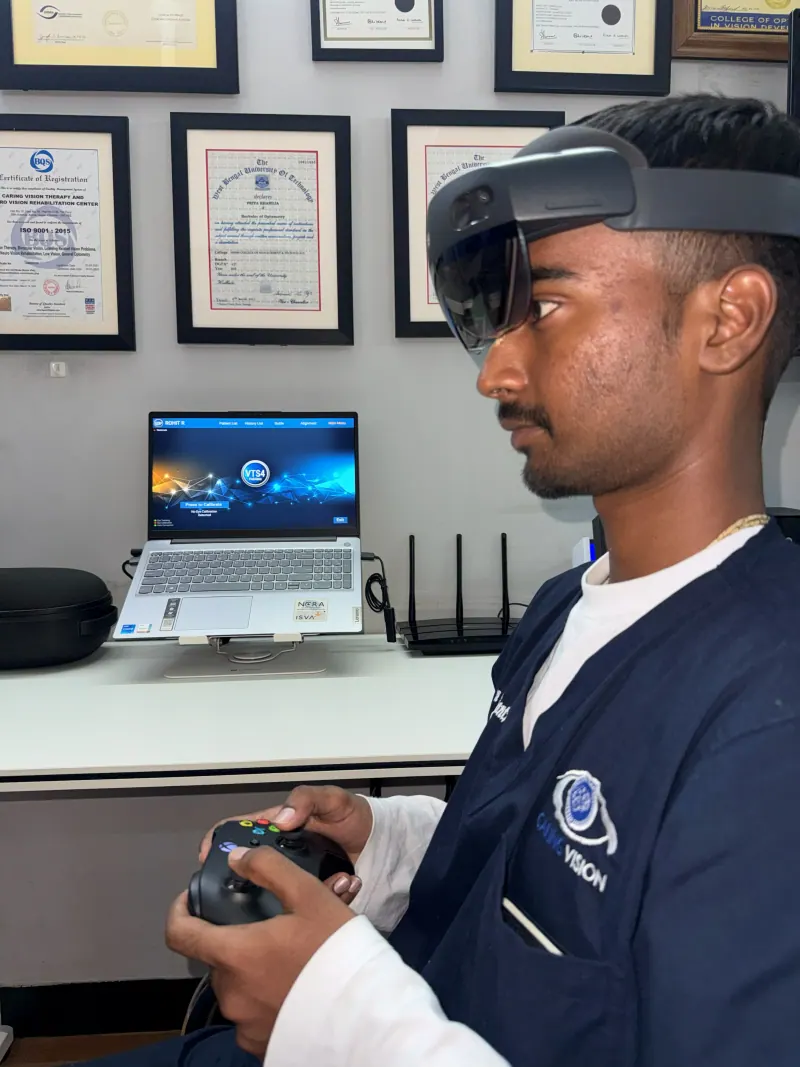
Adult patient using a virtual reality headset during binocular vision therapy for lazy eye
Binocular therapy in a VR headset shows each eye a different image, so the weaker eye has to contribute.

Realistic Results After 18

Results depend on the starting vision, the cause and whether there is a squint. As a guide from published studies, adults who complete a programme can expect:

  • Sharper vision in the weaker eye, most often by one to three lines
  • Better depth perception, which matters for driving, sport and fine work
  • Less eye strain as the two eyes start to work as a team
  • Smaller gains with a large constant squint or very deep suppression, which the assessment measures first

Told it was too late as a child? An adult assessment measures the suppression and shows what therapy can still change.

Try It Yourself

See the Gap Between Your Eyes

Pick the line the weaker eye can read. Then switch to both eyes open to see what suppression does.

6/24

Moderate lazy eye

Move the slider to compare the two eyes.

Stronger eye
Clear
Weaker eye
Blurred

With each eye tested on its own, the gap between them is what defines a lazy eye.

An illustration of blur and suppression, not a vision test. Only an eye examination can measure each eye.

How Adult Lazy Eye Treatment Works

Treatment starts with a full assessment: the vision in each eye with the best possible glasses, a check for squint, and tests of suppression and depth perception. Old prescriptions are often out of date, and correcting them can add a line on its own.

The core of the programme is dichoptic therapy, in which each eye sees a different part of a game or video so that both must contribute, alongside in-clinic binocular vision therapy for eye teaming and depth. Most adult programmes run 24 to 40 weeks, with formal re-measurement every eight weeks.

Our clinic programme is described on the adult lazy eye treatment in Chennai page. Adults elsewhere in India can start with an online consultation and, where suitable, a monitored home vision therapy programme.

Try It Yourself

True or Not?

Six things adults are told about lazy eye. Tap your answer to see what the evidence says.

  1. A lazy eye can only be treated before the age of seven.

    Not true. Younger is easier, but older children, teenagers and adults can all still improve with the right treatment.

  2. A lazy eye means the eye itself is damaged.

    Not true. The eye is usually healthy. The problem is in how the brain uses it, which is why the brain is what treatment trains.

  3. A child can have a lazy eye with perfectly straight eyes.

    True. A large difference in prescription between the eyes causes lazy eye with no visible sign at all.

  4. Squint surgery cures a lazy eye.

    Not true. Surgery straightens a turned eye. It does not improve the vision in it; that still needs lazy eye treatment.

  5. Two hours of patching a day can work as well as six.

    True. For moderate lazy eye, large trials found two hours a day as effective as six.

  6. Once the vision improves, treatment can stop straight away.

    Not true. Stopping suddenly lets vision slip back in about one child in four. Treatment is tapered and reviewed.

Answers reflect current published evidence.

Common Questions

Questions Families Ask

Is 30 too old for lazy eye treatment?
No. There is no fixed age after which the visual brain stops responding. Adults in their twenties, thirties and beyond have improved with binocular therapy. Results are usually more modest than in children, so an assessment first tells you whether the likely gain is worth the time.
Can lazy eye be fixed in adults without surgery?
Lazy eye is never treated with surgery; surgery only straightens a turned eye. Vision in the weaker eye is improved with up-to-date glasses and binocular or dichoptic therapy.
Does patching work for adults with lazy eye?
Patching alone rarely helps much after the late teens, because suppression returns as soon as the patch comes off. It is sometimes used for short periods alongside binocular therapy.
How long does adult amblyopia treatment take?
Most programmes run 24 to 40 weeks, with a re-measurement every eight weeks. Many adults notice a change within the first two to three months.
Will the improvement last?
Gains made with binocular therapy have held up well in follow-up studies, particularly when depth perception has improved. A short maintenance routine and a review at six months help protect them.
Can adult lazy eye treatment improve depth perception?
Often, yes. Because binocular therapy trains the two eyes together, adults frequently gain some stereo vision, which patching on its own does not train. People who have never had depth perception may gain only coarse 3D vision.

Find Out What Your Weaker Eye Can Still Gain

A lazy eye assessment measures the vision in each eye, checks for a squint and for suppression, and sets out a written plan. In clinic in Chennai and Hyderabad, with online consultations across India.

Vision Simulator