Lazy Eye Exercises
That Actually Help
Exercises on their own do not cure a lazy eye. The right activities, done while the stronger eye is patched or as part of a binocular programme, make treatment time count. Build a session for your child below.
Do lazy eye exercises work?
Lazy eye exercises work as part of treatment, not instead of it. Close-up activities done with the stronger eye patched keep the weaker eye busy and make patching easier to accept. Binocular games, in which each eye sees a different part of the screen, can improve vision and teamwork. Eye rolling or focusing drills on their own do not treat lazy eye.
- On their own
- Not a cure
- Best used
- During patching or binocular therapy
- Session length
- 15 to 30 minutes
- Most useful
- Close, detailed tasks
Build a Home Activity Session
Choose an age, the time you have and whether the patch is on. Then start the timer and work through each step.
- 2 minGet setGlasses on, patch on the stronger eye, good light.
- 5 minDot-to-dotJoin small numbered dots; pick a sheet with dots close together.
- 4 minMazesTrace the path with a pencil without touching the walls.
- 3 minSpot the differenceFind the small changes between two pictures.
- 1 minRestLook across the room or out of a window.
These activities make prescribed treatment time productive. They are not a treatment for lazy eye on their own.
Three Kinds of Exercise, Three Different Results
Activities with the stronger eye patched. Dot-to-dot, mazes, threading beads, colouring inside the lines, building blocks and small-print word searches give the weaker eye detailed work. They are less a treatment in themselves than a way to make patching hours productive and less boring.
Binocular and dichoptic games. Both eyes stay open, using red-blue glasses, a VR headset or a special screen, and each eye sees part of the game. These target suppression directly and train depth perception. They are prescribed and monitored as part of dichoptic therapy.
General eye exercises. Eye rolling, palming and near-far focusing drills are sometimes sold as lazy eye cures. They do not improve vision in an amblyopic eye. Eye-teaming exercises such as the Brock string help binocular vision problems, not the lazy eye itself.
What Supervised Exercises Look Like
In a vision therapy programme, home activities are matched to what the clinic is working on that week. In-clinic sessions use equipment that home cannot copy: stereoscopes, fusion cards, synoptophores and VR binocular programmes that are adjusted as the weaker eye improves.
For general activities that support eye teaming and focusing, see eye exercises for kids at home and our article on effective eye exercises for kids. Families outside Chennai and Hyderabad can follow a monitored programme through home vision therapy.
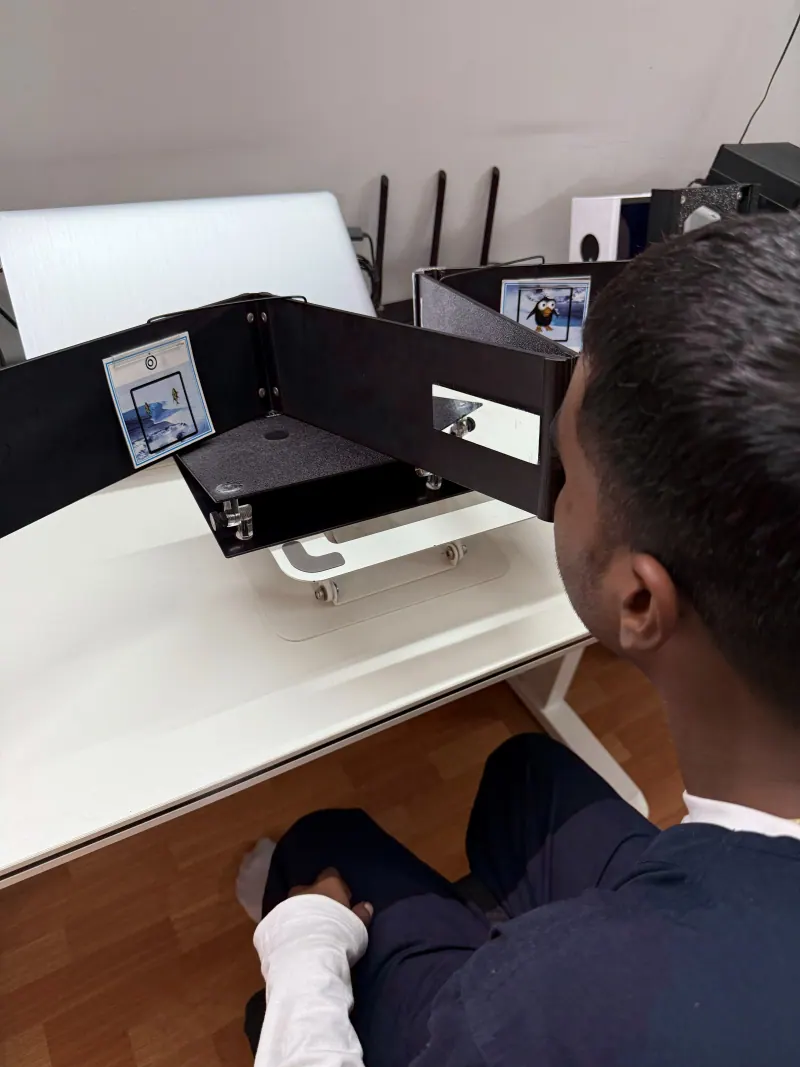
Want a home programme matched to your child's eye? An assessment sets the right activities, level and hours.
Choosing Activities by Age
The best activity is one your child will happily do every day. Match the size of the detail to the vision in the weaker eye: tasks that are too hard lead to frustration and peeking.
- Ages 3 to 5: stickers, large-piece puzzles, threading big beads, colouring simple shapes
- Ages 6 to 9: dot-to-dot, mazes, building blocks, spot the difference, simple tablet games
- Ages 10 to 14: word searches, model kits, drawing, handheld puzzle games, small print
- Adults: prescribed binocular programmes, fine detail work, reading with the stronger eye covered when advised
True or Not?
Six common claims about lazy eye. Tap your answer to see what the evidence says.
-
A lazy eye can only be treated before the age of seven.
Not true. Younger is easier, but older children, teenagers and adults can all still improve with the right treatment.
-
A lazy eye means the eye itself is damaged.
Not true. The eye is usually healthy. The problem is in how the brain uses it, which is why the brain is what treatment trains.
-
A child can have a lazy eye with perfectly straight eyes.
True. A large difference in prescription between the eyes causes lazy eye with no visible sign at all.
-
Squint surgery cures a lazy eye.
Not true. Surgery straightens a turned eye. It does not improve the vision in it; that still needs lazy eye treatment.
-
Two hours of patching a day can work as well as six.
True. For moderate lazy eye, large trials found two hours a day as effective as six.
-
Once the vision improves, treatment can stop straight away.
Not true. Stopping suddenly lets vision slip back in about one child in four. Treatment is tapered and reviewed.
Answers reflect current published evidence.
Everything We Have Written on Lazy Eye
Back to the overview: amblyopia (lazy eye) treatmentBy age
Treatments
Common questions
Parent Guides on This Topic
- Spotting lazy eye in a baby The age-by-age warning signs from newborn to three years, and why a school screening will not find them.
- Can lazy eye actually be cured? What the success rates look like by age, and why binocular therapy outperforms patching alone.
- Patching versus vision therapy Why amblyopia often returns after patching stops, and what treating the suppression instead involves.
- Lazy eye treatment, step by step Glasses, patching, drops and binocular therapy in the order they are used, with a tool to see which fit your child.
Questions Families Ask
Can lazy eye be cured with exercises alone?
What are the best lazy eye exercises for kids?
How long should lazy eye exercises take each day?
Do lazy eye apps and video games work?
Are there lazy eye exercises for adults?
Find Out How Much the Weaker Eye Can Gain
A lazy eye assessment measures the vision in each eye, checks for a squint and for suppression, and sets out a written plan. In clinic in Chennai and Hyderabad, with online consultations across India.