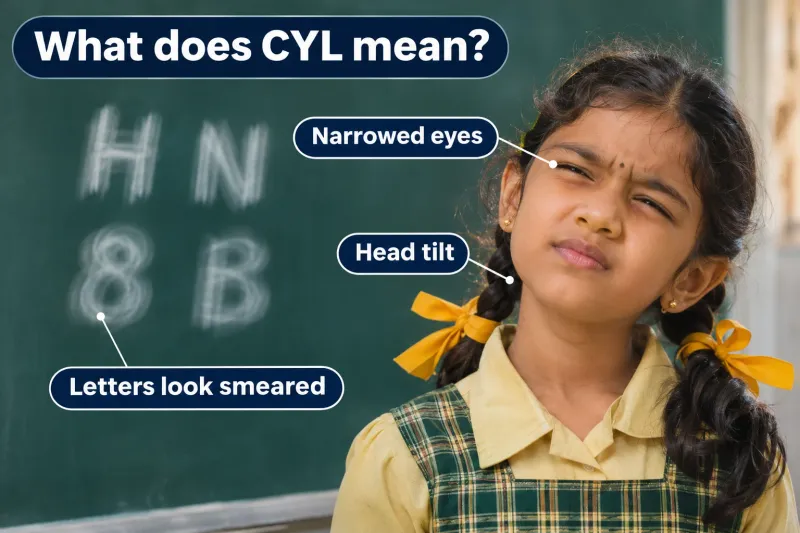
Cylindrical power in children explained: how to read CYL and AXIS, causes, whether it increases, when glasses are needed and why it matters for development.
What Does Cylindrical Power Mean in a Child?
Cylindrical power, written CYL on a prescription, corrects astigmatism. The front of the eye is curved more in one direction than the other, so lines in one direction look blurred. Babies often have more of it and it tends to reduce. In school children it often stays steady, so a quick rise should be checked.
You come home from the eye check with a slip of paper. Your child has a small minus number, which you sort of understand, and then two more columns called CYL and AXIS, which nobody explained. Then you see that the axis says 180 and wonder if that is very high.
It isn't. Let's go through what those numbers mean, why children have them, and the question nearly every parent asks: will it keep going up?
How to read your child's prescription
Take this example: SPH -1.00, CYL -0.75, AXIS 180.
- SPH (sphere) is the overall short-sight or long-sight power. Minus is for short sight, plus is for long sight.
- CYL (cylinder) is the extra correction for astigmatism. In this case it is 0.75. Higher numbers mean more astigmatism.
- AXIS is simply the angle at which the cylinder sits, from 1 to 180 degrees. It is a direction and not an amount, so 180 is not worse than 10.
Some clinics write cylinder as a plus number and some as a minus. The same correction can be written either way with different sphere and axis figures, so a slip from another shop can look different when it isn't. If you see a sudden jump in the numbers after changing clinics, ask them to compare them for you.
What cylindrical power actually is
A normal eye is curved at the front a bit like a football, equal in all directions. An eye with astigmatism is more like a rugby ball or the back of a spoon, steeper in one direction than the other. Light cannot come to a single sharp point, so some lines look clear and others look smeared.
That means a child with cylinder may read a plus sign with a sharp upright and a fuzzy crossbar. Letters like H and N, or 8 and B, may be hard to separate. Lights at night look like streaks. Short sight blurs things in the distance, while cylinder tends to blur at all distances.
Signs parents may notice
- Narrowing the eyes to see, even at close range
- Tilting the head to one side when reading or looking at the board
- Mixing up similar letters and numbers
- Headaches or tired eyes after reading
- Rubbing the eyes often
- Sitting close to the TV or holding a book near the face
Small amounts often cause no symptoms at all, and many children just assume that everyone sees this way.
What causes it? Is it there from birth?
In most children, cylinder comes from the natural shape of the cornea, and that shape is largely inherited. So yes, many have it from birth. Babies typically have steeper corneas and more astigmatism than older children. This reduces quickly in the early years as the eye grows, with eyelid pressure possibly playing a part. It is one reason why doctors are slower to give glasses for astigmatism in very young babies.
Reading, phones and watching TV have not been shown to create cylinder in the way that close work and lack of outdoor time are linked to short sight. It is not something your child did, or something you did or failed to do.
A few other things can cause or add to it:
- Frequent eye rubbing, often from eye allergy. Allergy of the eye is common in children living in hot, dusty places. Rubbing can change the shape of the cornea over time.
- A droopy eyelid or a lump on the lid, which presses on the cornea.
- An eye injury or eye surgery.
- Keratoconus, where the cornea slowly thins and bulges, usually starting in the teens.
Will the cylindrical power increase?
For many school-age children, it stays fairly steady or changes only a little. Small shifts of 0.25 or 0.50 between visits are common, and they can be just measurement differences, or the normal change in the eye as it grows. So one slip that shows a small change is nothing to panic about.
Look out for these:
- The cylinder keeps rising from one visit to the next
- The axis keeps changing
- New glasses never feel quite right
- Your teenager rubs their eyes a lot or has known eye allergy
Any of these should lead to a corneal map (topography) to check for keratoconus. It is much better found early, since there are treatments that can stabilise the cornea. Treating the allergy and stopping the rubbing is also worthwhile by itself.
If the minus power is also rising, that is a separate issue, usually from the eye growing longer. Our myopia management pages cover what can slow it down.
Does my child need to wear the glasses all the time?
There is no single rule, as it depends on the amount of cylinder, the child's age, and how they are getting on. A survey of paediatric ophthalmologists found that half would already prescribe at amounts below 4.00 in babies under 6 months, and below 2.00 by the age of 2. So doctors become readier to prescribe as a child gets older, once it has less chance of settling by itself.
A rough guide, for you to confirm with your own eye doctor:
- Very small amounts (around 0.50 or below) with no symptoms: glasses are often not needed.
- Moderate amounts, or any amount with symptoms: glasses are often advised, for school and reading at least.
- Around 1.50 or more in a young child, or a big difference between the eyes: full-time wear is commonly advised, because this is the level at which vision development becomes a concern.
When a child first wears a cylinder, the floor may seem to slope and things may look a bit tilted for a few days. This usually settles within a week or two. If it does not, have the glasses checked, because axis errors make a big difference. Well-fitted frames matter too, since a lens that sits crooked changes the axis.
Why it matters for vision development
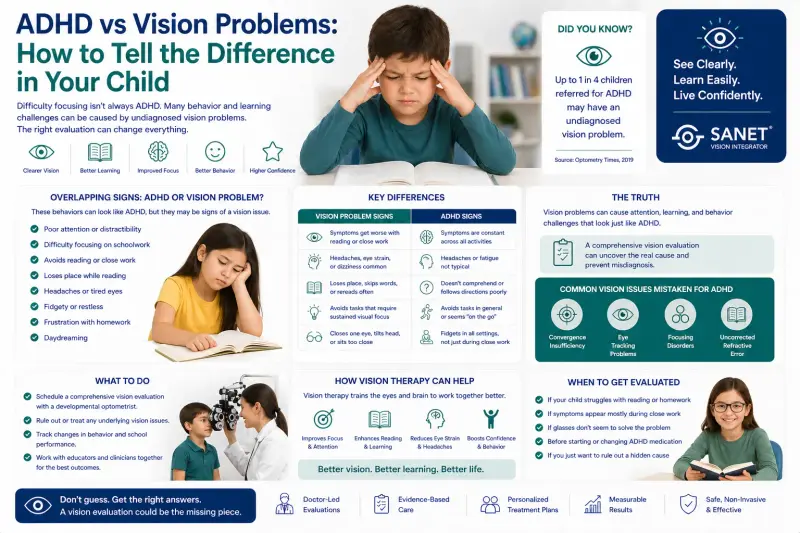
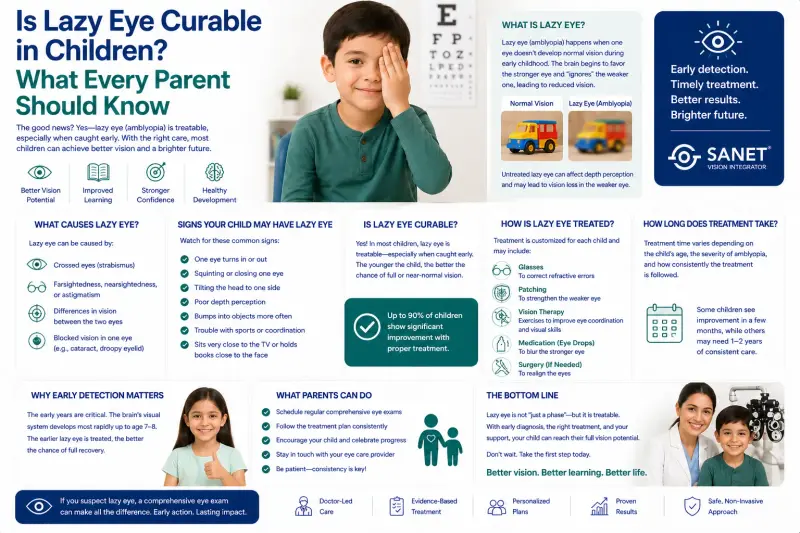
This is the part most parents have not been told. During the early years, the visual brain is wiring itself based on what it receives. If lines at one angle are always blurred, the brain does not get to practise seeing them sharply. Research shows that uncorrected astigmatism during this time can reduce the best vision a child can reach, even with glasses later on. It can also lead to meridional amblyopia, where vision stays weaker for lines in one particular direction.
Glasses work, and they work best if they are started early. Children in one study who were given glasses during preschool had better letter vision by kindergarten than those who were not. But their meridional amblyopia had not gone away, and reviewers note that optical treatment alone may not fully clear it. The best age for treatment has not yet been pinned down.
Beyond the eye chart, blur has a knock-on effect on early learning. A child who has trouble telling letters apart, or who has to narrow their eyes to see, has less attention left for what the letters mean. Drawing, copying and eye-hand work all rely on clear, stable vision.
How behavioural vision care helps, once the glasses are right
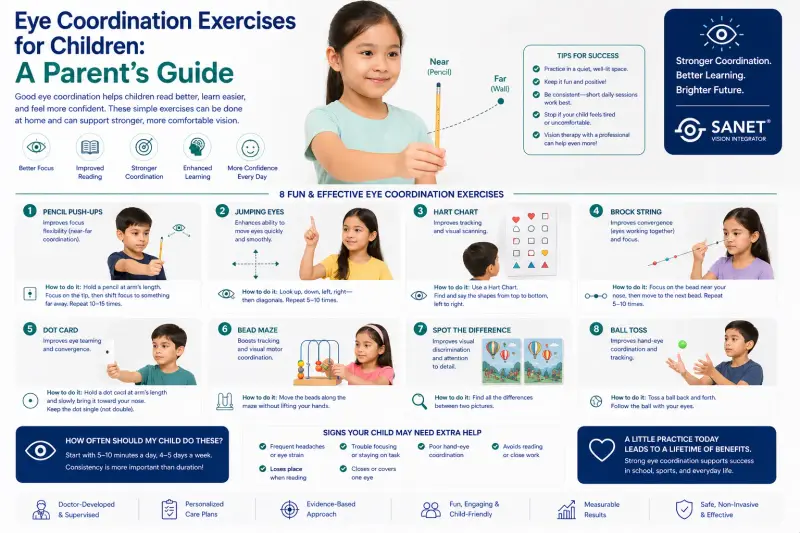
Glasses correct the blur. They do not automatically build the skills that may have lagged behind while the child was seeing poorly. Behavioural vision care looks at how the child uses their new clear vision:
- Do both eyes team and focus comfortably at reading distance?
- Can they track along a line without losing their place?
- Can they tell apart letters and shapes quickly, and copy them accurately?
- Has vision in one direction stayed weak despite good glasses?
If testing shows that these are weak, vision therapy can train them. The aim is functional vision that holds up across a school day. Therapy does not reduce the cylinder itself. No exercise, eye drop or diet can change the shape of the cornea, however the advert puts it.
Where a developmental and behavioural optometrist comes in
Most eye tests end when your child reads the chart. A developmental and behavioural optometrist carries on from there. They check the prescription carefully, usually with drops in younger children, and then look at how vision is developing for that child's age: focusing, eye teaming, eye movements and visual perception. They can follow the cylinder and axis over time, arrange a corneal map if something looks off, and tell you plainly whether the glasses are enough or whether more help is needed.
If your child has a cylinder and is still struggling with reading or complains of headaches even with glasses, book a child vision assessment at Caring Vision Therapy. Bring all the old prescriptions you can find, because the pattern over time often tells us more than a single number.
Explore More at Caring Vision Therapy
Frequently Asked Questions
What does cylindrical power mean in glasses?
Is cylindrical power of 0.5 or 0.75 high for a child?
What causes cylindrical power in children?
Will my child's cylindrical power increase?
Can cylindrical power go away?
Do phones or reading increase cylindrical power?
Can eye exercises remove cylindrical power?
Sources
- Physiology of Astigmatism. EyeWiki, American Academy of Ophthalmology.
- Development and Treatment of Astigmatism-Related Amblyopia. Optometry and Vision Science, 2009.
- Optical Treatment Reduces Amblyopia in Astigmatic Children Who Receive Spectacles Before Kindergarten. Ophthalmology, 2009.
- Prescribing Eyeglass Correction for Astigmatism in Infancy and Early Childhood: a Survey of AAPOS Members. Journal of AAPOS, 2005.
Reviewed by the Caring Vision Therapy clinical team. Updated November 2026.