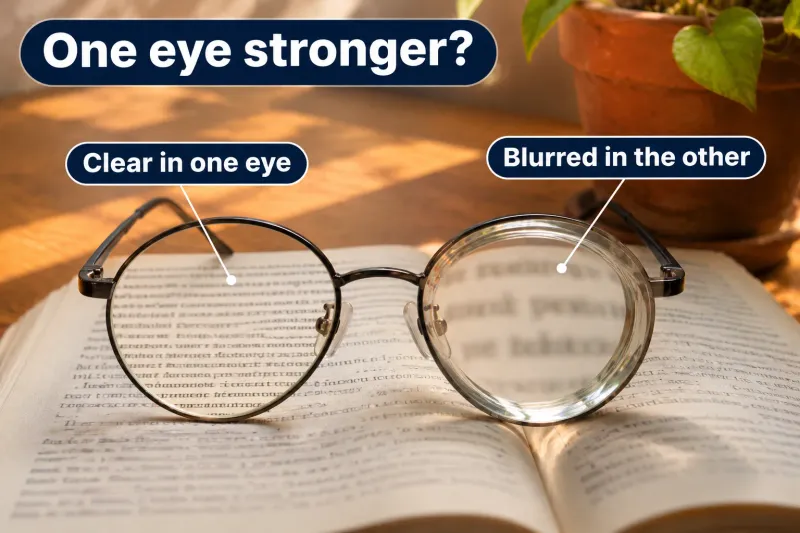
Anisometropia explained: when the power differs between eyes, why it goes unnoticed, image size problems with glasses, contact lens options, and what helps.
What Is Anisometropia?
Anisometropia means your two eyes need different lens powers, usually a difference of 1 dioptre or more. The better eye does most of the work, so it often goes unnoticed, especially in children with straight eyes. Left uncorrected in childhood it can lead to lazy eye, so it should be found and corrected early.
Plenty of people find out by accident. A child covers one eye during a school screening and suddenly can't read the top line. An adult rubs one eye on a train, looks at the station sign with the other, and realises it's a blur. The two eyes have been quite different for years, and nobody knew.
That is anisometropia: your two eyes need different lens powers. It is common, usually harmless once corrected, and easy to miss because the brain is very good at hiding it.
What counts as anisometropia
Most clinicians use the term when the two eyes differ by 1 dioptre or more, which is the same as 1.00 on your prescription. Here are two examples:
- Right eye +0.50, left eye +3.00: the difference is 2.50
- Right eye -1.00, left eye -4.50: the difference is 3.50
A difference of 0.25 or 0.50 is very common and rarely matters. Larger gaps are where we pay attention, and the type of power changes what we worry about. People sometimes say one eye is stronger, but really one eye simply needs more correction. The muscles are not weak.
Why nobody notices
Most children with anisometropia have perfectly straight eyes, and they see well with both eyes open because the better eye does the job. They read the board, play and pass as normal. They do not know that the other eye is blurred, because they have never seen any other way. A child's eyes need to be tested one at a time for this to show up.
Try this at home with a child over 3 years old. Make it a game: cover one eye with their palm and ask them to look at a picture across the room, then swap. If they fuss, peep or struggle much more with one eye covered than the other, book an eye test. Other possible signs are closing one eye, tilting the head, bumping into things on one side, or poor ball skills.
What causes it
Usually the two eyes have simply grown slightly differently, with one longer or differently curved than the other. It often has no clear reason and can run in families. It may also come from:
- Short sight that progresses faster in one eye
- Unequal cylinder, which we cover in our guide to cylindrical power
- A droopy eyelid, an eye injury or cataract
- Keratoconus, or surgery on one eye
Why the type of power matters
The picture is different depending on whether the eyes are long-sighted or short-sighted.
Plus power in one eye is the bigger concern. A long-sighted child focuses using the better eye. The focusing effort is shared equally between both eyes, so the worse eye stays blurred at every distance, near and far. A difference of as little as 1.50 in plus power is likely to affect development.
Minus power tends to be gentler. A short-sighted eye still sees clearly up close, so it gets some sharp images during the day. It usually takes a bigger gap, around 3.00, before development is affected. For cylinder, the figure is about 2.00.
These are general figures, and some children with smaller differences are also affected.
How unequal power affects vision development
During childhood, the brain builds two-eyed vision by comparing clear images from both eyes. With anisometropia, one image is sharp and one is blurred. The brain then starts to favour the sharper one and may ignore the other. Three things can follow:
- Weaker vision in the blurred eye. This is anisometropic amblyopia, a type of lazy eye. That page goes into the detail.
- Reduced teamwork between the eyes. The eyes may not combine their images comfortably even with good glasses.
- Poorer depth perception, which can affect catching, stairs and judging distances.
A study of 107 children helps to show this. Those with anisometropia but no amblyopia had similar stereo vision to children without anisometropia, but fewer of them could fuse images on testing: 65% against 81%. In those who also had amblyopia, it was much lower, at just 14%. So even when the chart looks fine, two-eyed skills deserve a check.
Glasses are usually the first treatment
Children start with glasses, worn all day. This alone does a great deal. In large studies by a US paediatric eye research group, 77% of children with anisometropic amblyopia gained at least 2 lines on the chart within 15 weeks of simply wearing their glasses. Patching or other treatment may be added if that is not enough, and it's worth giving the glasses a real chance first.
With a child, the common difficulty is getting them to wear the glasses, particularly as the world may not look very different to them with both eyes open. It can help to explain that the glasses are helping their other eye to learn. Good-fitting frames and a regular routine make a difference too.
When glasses feel strange: aniseikonia
Lenses change the size of what you see. With a big difference in power, each eye's image can end up a different size, which is called aniseikonia. As a rough guide, glasses change image size by about 1 to 2 percent per dioptre, so a large difference adds up. Small differences go unnoticed. Larger ones can cause headaches, eye strain, dizziness, nausea, or a floor that seems to tilt.
There is a second problem when reading. Your eyes look through the lower part of each lens, and lenses of different strength bend light by different amounts there. Your eyes then have to move unequally, and that can tire them out.
Children often adapt surprisingly well. Adults who get a full correction for the first time may find it harder, and that's where the options below come in.
Other options
- Contact lenses. Because they sit on the eye, they often reduce the image size difference and remove the reading problem. They can work well for large differences, and many older children and teenagers can manage them with parents' help.
- Lens design. Choices such as higher-index lenses, the distance from the eye and a separate pair for reading can reduce some of the difference.
- Partial correction in adults. Reducing the difference in the glasses is sometimes more comfortable, though the worse eye will not be as sharp. This is not the usual approach in a child who is still developing.
- Laser or lens surgery in adults. This can suit some adults once the power is stable. It isn't normally used for children, and it needs a surgeon's opinion.
- Myopia control. If short sight is rising in one eye, management can be directed towards slowing it down.
What behavioural vision care adds
Glasses can give each eye a clear picture, but they do not ensure that the brain uses both pictures together. That's where behavioural vision care comes in. It tests whether both eyes are being used at the same time, then trains the skills that are lagging.
Vision therapy for anisometropia may include activities where each eye sees something different and the brain has to use both, along with focusing work that balances the two eyes, and tasks that bring eye teaming, depth judgement and eye-hand skills into daily life. What you are after is two eyes that work as a pair during reading, sport and moving around, which is what we mean by functional vision. Therapy will not make the two powers equal, and nor will any exercise, since the difference comes from the eye's physical shape.
How a developmental and behavioural optometrist looks at unequal eyes
A developmental and behavioural optometrist starts with an accurate prescription, using drops in children, and tests each eye separately. Then come the questions a basic test doesn't ask. Is one eye being switched off? How good is depth perception? Are focusing and eye teaming equal? Are the image sizes causing trouble? Is this child hitting visual milestones for their age? They then decide what to do about glasses or contact lenses, plan any therapy, and refer to an ophthalmologist if there is an underlying eye condition. Children should be reviewed regularly, because the gap can change as they grow.
For adults, the assessment often explains something long-standing, such as glasses that have never felt right or a lifelong dislike of ball games. It is rarely too late to look at comfort and two-eyed function, even if the best time for improving a lazy eye has passed.
If you or your child has a big difference between the two eyes, book a binocular vision assessment at Caring Vision Therapy. Bring your current glasses and previous prescriptions.
Explore More at Caring Vision Therapy
Frequently Asked Questions
What is anisometropia?
How much difference between eyes is normal?
Is anisometropia serious?
Can anisometropia be corrected without glasses?
Why do my new glasses make me dizzy?
Can a child with anisometropia wear contact lenses?
Does anisometropia get better on its own?
Sources
- Anisometropia. StatPearls, NCBI Bookshelf.
- Anisometropic Amblyopia. EyeWiki, American Academy of Ophthalmology.
- PEDIG Studies: Quality Healthcare and Amblyopia Treatment. American Academy of Ophthalmology.
- Stereopsis and Fusion in Anisometropia According to the Presence of Amblyopia. Graefe's Archive for Clinical and Experimental Ophthalmology, 2017.
- Aniseikonia. StatPearls, NCBI Bookshelf.
Reviewed by the Caring Vision Therapy clinical team. Updated November 2026.