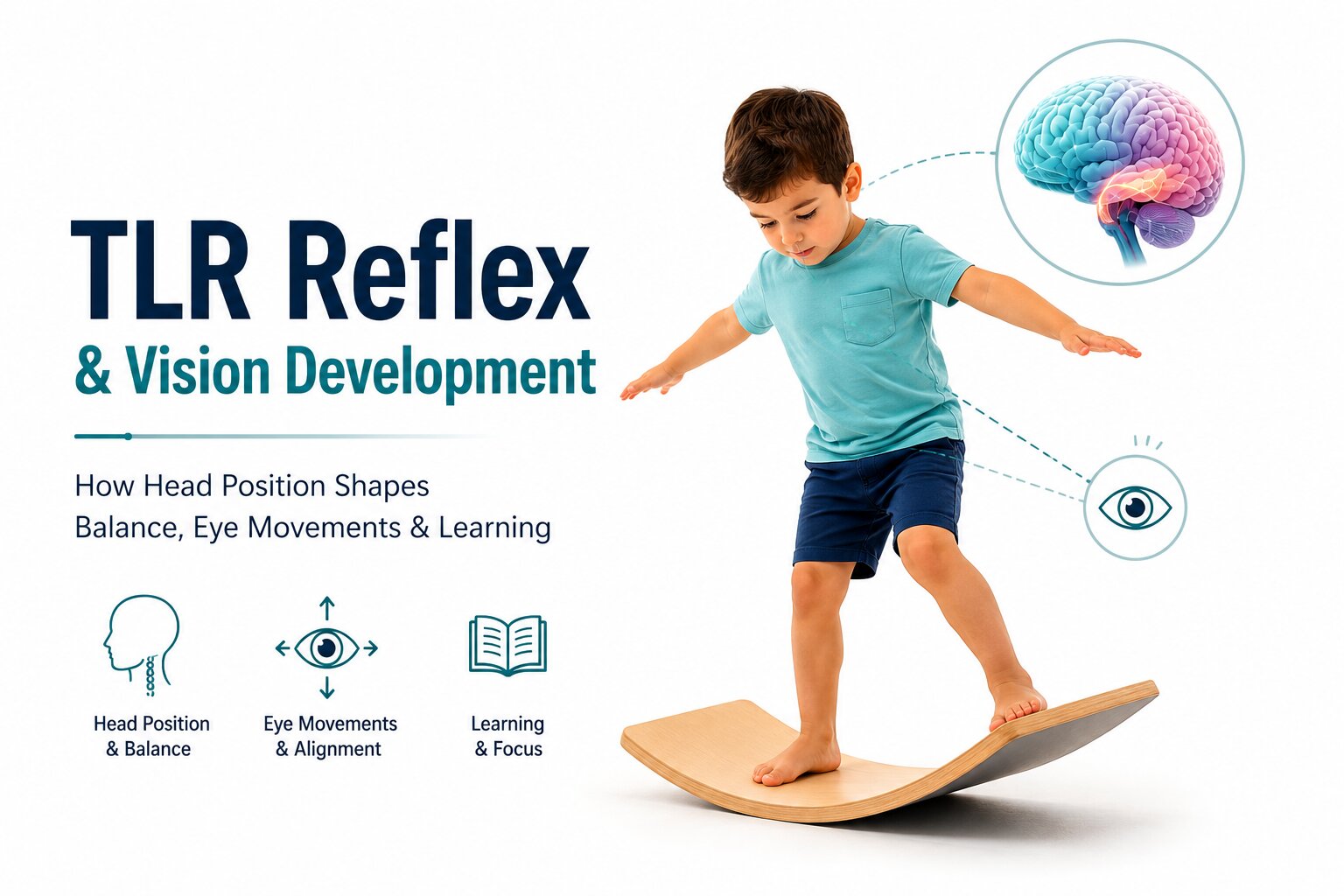
The TLR should integrate by 3-6 months. Signs of a retained Tonic Labyrinthine Reflex, how it disrupts posture, balance and reading, and how it is treated.
Book a ConsultationWhat Is the Tonic Labyrinthine Reflex (TLR) and How Does It Affect Vision?
The TLR should integrate by 3-6 months. Signs of a retained Tonic Labyrinthine Reflex, how it disrupts posture, balance and reading, and how it is treated.
There is a category of children who are harder to help than most, not because their difficulties are severe, but because they are so diffuse. These children slouch despite constant reminders. They are clumsy in ways that do not make obvious sense. They find reading tiring after just a few minutes. Their posture while writing is awkward and effortful. They may be reluctant to try sports or physical activities where other children their age show confident movement. Their school performance sits below what their intelligence suggests it should be.
One thread that runs through many of these presentations is the Tonic Labyrinthine Reflex (TLR) — a primitive reflex that shapes the earliest relationship between gravity, movement, posture, and vision. Understanding this reflex, and what happens when it does not fully integrate during infancy, helps make sense of a pattern of difficulties that otherwise seems fragmented and inconsistent.
What Is the Tonic Labyrinthine Reflex?
The Tonic Labyrinthine Reflex is one of the earliest postural reflexes, active before birth and fully present in newborns. It is controlled by the vestibular system — specifically, by the labyrinths of the inner ear — and its function is to help an infant begin to organise muscle tone in relation to gravity and head position.
The reflex has two components. When the head tilts backward, the muscles on the back of the body increase in tone, causing the back to arch, the legs to extend, and the arms to straighten. When the head tilts forward, the opposite occurs: the muscles on the front of the body increase in tone, causing the body to curl and overall muscle tone to reduce.
Between three and six months of age, the TLR should gradually integrate as voluntary motor control and more sophisticated postural reflexes develop. Each developmental milestone — pushing up on the arms during tummy time, developing core stability, beginning to crawl — depends, in part, on the TLR having stepped back to allow voluntary control to take over.
The Relationship Between the TLR and the Vestibular System
Understanding the TLR requires understanding the vestibular system, because the two are inseparable. The vestibular system detects the position of the head in space, registers acceleration and deceleration, coordinates the muscles of the eyes with the movements of the head, and provides continuous postural adjustment signals throughout the body.
Vision and the vestibular system are particularly tightly coupled. One of the most important functions of the vestibular system is to stabilise visual images on the retina during head movement — a process controlled by the vestibulo-ocular reflex. When the TLR has not fully integrated, the vestibular system remains in a state of developmental immaturity, with cascading effects on posture, balance, the efficiency of eye movements during head movement, and how the brain processes spatial information.
How a Retained TLR Affects Posture and Balance
The most visually obvious effect of a retained TLR is its impact on posture. Because the reflex continues to link head position with muscle tone, children with a retained TLR often develop characteristic postural compensations to avoid triggering it. Many naturally gravitate toward sitting with the head slightly forward and downward — a position that increases flexor tone and reduces the competing motor signals from the unintegrated reflex. This is why so many of them end up slumping over their desks. It is not laziness or poor discipline; their nervous system is actively finding a posture that reduces discomfort.
Balance is similarly affected. Tasks that require maintaining balance during head movement — riding a bike, swimming, using playground equipment, participating in team sports — can be genuinely challenging. The cerebellum, which coordinates movement, relies on accurate vestibular input to do its job. When that input is contaminated by an unintegrated reflex, movement is less fluid, less confident, and more effortful.
How the TLR Interferes with Vision
The visual consequences of a retained TLR are less well known among parents and teachers, but they are clinically significant. Because eye movements during head movement depend on accurate vestibular calibration, children with a retained TLR may have reduced efficiency of the vestibulo-ocular reflex. Reading while the head is in motion, tracking a moving object while walking, or shifting gaze smoothly during sports can all be harder than expected.
Maintaining stable binocular vision — the ability of both eyes to work together as a coordinated team — also requires a stable postural platform. When the body is fighting against an unintegrated postural reflex, the platform from which the eyes work is constantly shifting, even in apparently still positions like sitting at a desk. Children with these difficulties often develop visual fatigue more quickly than their peers during reading, writing, or screen-based tasks. They may complain that words move on the page, report intermittent blurring after reading for a few minutes, or begin to avoid close visual work because it is simply not comfortable.
Academic and Classroom Consequences
In the classroom, the effects of a retained TLR tend to cluster in predictable ways. Reading endurance is often poor. Copying from the board is slow and effortful. Handwriting is physically awkward because the postural instability the retained reflex creates makes it hard to provide the core stability from which controlled hand movements can flow. Spatial organisation in written work is often weak — margins wander, lines slope, letters vary in size.
Parents often describe children with a retained TLR as perpetually tired. The energy expenditure required to manage posture, maintain visual stability, and process spatial information is genuinely greater for these children than for peers whose reflexes are fully integrated. By the time they arrive home from school, many are exhausted — not because school has been academically difficult, but because it has been physically and neurologically demanding in ways that are invisible to everyone around them.
Developmental Vision Therapy and TLR Integration
Developmental Vision Therapy addresses the functional visual difficulties that the retained TLR contributes to, while recognising that lasting improvement requires supporting the integration of the underlying reflex itself. Therapy activities are designed to build efficient eye tracking, stable binocular vision, and visual-motor integration, while gradually placing greater demands on the vestibular-visual system in a controlled and graduated way.
Alongside visual rehabilitation, therapy for children with a retained TLR typically incorporates Primitive Reflex Integration activities. These are carefully designed movement exercises that provide the nervous system with the specific kinds of sensory and motor input needed to complete the developmental programme that was not fully completed during infancy. Parents frequently notice that as integration improves, children hold their bodies differently — posture improves not because the child is trying harder, but because the neurological competition has reduced.
For questions about how this applies to your child, we invite you to book a comprehensive developmental vision evaluation at Caring Vision Therapy.
Explore More at Caring Vision Therapy
Frequently Asked Questions
What is the Tonic Labyrinthine Reflex, simply explained?
The TLR is a primitive reflex present from before birth that links head position with muscle tone throughout the body. When the head tilts back, body tone increases and the back arches. When the head tilts forward, tone reduces and the body curls. It is meant to integrate during the first six months of life. When it does not, it continues to influence posture, balance, eye movements, and learning into childhood and beyond.
How does a retained TLR affect reading?
A retained TLR affects the vestibular system, which in turn affects the stability of eye movements, the efficiency of binocular vision, and the ability to maintain a comfortable posture during sustained close visual work. This can cause reading fatigue, visual discomfort, difficulty tracking across a page, and poor reading endurance — even in children with otherwise normal eyesight.
Can a retained TLR cause poor balance in children?
Yes. The TLR is controlled by the vestibular system, and residual TLR activity is associated with vestibular immaturity. Children with a retained TLR may show difficulty with balance tasks, particularly those involving head movement, and they may avoid activities that require confident balance and spatial orientation.
Is primitive reflex integration the same as Vision Therapy?
No, they are complementary but distinct. Developmental Vision Therapy addresses functional visual skills — eye tracking, binocular vision, accommodation, visual-motor integration. Primitive Reflex Integration addresses the underlying neurodevelopmental programme of which visual development is a part. When both are involved, combining the two approaches often produces better outcomes than either alone.
Can a retained TLR be treated in older children or teenagers?
Yes. While the optimal window for primitive reflex integration is during early childhood, the nervous system retains plasticity well into adolescence and beyond. Older children and teenagers can benefit from targeted intervention, though the programme may look different and progress may be more gradual than in younger children.