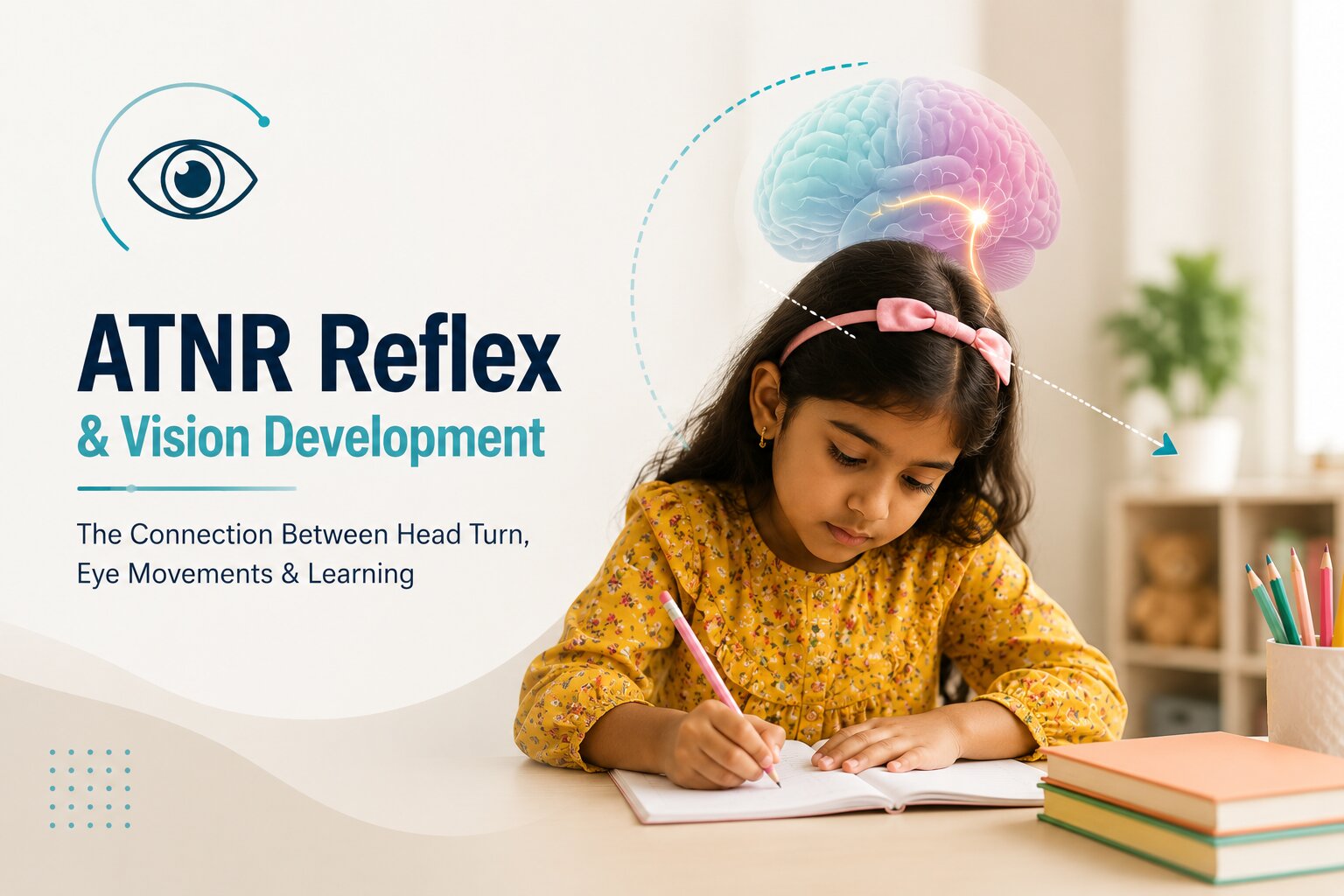

Learn how a retained Asymmetrical Tonic Neck Reflex (ATNR) may influence reading, handwriting, eye tracking, balance, coordination, and classroom learning. Discover the signs, assessment process, and how Developmental Vision Therapy may help.
Book a ConsultationWhat Is the ATNR and How Does It Affect Vision and Learning?
Learn how a retained Asymmetrical Tonic Neck Reflex (ATNR) may influence reading, handwriting, eye tracking, balance, coordination, and classroom learning. Discover the signs, assessment process, and how Developmental Vision Therapy may help.
One of the things that makes certain children so difficult to help is that the problem does not lie where anyone is looking. Their eyesight is normal. Their hearing is fine. Their intelligence is evident to anyone who spends time with them. And yet, reading is a struggle. Handwriting is effortful and often messy. Keeping their place on a page while reading is genuinely hard. Activities that require the two sides of the body to work together — throwing and catching a ball, swimming, using scissors — are more difficult than they appear for children of similar age and apparent ability.
The Asymmetrical Tonic Neck Reflex (ATNR) is one of the developmental reflexes that most frequently contributes to this kind of unexplained difficulty. It is a reflex that plays a critical and entirely appropriate role during early infancy, but one that creates a range of specific functional problems when it remains active beyond its developmental window.
What the ATNR Is and How It Works
The Asymmetrical Tonic Neck Reflex is present at birth and is fully active throughout the first months of life. When the infant turns the head to one side, the arm and leg on the side toward which the face is pointing automatically extend — straighten out — while the arm and leg on the opposite side automatically flex. The posture this creates is sometimes called the fencing reflex, because the outstretched arm makes the infant look momentarily like a fencer in position.
The ATNR is normally integrated between four and six months of age. As the infant develops voluntary motor control and begins to explore movement in three dimensions — rolling, reaching across the body, beginning to push up toward crawling — the reflex steps back and allows the head, arms, and legs to move independently of one another. This independence is essential for the skills that follow.
Why Full Integration of the ATNR Matters
Reading requires the eyes to track smoothly from left to right across a line of text — a movement that, by definition, requires the eyes to cross the body's midline. In a child with a retained ATNR, head rotation as the eyes track across the page activates extension on one side of the body and flexion on the other. This creates a momentary postural disruption at the midline — precisely the moment the visual system needs the eyes to hold a stable trajectory. Many children with retained ATNR show a characteristic hesitation or bobble in their eye movements at the midline during reading, which manifests as losing their place, skipping words or lines, or losing comprehension because fluency has been interrupted.
Handwriting is equally affected. Writing requires the head to be oriented toward the hand in near space. In a child with a retained ATNR, turning the head toward the writing hand creates an extensor drive in that hand and arm, increasing muscle tone and making fine motor control more difficult. Children compensate in various ways — tilting the paper dramatically, writing with the wrist hooked in an unusual position, holding the pencil with excessive pressure, or developing a slow and laboured writing style that does not reflect their intellectual capacity.
Midline crossing — the ability to reach across the body's midline with either hand without the other hand taking over — is directly disrupted by a retained ATNR. Children who cannot cross the midline efficiently often switch hands at the midpoint of tasks, rotate paper or their whole body instead of reaching across, and appear ambiguous in their hand dominance past the age at which a clear preference is expected.
The Visual Consequences in Detail
When we assess children with a suspected retained ATNR, the visual findings are usually consistent with what the developmental theory predicts. Eye tracking — particularly smooth pursuit movements — tends to be less efficient, with a characteristic disruption as the eyes approach and pass the midline. Saccades — the rapid jumping eye movements used to shift gaze between fixation points — also tend to be less accurate. Children may undershoot or overshoot target words, requiring multiple small corrective movements to land accurately. This slows reading speed and increases the cognitive load of the reading process, leaving fewer resources available for comprehension.
Binocular vision often shows reduced stability. In some children this is subclinical; in others it is more overt — the child experiences intermittent blurring, double vision, words that appear to move on the page, or eye discomfort during close work. In all cases, the underlying mechanism involves the same brainstem pathways that mediate the ATNR itself.
Balance, Coordination, and Movement
Children with a retained ATNR often show difficulties in physical activities that require the two sides of the body to work together smoothly and independently of where the head is pointing. Swimming is a particularly revealing activity: the crawl stroke requires the head to rotate to breathe on one side while the arms and legs continue their alternating bilateral pattern. In a child with a retained ATNR, rotating the head to breathe interferes with the arm on the same side, disrupting the smooth bilateral rhythm. Children often avoid the crawl stroke, preferring breaststroke where the head stays in midline.
What This Looks Like in the Classroom
Teachers notice the ATNR in particular ways. The child who consistently loses their place while reading, even with a finger as a marker. The child whose handwriting is adequate at the start of a piece but deteriorates visibly as fatigue accumulates. The child who takes twice as long as classmates to copy from the board. The child who reverses letters and numbers consistently past the age at which this is developmentally expected — because the visual system's differentiation of left and right is less secure when the ATNR has not integrated. The child who appears to have difficulty with directionality in reading — confusing b and d, p and q, was and saw.
Assessment and Therapy at Caring Vision Therapy
A comprehensive developmental vision assessment for suspected ATNR retention at Caring Vision Therapy includes functional evaluation of eye tracking, binocular vision, saccadic accuracy, visual-motor integration, and visual perception alongside clinical testing of primitive reflex status, postural responses, midline crossing, and bilateral coordination.
Intervention combines targeted Developmental Vision Therapy with graduated Primitive Reflex Integration activities. The integration activities are individually designed based on assessment findings and adjusted throughout therapy as the child's neurological organisation develops. Contact us to arrange a comprehensive assessment.
Explore More at Caring Vision Therapy
Frequently Asked Questions
Can a retained ATNR cause letter reversals past a normal age?
Letter reversals are common in young children learning to read and write and are not in themselves diagnostic of any specific difficulty. However, when reversals persist significantly past the age of seven or eight years, and particularly when accompanied by other signs of difficulty with directionality and midline crossing, a retained ATNR is worth considering as a contributing factor.
Why does my child switch hands in the middle of activities?
Hand switching at the midpoint of tasks — particularly when the hand needs to work on the opposite side of the body — is one of the most consistent signs of difficulty crossing the body's midline. In children with a retained ATNR, the midline represents a zone of increased reflex-driven motor resistance. Switching hands is a natural compensation that avoids crossing it.
How does the ATNR affect binocular vision?
The ATNR is mediated through brainstem pathways that also influence the oculomotor system. In a child with a retained ATNR, the reflex creates asymmetrical postural and motor signals each time the head rotates — signals that can disturb the stability and accuracy of binocular convergence. The result is a visual system that works adequately in static conditions but becomes less efficient and less comfortable during the sustained head rotation involved in reading.
Is there any link between the ATNR and swimming difficulty?
Yes. The crawl stroke specifically requires the child to rotate the head to one side for breathing while maintaining a bilateral alternating arm pattern — exactly the movement combination that most challenges the ATNR. A child who swims well in breaststroke but struggles specifically with the crawl may be demonstrating the functional signature of a retained ATNR.
Can adults have a retained ATNR?
Yes. While the ATNR normally integrates during the first six months of life, not all children complete this process on schedule, and some adults continue to show residual reflex activity. In adults, a retained ATNR may contribute to difficulties with reading endurance, writing comfort, midline crossing in fine motor tasks, and certain sports skills.