Discover how a retained Moro Reflex can influence vision, reading, balance, attention, learning, and child development. Learn the symptoms, causes, and how Developmental Vision Therapy and Primitive Reflex Integration may help.
Book a ConsultationWhat Is the Moro Reflex and How Does It Affect Vision?
Discover how a retained Moro Reflex can influence vision, reading, balance, attention, learning, and child development. Learn the symptoms, causes, and how Developmental Vision Therapy and Primitive Reflex Integration may help.
It is one of the more bewildering experiences a parent can have. The eye test comes back normal. The teacher says the child is bright. Yet at home and in the classroom, something clearly is not working — the child avoids reading, loses their place constantly, startles easily, struggles to sit through homework, and seems perpetually on edge. Parents often leave these appointments without answers, carrying a quiet worry that something has been missed.
In many cases, something has been missed. Not because the clinicians were careless, but because standard eyesight testing is not designed to evaluate how the entire visual system — the eyes, the brain, the balance system, the postural muscles, the sensory processing networks — functions as a unit. When that system is inefficient, even a child with perfectly healthy eyes will struggle to read comfortably, sustain attention, coordinate movement, or learn with ease.
One of the less discussed but clinically important contributors to this kind of difficulty is the Moro Reflex — a primitive reflex that all healthy newborns possess, and that should gradually disappear during the first few months of life as the brain matures. When it lingers beyond infancy, its effects ripple through the sensory and visual systems in ways that are rarely obvious from the outside.
At Caring Vision Therapy & Neurovision Rehabilitation Center, we assess not only the sharpness of a child's eyesight but the neurological foundations that allow vision to work efficiently within a developing body.
What Is the Moro Reflex?
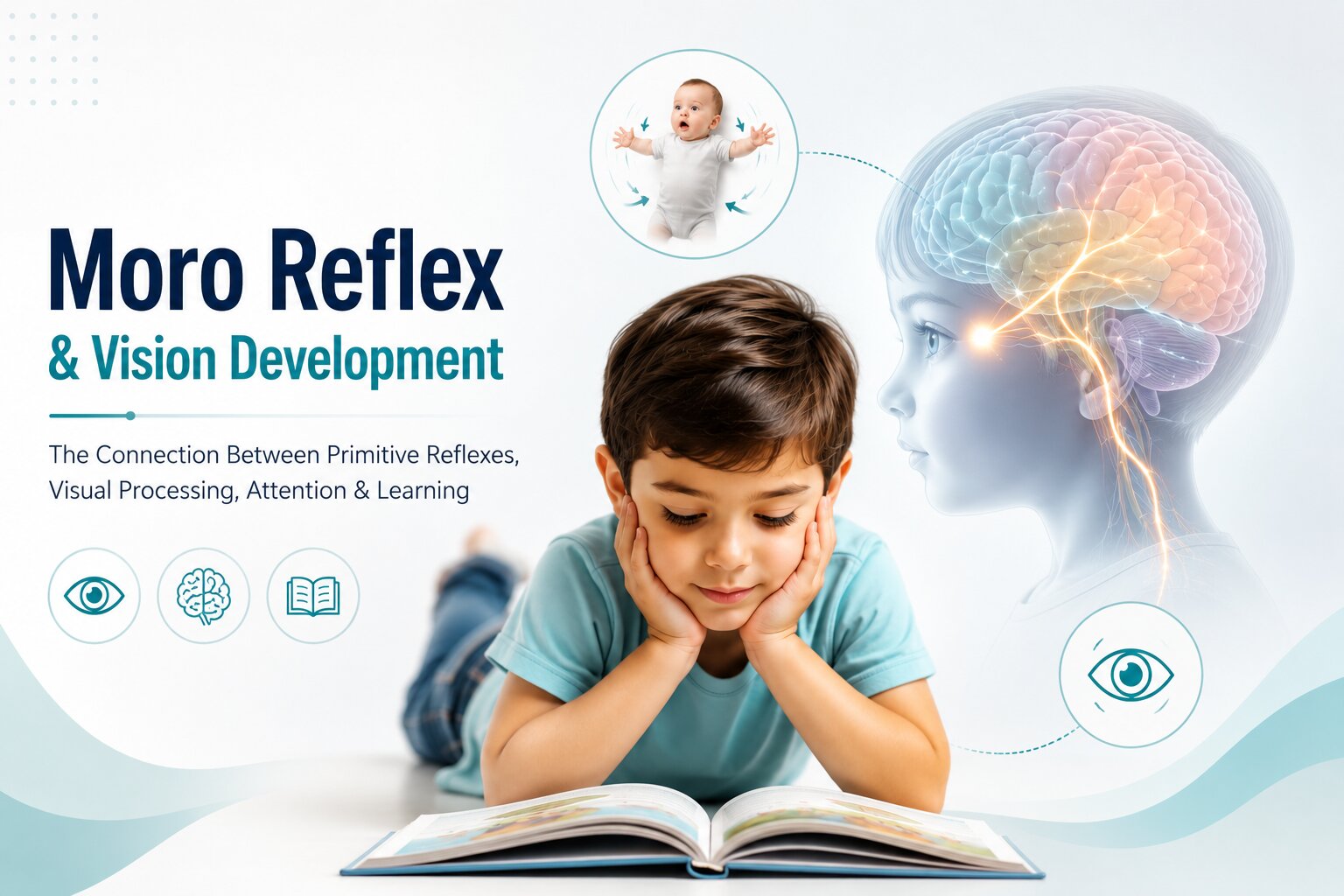
The Moro Reflex is the first protective reflex a newborn has. When a baby experiences a sudden change — a loud noise, an unexpected movement, a sensation of falling — the reflex fires automatically. The arms fling outward and upward, the fingers spread wide, the back arches, and then the arms pull back in toward the body as the baby often begins to cry.
This is not random movement. The Moro Reflex is a full-body survival response, rooted in the most primitive parts of the nervous system. It floods the body with adrenaline and cortisol, activates the stress response, sharpens sensory alertness, and prepares the infant to react to perceived danger.
Under normal developmental circumstances, the Moro Reflex gradually integrates between two and four months of age. As higher brain regions develop and voluntary motor control emerges, the reflex becomes unnecessary and is replaced by more mature protective and postural responses. When integration does not happen on this timeline, the reflex remains active in an older child's nervous system — not because anything is fundamentally broken, but because the brain has not yet completed the maturational process that quiets it.
Why Does a Retained Moro Reflex Affect Vision?
The Moro Reflex is processed through the brainstem and is deeply connected to the vestibular system — the inner ear mechanism responsible for balance, spatial orientation, and the stabilisation of vision during movement. It is also linked to the visual alerting system, which controls how the eyes and brain respond to sudden changes in the visual environment.
In a child with a retained Moro Reflex, the threshold for triggering the stress response remains low. Sensory stimulation that most children process without difficulty — a busy classroom, a flickering screen, a sudden noise, peripheral movement in the visual field — can trigger a partial activation of the reflex. When that happens, the autonomic nervous system shifts toward heightened alertness, reducing the brain's capacity for calm, sustained visual attention.
This creates a cycle that is genuinely difficult for a child to control. Their visual system is constantly scanning for threat rather than settling into the focused, relaxed state that reading and learning require. Eye tracking becomes effortful. Binocular vision — the coordination of both eyes working together — becomes less stable. Peripheral sensitivity increases, which can make a visually busy environment overwhelming. None of this shows up on a standard eye chart.
The Stress System and Sustained Visual Attention
Sustained visual attention depends on the nervous system being in a calm, regulated state. Reading requires the eyes to move smoothly and predictably across a line of text, to hold focus at near distance for extended periods, and to shift quickly between the page and other visual targets. None of this happens efficiently when the brain is in a heightened stress state.
Children with a retained Moro Reflex often describe reading as tiring. They lose their place frequently, need to reread sentences to understand them, feel their eyes “jumping” on the page, and find it very hard to sustain concentration for more than a few minutes. They may also be sensitive to bright light, easily distracted by movement in their peripheral vision, and prone to overreaction when startled unexpectedly.
In the classroom, these children are often described as easily distracted, anxious, or immature. They may avoid tasks that require close visual work, become frustrated quickly during reading activities, and struggle to filter out the background visual noise of a busy classroom.
Postural Foundations of Visual Stability
The relationship between posture and vision is fundamental. For vision to remain stable during movement, the postural muscles, the vestibular system, and the visual system must communicate in a continuous, rapid feedback loop. The Moro Reflex, when retained, tends to produce a characteristic postural pattern — higher tone in the muscles at the back of the neck and spine, a tendency toward a slightly hunched or guarded posture, and reduced trunk stability. This affects the platform from which the eyes work, making smooth, accurate eye movements during reading or physical activity significantly harder.
Balance is another area where the connection becomes visible. Some children with a retained Moro Reflex have genuine difficulty with balance tasks — particularly those that require the visual and vestibular systems to work together. They may be reluctant to use playground equipment that involves height or movement, not because they are timid by nature, but because their balance system is genuinely less stable than their peers'.
Emotional Regulation and the Visual Learning Environment
Because the retained Moro Reflex keeps the stress system partially activated, children often have a lower threshold for emotional overload. Transitions, unexpected changes, and sensory-rich environments are genuinely more demanding for them than for peers with fully integrated reflexes. In a school context, this can look like anxiety, stubbornness, or what teachers sometimes describe as being emotionally “younger” than the child's chronological age.
Understanding this emotional dimension is important for parents and teachers alike. A child who is perpetually slightly stressed will find every visual and cognitive task harder. The goal of intervention is not just to improve eye movements or reading fluency in isolation — it is to reduce the underlying neurological load that makes all of these tasks more demanding than they need to be.
Signs That May Suggest a Retained Moro Reflex
No single sign can confirm that a child has a retained Moro Reflex. A comprehensive assessment is always needed. But there are patterns that, when seen together, are worth investigating. Children with a retained Moro Reflex often show some combination of the following:
- They startle easily and take longer than expected to settle after being startled
- They are sensitive to bright or flickering lights
- They become overwhelmed in busy or visually noisy environments
- They find loud or unexpected sounds genuinely distressing
- They have difficulty with balance and appear physically cautious compared to peers
- They tire easily during reading or close visual work
- They have poor visual attention despite appearing intellectually capable
- They have sleep difficulties, particularly trouble settling at night
How Developmental Vision Therapy Can Help
Developmental Vision Therapy is an individualised program of clinical activities designed to improve the efficiency of the functional visual system. Unlike glasses, which correct the optical clarity of vision, Vision Therapy addresses the neurological processes that allow the eyes and brain to work together effectively — eye tracking, binocular vision, focusing flexibility, visual attention, and visual-motor integration.
For children in whom a retained Moro Reflex is contributing to visual difficulties, therapy is designed with that additional layer of complexity in mind. Activities are graded carefully to avoid triggering the stress response while gradually building the capacity of the visual and sensory systems to handle more demanding environments.
When appropriate, Developmental Vision Therapy may be combined with specific Primitive Reflex Integration activities — carefully graded movement exercises designed to encourage the nervous system to complete the maturational process that quiets the retained reflex. Families frequently notice that as therapy progresses, children become less reactive to sensory stimulation, more willing to engage with reading and close visual work, better able to sustain attention in the classroom, and calmer in environments that previously overwhelmed them.
A Note for Parents
If your child's learning difficulties, reading struggles, or sensory sensitivities have remained unexplained despite normal test results, it is worth asking whether a comprehensive developmental vision assessment has been done. The kind of evaluation that looks at functional vision, primitive reflex status, vestibular processing, and postural stability is different from a routine eye test, and it often reveals factors that routine testing cannot detect.
At Caring Vision Therapy & Neurovision Rehabilitation Center, we provide evidence-informed assessment and individualized rehabilitation for children with functional vision and neurodevelopmental challenges. We believe that seeing clearly is only the beginning of what it means to have healthy vision. Book a comprehensive developmental vision evaluation or learn more about our Primitive Reflex Integration programmes.
Explore More at Caring Vision Therapy
Frequently Asked Questions
At what age should the Moro Reflex disappear?
The Moro Reflex is normally present at birth and integrates gradually between two and four months of age. If a child is still showing a Moro Reflex response beyond six months, this is generally considered outside the expected developmental range and warrants further evaluation.
Can a retained Moro Reflex cause anxiety in children?
A retained Moro Reflex keeps the autonomic nervous system in a state of heightened alertness, which can contribute to anxiety-like behaviour in children. The underlying neurological mechanism — chronic low-grade activation of the stress response — can make everyday situations feel more threatening than they are. Addressing the retained reflex through appropriate therapy may reduce this reactivity over time.
Can my child have a retained Moro Reflex if they passed their eye test?
Yes. Standard eye tests measure the clarity of vision. They do not measure how efficiently the visual system works during reading, how well the eyes track across a page, how stably the two eyes team together, or how the visual system responds to stress and sensory overload. A child can have perfectly clear eyesight and still have significant functional visual difficulties associated with a retained primitive reflex.
How long does therapy take?
This varies considerably depending on the child, the severity of the difficulties, the presence of other contributing factors, and how consistently therapy activities are practised at home. Some children show meaningful improvement within a few months. Others benefit from a longer programme. Following the initial assessment, your therapist will discuss realistic expectations for your child's specific situation.
Can adults have retained primitive reflexes?
Yes. Primitive reflexes are not always fully integrated during childhood. Some adults continue to show residual reflex activity, which can contribute to difficulties with reading endurance, visual stress, balance, coordination, and emotional regulation. Assessment and therapy are available for adults as well as children.