The STNR should integrate by around 11 months. Retention signs, why children slump and slouch when writing, and how reflex integration therapy helps.
Book a ConsultationWhat Is the STNR and How Does It Affect Vision and Learning?
The STNR should integrate by around 11 months. Retention signs, why children slump and slouch when writing, and how reflex integration therapy helps.
Watch a child who is struggling in school carefully enough, and you will often notice things happening at a physical level that the child cannot explain and the teachers have not thought to consider. The child cannot sit still while reading. Their posture collapses after just a few minutes at the desk. They hold the paper at an unusual angle. Copying from the classroom board takes far longer than it should. When they look up from the page, they seem to need a moment to refocus — as though the visual system has to reset each time the head changes position.
These are not behaviours born of laziness or inattention. They are the outward signs of a nervous system that is working much harder than it should to manage a fundamental disconnect between where the head is pointing and what the rest of the body is doing. In developmental optometry and neurodevelopmental rehabilitation, this pattern is one we associate with the Symmetrical Tonic Neck Reflex (STNR).
What the STNR Does and When It Appears
The Symmetrical Tonic Neck Reflex typically emerges around six to nine months of age, which sets it apart from the more primitive reflexes that are present at birth. This timing is significant: the STNR appears precisely when the infant is beginning to learn to crawl on all fours, and it plays a specific role in facilitating that transition.
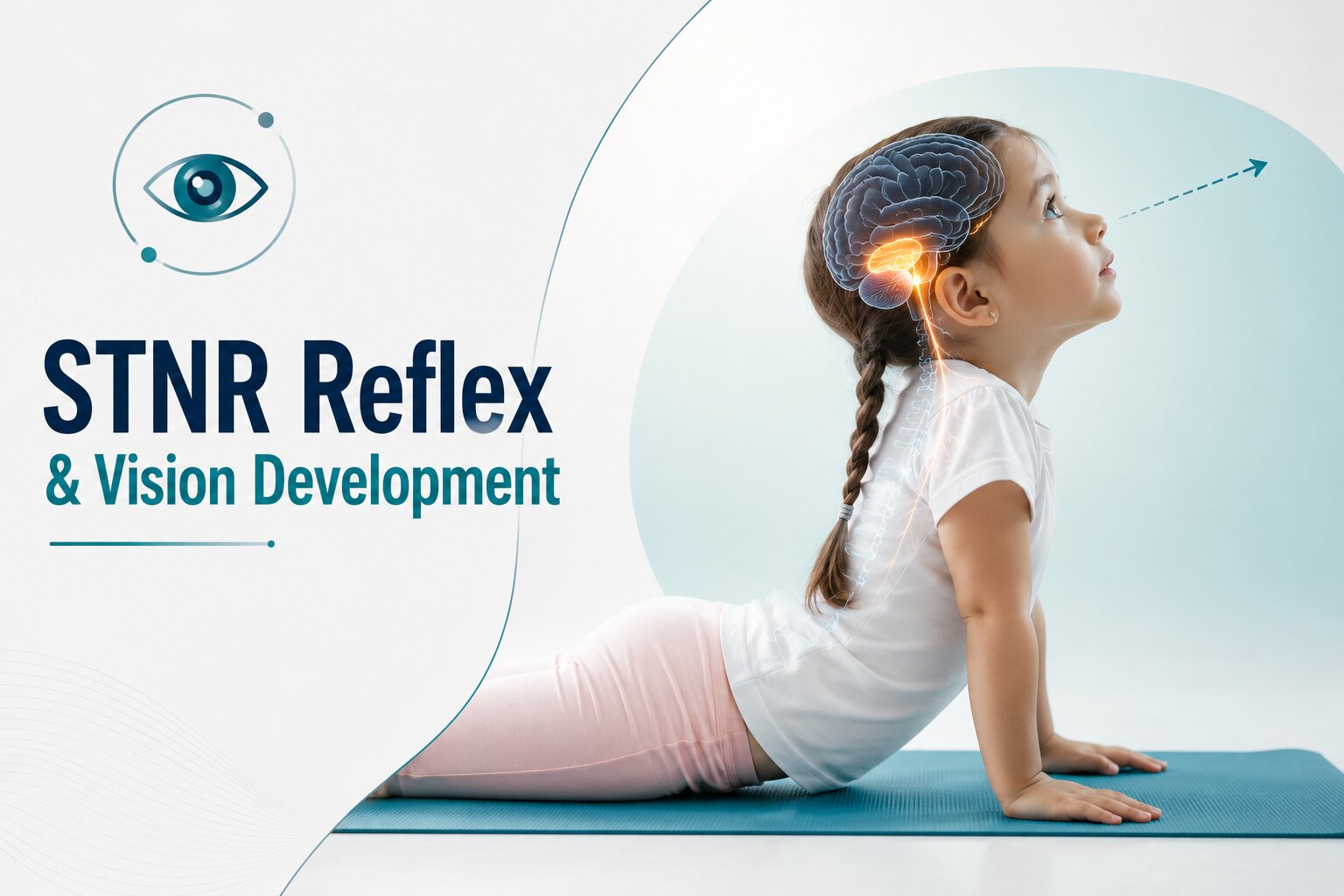
The mechanics of the STNR are symmetrical. When the head moves into extension (tilts upward), the arms automatically increase in tone and straighten, while the legs bend. When the head moves into flexion (tucks downward toward the chest), the opposite occurs: the arms bend and the legs straighten. Over weeks of experimentation, the nervous system gradually learns to separate these movements. This process of separation — called integration — should be largely complete by around eleven months of age.
When integration is complete, the child can hold the head in any position without the arms and legs automatically following. When it is not complete, a residual coupling remains between head position and limb posture that continues to influence the body throughout childhood and beyond.
The Problem with Near Vision: Why the STNR Matters for Reading
The practical consequences of a retained STNR become most apparent during any task that requires the head to be bent forward and the eyes to work at close range — which is, of course, what reading and writing require for most of the school day.
When a child with a retained STNR sits at a desk with the head in flexion to read, the reflex pattern fires: arm flexors increase in tone and leg extensors increase in tone. The arms want to bend and pull toward the body. The legs want to straighten and push away. The child's body is fighting against the furniture, against the seated posture, and against the visual demands of close work — all at the same time.
The compensations children develop are remarkably consistent. Many wrap their legs around the chair legs to anchor themselves. Many prop their heads on one hand. Many hunch dramatically over the desk. Some avoid the desk altogether when possible, choosing to read lying on the floor with the head slightly extended — a position that activates the opposite pattern and makes arm extension easier.
The Impact on Eye Movements and Visual Transitions
Beyond posture, the STNR has a direct neurological relationship with the muscles that control eye movements. The same brainstem pathways that mediate the reflex relationship between head position and limb tone also influence the tone and coordination of the extraocular muscles — the muscles that move the eyes.
This means that head movement in a child with a retained STNR does not just create postural disruption. It also creates a transient shift in the oculomotor system — a moment of visual disruption each time the child looks up from the page to the board, or back down again. For most children, looking up at the board and back down at their notebook is seamless. For a child with a retained STNR, each transition involves a brief period of visual recalibration. Multiply that by dozens of transitions during a typical lesson, and the cumulative cost in time, effort, and visual fatigue is substantial.
Binocular Vision and Accommodation
Two aspects of visual function are particularly vulnerable to a retained STNR: binocular vision and accommodation. Binocular vision — the ability of both eyes to work together as a stable, accurately converged team at near distance — becomes variable and effortful when the oculomotor system is being influenced by changing reflex patterns linked to head position. Some children experience intermittent double vision; others experience words that blur or jump after a few minutes of reading; others simply develop eye strain and headaches after sustained close visual work.
Accommodation — the ability to shift focus quickly between near and far targets — also tends to be less efficient. The ability to shift gaze from near to far and maintain clarity depends on coordinated signals from the oculomotor and autonomic systems. Disruption at the brainstem level — where the STNR is mediated — can reduce the speed and accuracy of this focusing response, further contributing to reading fatigue.
Handwriting: When the Hand Cannot Work Independently of the Head
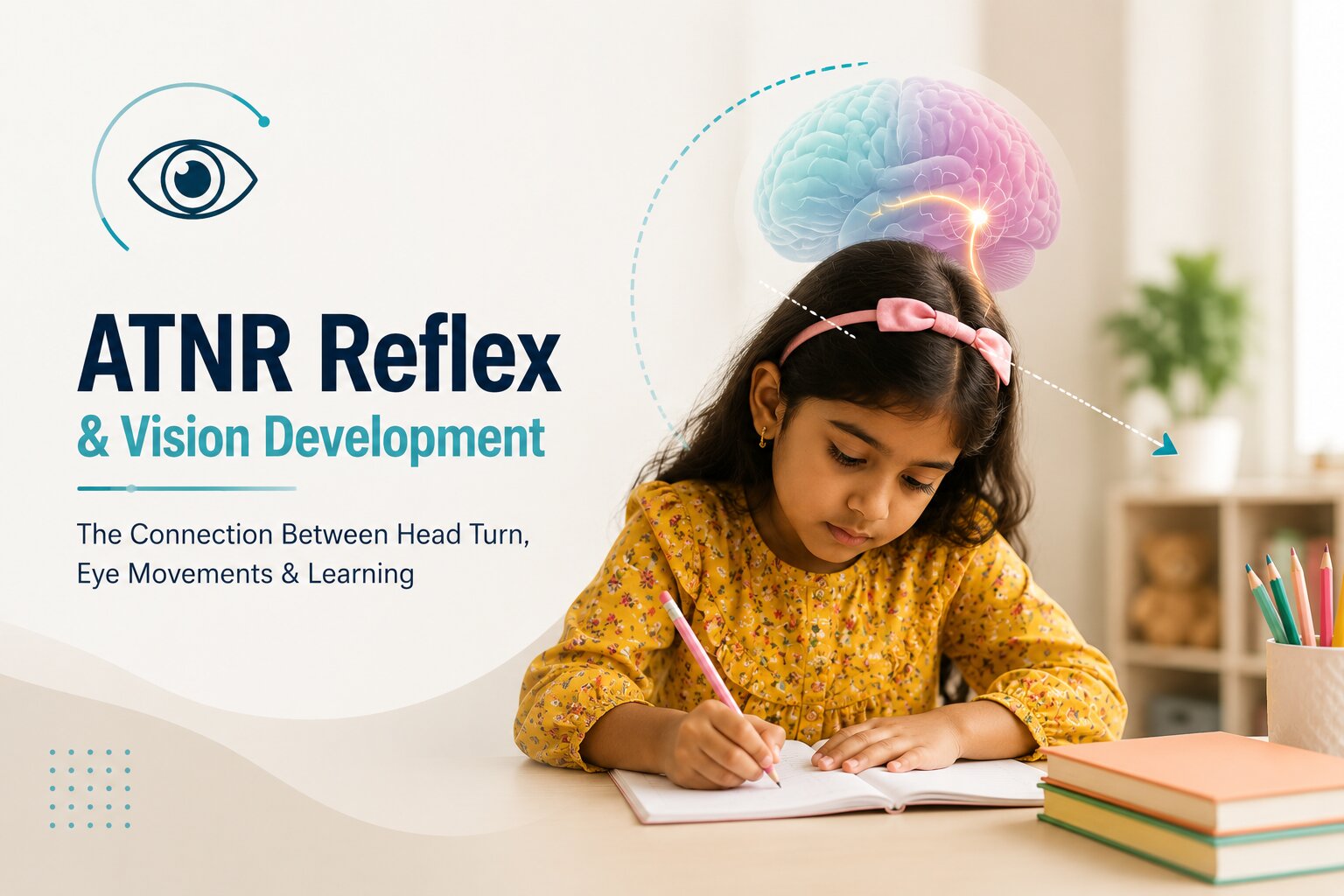
Handwriting is one of the most visually and motorically complex tasks we ask young children to do. In a child with a retained STNR, the act of bending the head forward to watch what the hand is writing activates flexor tone in the arms. This increases the tension in the hand and forearm, often leading to an excessively tight grip on the pen or pencil. Children with this pattern frequently apply heavy pressure, break pencil leads, tire quickly during writing tasks, and produce work that looks more effortful than its content warrants.
Learning, Attention, and the Energy Cost of Compensation
There is an energy cost to all of this. A child who is constantly managing postural instability, visual transitions that require effort, binocular vision that needs maintenance, and handwriting that is physically demanding is spending neurological and physical energy at a rate that their peers are not. By mid-morning in a full school day, these children are often genuinely fatigued — not intellectually, but physically and neurologically.
This fatigue tends to look like inattention. When this is misidentified as a behavioural problem and addressed through behaviour management strategies, the underlying cause is never reached. The child tries harder, manages a little better temporarily, and then the pattern returns — because nothing about the neurological situation has changed.
Assessment and Intervention at Caring Vision Therapy
At Caring Vision Therapy & Neurovision Rehabilitation Center, assessment for suspected STNR retention is embedded within a comprehensive developmental vision evaluation covering the full functional visual system alongside primitive reflex status, postural stability, and the relationship between head position and limb posture.
Intervention combines Developmental Vision Therapy — targeting the specific visual skill deficits — with carefully graded Primitive Reflex Integration activities designed to encourage the nervous system to complete the developmental process of separating head movements from limb responses. Book an assessment to discuss your child's specific situation with our specialists.
Explore More at Caring Vision Therapy
Frequently Asked Questions
Why does my child read better on the floor than at a desk?
When lying on the floor prone — on the tummy — the head is naturally extended, which activates arm extension rather than arm flexion. The arms are in a position that reduces the reflex-driven tension in the hands and forearms, making close visual work slightly easier. The floor also provides proprioceptive input through the whole body, which can reduce vestibular and postural demands.
Can the STNR cause handwriting to be messy even if the child is intelligent?
Yes. The STNR can produce genuine mechanical difficulties with handwriting through its effects on arm and hand tone, postural stability, and the coupling between head position and upper limb posture. These mechanical difficulties are independent of intelligence or effort. A child can be highly intelligent and trying their hardest while still producing handwriting that is poor because of neurological factors not under voluntary control.
At what age should the STNR integrate?
The STNR typically integrates between nine and eleven months of age, as the infant completes the process of learning to crawl and develops the ability to move the head independently from the arms and legs. Beyond approximately twelve months, residual STNR activity is outside the expected developmental range.
Can the STNR be addressed through mainstream educational support?
Mainstream educational support strategies can help a child manage the functional consequences of a retained STNR more effectively. However, they address the symptoms rather than the underlying neurological cause. Primitive Reflex Integration, combined with Developmental Vision Therapy, targets the neurological basis of the difficulty and aims to produce more lasting change.
Will my child grow out of it naturally?
Some children do show spontaneous integration over time, particularly with high levels of physical activity, crawling, and varied sensory-motor experience. However, children who reach school age with a retained STNR often benefit from targeted intervention rather than simply waiting, particularly where the reflex is actively interfering with academic performance.