The Babinski reflex is normal in infants and should resolve by 12-24 months. What the test shows, and when a positive result signals a real concern.
Book a ConsultationWhat Does the Babinski Reflex Tell Us About Neurological Development and Vision?
The Babinski reflex is normal in infants and should resolve by 12-24 months. What the test shows, and when a positive result signals a real concern.
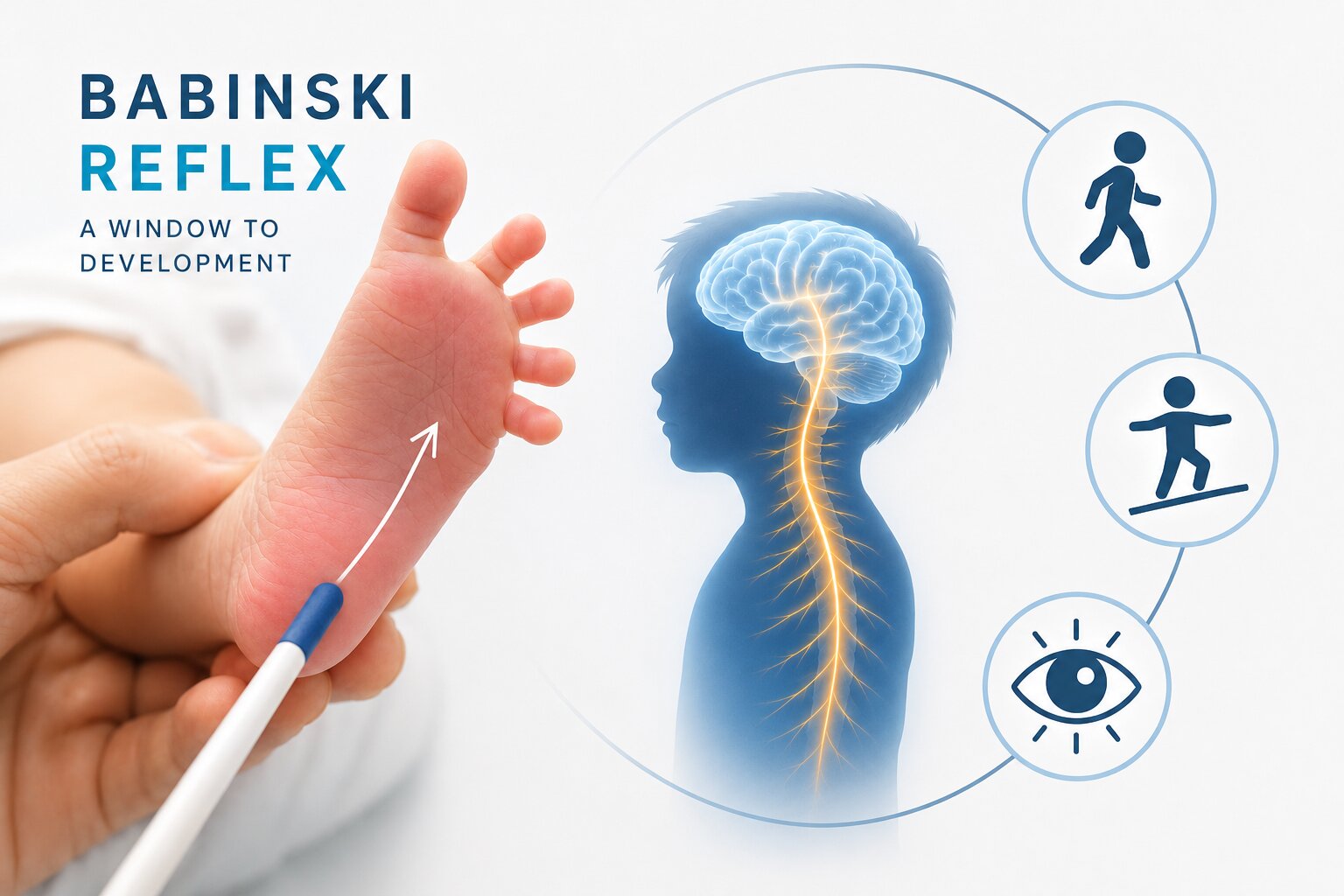
Of all the primitive reflexes that neurologists and developmental clinicians test, the Babinski Reflex is probably the most well known — and among parents, the most likely to be mentioned at well-baby appointments. Touch the outer edge of the sole of a newborn's foot and stroke it toward the toes, and the big toe extends upward while the other toes fan outward. This response, named after the French neurologist Joseph Babinski who described it in 1896, is entirely normal in infants and young children. It is also one of the most informative single signs in all of clinical neurology — because knowing whether the Babinski response is present or absent, and in whom, tells you a great deal about the state of the central nervous system.
What parents are less often told is why this reflex is present in infants, what it tells us about how the nervous system is developing, and what the connection is between this seemingly simple foot response and the broader development of movement, balance, and vision.
What the Babinski Reflex Actually Tells Us
The Babinski response is normally present only when the corticospinal tract — the long descending pathway that connects the motor cortex to the spinal cord and controls voluntary movement — is not yet fully developed and myelinated. Myelin is the protective sheath that forms around nerve fibres and dramatically increases the speed and reliability of neural signal transmission. Myelination of the corticospinal tract is not complete at birth; it develops progressively through infancy and early childhood, driven by movement experience, sensory input, and normal neurological maturation.
As myelination of the corticospinal tract progresses, voluntary motor control becomes more refined and the Babinski response is gradually suppressed. The cortex, now able to exert more reliable inhibitory control over spinal cord circuits, replaces the primitive plantar response with the mature plantar reflex (toes curling downward). This transition normally occurs between twelve and twenty-four months of age.
A positive Babinski response in a child older than two years, or in an adult, is clinically significant — not because the Babinski reflex itself is the problem, but because its continued presence indicates that something has disrupted the normal development or integrity of the corticospinal tract.
The Babinski Reflex as a Window into Neurological Maturation
The corticospinal tract that the Babinski response helps us evaluate is not just a motor pathway. It is a fundamental part of the architecture through which the brain exerts voluntary, precise control over movement — the kind of control required for handwriting, sports, musical instrument playing, and the hundreds of fine and gross motor tasks that fill a child's day. When myelination and maturation of this pathway proceed on schedule, voluntary movement becomes increasingly precise, smooth, and reliable.
For clinicians working in developmental vision and neurodevelopmental rehabilitation, the Babinski Reflex is one data point in a larger picture. Alongside assessment of other primitive reflexes, postural control, balance, and functional vision, it helps us understand where a child's nervous system sits on the maturation continuum — and therefore what kind of intervention is most likely to be helpful.
The Connection Between Neurological Maturation and Visual Development
Efficient vision depends on a nervous system that is maturing on schedule. The visual cortex, the oculomotor control centres in the brainstem, the vestibulo-ocular pathways, the cerebellum, and the cortical networks responsible for visual attention and visual processing are all influenced by the same maturational processes that govern the Babinski Reflex and voluntary motor control.
When the central nervous system matures efficiently, several things happen in parallel: voluntary motor control becomes more precise; postural stability improves; the vestibular system develops more accurate calibration; eye movements become smoother and more controlled; binocular vision matures; and the ability to sustain visual attention and to process visual information quickly and accurately develops. These are not separate developmental streams — they share underlying neurological substrate, and they advance together.
Postural Maturation and Its Relationship to the Babinski Reflex
The corticospinal tract, whose development the Babinski response tracks, is also central to postural maturation. As voluntary motor control develops and the corticospinal tract myelinates, the postural system becomes progressively more sophisticated — moving from purely reflex-driven postural responses through the development of righting reactions, equilibrium responses, and ultimately the complex, anticipatory postural control that allows an older child to maintain balance during sports, physical play, and everyday movement.
Postural stability is one of the foundational conditions that efficient vision requires. The eyes sit in a body that is always adjusting its position in relation to gravity and the environment. For vision to remain stable during all this movement, the postural muscles, the vestibular system, and the oculomotor system must communicate continuously and accurately. When postural maturation is delayed, the platform from which the visual system works is less stable, and the quality of visual function during movement is correspondingly reduced.
Balance, the Vestibular System, and Vision
Vestibular development advances alongside the broader maturation of the central nervous system. The same processes that drive myelination of the corticospinal tract also support the maturation of the vestibular pathways, the cerebellum, and the coordinated motor control systems on which smooth, confident movement depends. When neurological maturation is delayed, balance and vestibular function are often among the areas affected.
In children, this can manifest as genuine reluctance to engage with playground equipment involving height, rotation, or unpredictable movement; difficulty riding a bicycle; poor performance in ball sports; motion sensitivity; or difficulty maintaining balance during activities that close the eyes or challenge the visual system. In the classroom, it can contribute to difficulty maintaining posture, reduced reading endurance, and a tendency to become overwhelmed in visually complex environments.
The Role of Movement Experience in Neurological Maturation
One of the important implications of understanding the Babinski Reflex in its developmental context is that neurological maturation is not a passive process. It is driven, in significant part, by movement experience. The corticospinal tract develops and myelinates in response to the sensory and motor experiences the infant has during the first years of life. Movement against gravity, varied sensory input, exploration of the environment, crawling, climbing, throwing, catching — all of these experiences provide the kind of neurological stimulation that supports central nervous system maturation.
Developmental Vision Therapy in the Context of Neurological Maturation
Developmental Vision Therapy at Caring Vision Therapy is always designed with an understanding of the child's broader neurological context. For children whose visual difficulties exist in the context of delayed neurological maturation, therapy activities are graded to begin at the level the nervous system is currently functioning at — not the level that the child's chronological age might suggest — and to build progressively from there.
This might mean beginning therapy with activities that emphasise postural stability and gross motor organisation, progressing to vestibular-visual integration, and then working toward the finer aspects of oculomotor control, binocular vision, and visual processing as the foundational systems develop. Book a comprehensive developmental vision evaluation to find out how we can help.
Explore More at Caring Vision Therapy
Frequently Asked Questions
When should the Babinski Reflex disappear?
The Babinski Reflex is normal and expected in infants and should gradually transition to the mature plantar response (toes curling downward when the sole is stroked) by twelve to twenty-four months of age, as the corticospinal tract myelinates and matures. Beyond this age, a continued Babinski response warrants neurological evaluation.
Does a positive Babinski reflex in an infant mean something is wrong?
Not at all. The Babinski response is entirely normal in infants and indicates that the corticospinal tract is still in its process of development and myelination. It is expected. The reflex only becomes clinically significant when it persists beyond the normal developmental window or when it appears in older children or adults who previously showed a mature plantar response.
Can delayed neurological maturation affect a child's vision?
Yes. The neural pathways responsible for voluntary motor control overlap significantly with those that support efficient visual function — including eye movement control, vestibulo-ocular calibration, postural stability, and the higher-level processing of visual information. When neurological maturation is delayed, these visual systems may also develop more slowly or less efficiently.
How does posture relate to vision in children?
Efficient visual function requires a stable postural platform. The eyes work best when the head and body are well-supported by developed postural muscles and mature postural reflexes. When postural development is behind schedule, the visual system has to work harder to maintain stable image perception during movement and during sustained close visual work.
What types of intervention support neurological maturation?
Structured movement programmes that provide varied sensory and motor input — particularly activities that challenge balance, gross motor coordination, bilateral coordination, and vestibular-visual integration — can support the process of neurological maturation. Developmental Vision Therapy builds on this foundation by addressing the specific functional vision skills that depend on it.