Amblyopia, widely known as lazy eye, is one of the leading causes of vision impairment in children worldwide and the most common preventable cause of monocular vision loss in India. The condition develops when the visual system fails to build a strong, efficient connection between one eye and the brain during the critical period of visual development in early childhood. Even with corrective glasses, vision in the affected eye often does not recover to normal levels without targeted treatment, because the brain has learned to suppress or ignore signals from that eye.
The main causes of amblyopia include strabismus (a misaligned or turned eye), anisometropia (a significant difference in refractive prescription between the two eyes), high refractive errors in both eyes such as hyperopia or astigmatism left uncorrected during childhood, and visual deprivation from conditions such as congenital cataract, ptosis (drooping eyelid), or corneal scarring. In each case, the visual input reaching the brain from one eye is degraded, inconsistent, or absent during the sensitive period of visual development, which prevents normal binocular vision from establishing itself.
Amblyopia is frequently invisible to parents and teachers because children rarely complain of blurred vision. The stronger eye compensates so effectively that a child may appear to see normally in everyday activities. Signs that suggest amblyopia include poor depth perception, clumsiness when catching objects, difficulty with activities requiring accurate spatial judgement, head tilting or turning to favour one eye, squinting in bright light, closing one eye to focus, and avoidance of reading or near tasks. In many cases, amblyopia is first detected only during a routine optometric visit or school vision screening, well after the most sensitive window for treatment has passed.
Standard school vision tests conducted in India check only basic distance visual acuity and are not capable of detecting amblyopia, measuring binocular suppression, or evaluating the full functional vision profile. A child can pass a school screening and still have clinically significant amblyopia. At Caring Vision Therapy in Chennai, a comprehensive functional vision evaluation assesses visual acuity at multiple distances and contrast levels, binocular coordination, suppression depth, stereopsis, fixation stability, and eye teaming to produce a complete clinical picture of how each eye is functioning and how the two eyes interact.
The conventional treatment for amblyopia has historically been occlusion therapy, or patching, where the stronger eye is covered to force the weaker eye to work. While patching can improve monocular visual acuity in some patients, it does not address the central problem in amblyopia, which is the failure of the two eyes to work together as a coordinated pair. True visual recovery requires training the brain to integrate input from both eyes simultaneously, developing stable binocular vision and functional depth perception. Clinical research consistently demonstrates that binocular vision therapy produces more durable and complete outcomes than patching alone, particularly for depth perception, sustained reading comfort, and long-term visual stability in daily life.
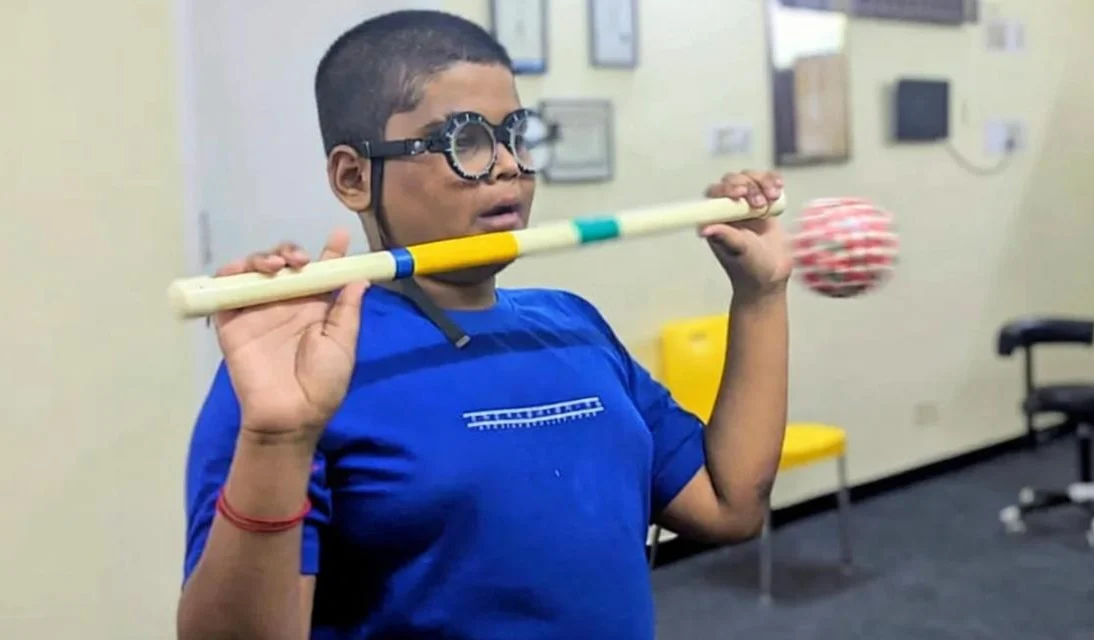
At Caring Vision Therapy in Chennai, amblyopia treatment is individualised and multimodal, designed by our COVD certified specialists. The treatment programme includes monocular training to improve visual acuity and contrast sensitivity in the weaker eye, structured binocular integration therapy to train both eyes to cooperate simultaneously, optometric syntonics phototherapy to stimulate neurological visual pathways and reduce suppression, and neuro-optometric rehabilitation exercises to strengthen the brain-eye connection. All therapy activities are evidence-based and adapted to the patient's age, severity, and specific visual profile, with objective progress tracking at every session.
One of the most important and widely misunderstood facts about amblyopia treatment is that it is not restricted to young children. While earlier intervention produces faster results because of greater neurological plasticity in the developing brain, clinical research and our own patient outcomes at Caring Vision Therapy confirm that teenagers and adults can achieve meaningful, measurable improvements through structured vision therapy. The visual cortex retains plasticity into adulthood, and age alone should not prevent someone from seeking evaluation and treatment for lazy eye.
Treatment at Caring Vision Therapy typically spans 12 to 36 weeks, with the duration depending on the severity of amblyopia, the patient's age, and adherence to the home exercise programme that complements in-clinic sessions. Progress is measured at every visit using objective standardised tests, and families receive regular updates on improvements in visual acuity, binocular function, and day-to-day visual performance. If you or your child have been told that amblyopia cannot be treated after a certain age, or that patching is the only available option, we encourage you to schedule a comprehensive functional vision evaluation at our Chennai or Hyderabad clinic for a specialist second opinion based on current evidence.
Related Reading