Understand how letter reversals, dyslexia-related symptoms, visual-spatial deficits, and developmental vision problems affect reading and learning. Explore Neuro Optometric Rehabilitation and Vision Therapy at Caring Vision Chennai.
Book a ConsultationWhy Does My Child Reverse Letters and Numbers?
Understand how letter reversals, dyslexia-related symptoms, visual-spatial deficits, and developmental vision problems affect reading and learning. Explore Neuro Optometric Rehabilitation and Vision Therapy at Caring Vision Chennai.
Related Resources
- Learn more about convergence insufficiency treatment - the most common binocular vision condition in children
- Explore lazy eye (amblyopia) treatment for kids and adults - evidence-based vision therapy options
- Vision therapy in Chennai - our in-clinic specialist services
- Check all vision symptoms in children - 80+ signs of binocular vision dysfunction
- Book a comprehensive vision evaluation - Chennai, Hyderabad & global telehealth
Many parents become concerned when their child begins reversing letters or numbers during reading and writing activities - confusing b and d, p and q, 6 and 9, or even writing entire words backwards. These challenges are often misunderstood as simple carelessness, poor handwriting, lack of attention, or low academic effort.
However, persistent letter and number reversals may indicate underlying developmental vision, visual-spatial processing, and neurodevelopmental integration difficulties. At Caring Vision, we frequently evaluate children who demonstrate normal eyesight and eye health yet continue struggling with reading, writing, spelling, spatial orientation, left-right confusion, visual memory, eye tracking, and academic performance. These challenges are often connected to immature visual processing pathways, retained primitive reflexes, developmental delays, visual-spatial deficits, and inefficient sensory-motor integration.
Understanding Letter and Number Reversals
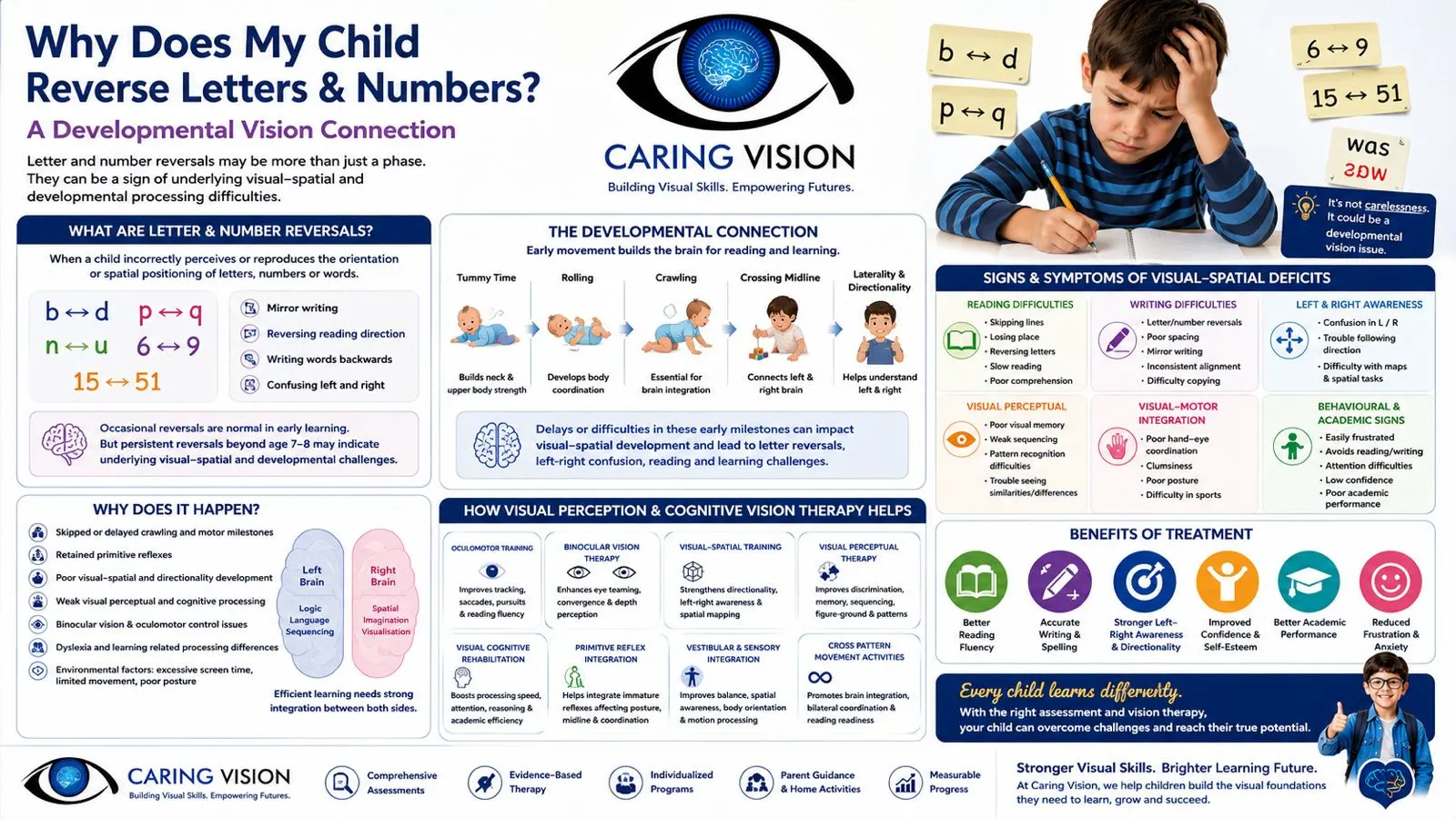
Letter reversals occur when a child incorrectly interprets or reproduces the orientation of symbols, letters, or numbers. Common examples include b↔d, p↔q, n↔u, 6↔9, 15↔51, mirror writing, reversing reading direction, and writing words backwards.
Occasional reversals may be developmentally normal in younger children who are still learning letter formation and orientation. However, persistent reversals beyond the expected developmental stage - especially when associated with reading difficulties, poor coordination, visual fatigue, or learning struggles - may indicate underlying visual-perceptual and neurodevelopmental dysfunction.
Vision Is More Than Seeing Clearly
Most parents assume vision simply means seeing clearly or passing a standard eye chart test. However, functional vision involves far more complex neurological processing. Efficient vision depends on accurate eye teaming, eye tracking, visual attention, spatial orientation, directionality, visual memory, laterality awareness, body awareness, visual-motor integration, and higher cortical visual processing.
A child may have completely normal visual acuity and still struggle academically because the brain is not efficiently processing and organising visual information. This is why a standard school eye screening is not sufficient to rule out a developmental vision contribution to a child's learning difficulties.
The Developmental Foundation of Visual-Spatial Skills
Visual-spatial processing develops during early childhood through movement, sensory experiences, motor development, and environmental interaction. Important developmental experiences include tummy time, rolling, crawling, creeping, midline crossing, bilateral coordination, vestibular stimulation, postural control, and spatial exploration.
These experiences help the nervous system establish left-right awareness, spatial mapping, directionality, eye-hand coordination, reading readiness, and visual orientation. When these developmental milestones are delayed, skipped, or poorly integrated, children may develop immature visual-spatial processing systems that later affect reading and writing.
Why Crawling Is Neurologically Important
Crawling is one of the most important developmental milestones for neurological and visual integration. During crawling, children develop cross-pattern movement, bilateral body coordination, midline integration, vestibular activation, proprioceptive awareness, eye-hand coordination, and hemispheric communication.
Crawling helps establish laterality, directionality, visual tracking, convergence, spatial awareness, and postural stability. Children who skipped crawling, crawled minimally, bottom-shuffled, demonstrated asymmetrical crawling, or had delayed motor milestones may later demonstrate letter reversals, reading instability, weak visual memory, dyslexia-like symptoms, poor handwriting, and visual-spatial deficits.
What Are Visual-Spatial Deficits?
Visual-spatial processing refers to the brain's ability to understand position, direction, orientation, size, distance, spatial relationships, movement, and body position in space. Visual-spatial deficits affect how children organise, interpret, and respond to visual information - and they can be present in children who see perfectly clearly on a standard eye chart.
Signs and Symptoms of Visual-Spatial Difficulties
Children with visual-spatial deficits may present across several functional areas. A comprehensive learning-related vision evaluation helps identify which specific systems are affected.
Reading Difficulties
Children may experience losing place while reading, skipping lines, re-reading the same line, slow reading speed, reduced comprehension, visual fatigue, and confusing similar-looking words.
Writing Difficulties
Children may demonstrate letter reversals, number reversals, mirror writing, poor spacing, directional confusion, inconsistent alignment, and difficulty copying from the board.
Left and Right Awareness Problems
Children may experience difficulty identifying left and right, poor spatial orientation, difficulty following directional instructions, and weak sports coordination.
Visual-Motor Integration Difficulties
Possible signs include poor hand-eye coordination, clumsiness, poor posture while writing, difficulty catching balls, and weak desk posture stability.
Behavioural and Academic Signs
Children may also demonstrate reduced confidence, homework frustration, avoidance of reading, attention difficulties, slow classroom performance, and emotional distress related to academics.
The Connection Between Dyslexia and Developmental Vision
Dyslexia is a complex neurodevelopmental learning disorder involving multiple processing systems. Although dyslexia is not caused solely by eyesight problems, many children with dyslexia also demonstrate visual processing deficits, poor eye tracking, weak visual sequencing, directionality problems, visual crowding, reduced visual attention, binocular vision dysfunction, and letter reversals.
This is why comprehensive developmental vision assessment becomes an important component of evaluating children with reading and learning difficulties - not as a substitute for other assessments, but as an essential parallel evaluation.
Understanding Laterality and Directionality
Efficient reading and writing require stable directional awareness built on two closely related developmental skills.
Laterality
Laterality refers to awareness of the left and right sides of one's own body. It is an internal sense that forms the neurological foundation for directional understanding.
Directionality
Directionality refers to understanding left and right orientation within external visual space. Immature laterality and directionality may contribute to letter reversals, reading confusion, writing instability, spatial disorganisation, and persistent left-right confusion.
Visual Perception and Cognitive Visual Processing
Visual perception involves the brain's ability to interpret and organise visual information meaningfully. Important visual perceptual skills include visual discrimination, visual memory, spatial relationships, figure-ground perception, visual sequencing, form constancy, visual closure, and directionality. These cognitive visual processing skills affect reading, spelling, academic learning, information organisation, problem solving, and visual reasoning.
Comprehensive Developmental Vision Evaluation
At Caring Vision, children with letter reversals, dyslexia-related symptoms, learning difficulties, visual-spatial deficits, reading instability, and academic concerns undergo comprehensive neuro-developmental vision evaluation. Assessment may include:
- Binocular vision analysis
- Eye tracking assessment
- Convergence testing
- Accommodation evaluation
- Visual perceptual testing
- Spatial orientation analysis
- Primitive reflex evaluation
- Vestibular integration analysis
- Functional reading assessment
- Visual-motor integration testing
How Vision Therapy Helps Visual-Spatial Deficits
Vision Therapy and Neuro Optometric Rehabilitation aim to improve how the brain processes and integrates visual information. Therapy is individualised based on each child's developmental profile and functional challenges.
Oculomotor Training
Oculomotor therapy helps improve eye tracking, pursuits, saccades, reading fluency, and visual fixation stability - the foundational skills needed for a child to move their eyes smoothly across a line of text without losing their place.
Binocular Vision Therapy
Binocular therapy focuses on improving eye teaming, convergence, depth perception, spatial orientation, and visual coordination - skills that underpin stable reading and accurate spatial judgement.
Visual-Spatial and Perceptual Therapy
Therapy may target directionality, left-right awareness, spatial mapping, visual memory, sequencing, pattern recognition, and figure-ground processing - directly addressing the processing deficits that contribute to reversals and reading confusion.
Primitive Reflex Integration Therapy
Retained primitive reflexes may interfere with midline crossing, bilateral coordination, spatial orientation, reading stability, and postural control. Primitive Reflex Integration Therapy helps support neurological maturation and sensory-motor organisation, providing the neurological foundation that visual-spatial skills depend on.
Vestibular and Sensory Integration Therapy
Vestibular rehabilitation and sensory integration therapy help improve balance, motion processing, body awareness, spatial confidence, postural stability, and visual-vestibular integration - all of which contribute to the sense of stable orientation in space that reading and writing require.
Benefits of Developmental Vision Therapy
Children undergoing structured developmental vision rehabilitation may demonstrate improvements across multiple functional areas.
Reading Benefits
- Improved reading fluency
- Reduced reversals
- Better eye tracking
- Enhanced comprehension
- Faster reading speed
Writing Benefits
- Better spacing and alignment
- Reduced mirror writing
- Improved directional awareness
- Enhanced handwriting organisation
Academic Benefits
- Improved concentration
- Better processing speed
- Increased classroom confidence
- Reduced homework frustration
Motor and Spatial Benefits
- Improved coordination
- Better posture
- Enhanced balance
- Improved body awareness
Why Early Intervention Matters
The developing brain demonstrates significant neuroplasticity during childhood. Early identification and intervention may help strengthen visual processing pathways, improve spatial integration, enhance reading readiness, improve academic confidence, and prevent secondary emotional difficulties.
Children should never be labelled as lazy, careless, slow learners, unmotivated, or inattentive without evaluating underlying developmental vision and visual processing factors. A comprehensive paediatric vision evaluation is often the missing piece in a child's assessment.
The Caring Vision Approach to Developmental Vision Therapy
At Caring Vision, we believe learning difficulties should be approached compassionately and comprehensively. Our multidisciplinary approach may include Developmental Vision Therapy, Neuro Optometric Rehabilitation, Primitive Reflex Integration, Vestibular Rehabilitation, Visual Perceptual Therapy, Reading Rehabilitation, and Sensory Integration Support. Each therapy plan is individualised based on the child's developmental profile and functional needs.
Final Thoughts
Letter and number reversals are often much more than simple writing mistakes. They may represent underlying developmental visual-spatial and neuroprocessing difficulties affecting how the brain organises and interprets visual information. Visual-spatial deficits, immature directionality, retained primitive reflexes, delayed motor development, and inefficient visual perception may significantly contribute to dyslexia-related symptoms, reading difficulties, writing problems, learning disabilities, and academic struggles.
Through comprehensive developmental vision evaluation and individualised Neuro Optometric Rehabilitation, many children can improve their visual processing, reading fluency, spatial awareness, confidence, and academic performance. At Caring Vision, we are committed to helping children develop stronger neurological and visual foundations for lifelong learning success. Book a comprehensive developmental vision evaluation to understand what may be underlying your child's challenges.
Explore More at Caring Vision Therapy
- Vision therapy clinic in Chennai - in-clinic specialist appointments, evaluation process & location
- All vision therapy and neuro-optometric treatments - full list of conditions we treat for children & adults
- Convergence insufficiency treatment - the leading cause of reading difficulties in children
- Vision symptom checker for children - 80+ symptoms that may indicate a binocular vision problem
- Book a comprehensive functional vision evaluation - Chennai, Hyderabad & global telehealth available
Frequently Asked Questions
Are letter reversals normal in children?
Occasional reversals may be normal during early learning stages. Persistent reversals beyond the expected developmental age - particularly when associated with reading difficulties, poor coordination, or visual fatigue - may indicate visual-spatial or developmental processing difficulties worth evaluating.
Can developmental vision problems cause letter reversals?
Yes. Difficulties involving visual-spatial processing, eye tracking, directionality, and visual perception may contribute to letter and number reversals in children who have otherwise normal eyesight.
Is dyslexia related to vision problems?
Dyslexia is multifactorial. Many children with dyslexia also demonstrate associated visual processing and binocular vision difficulties, which is why a comprehensive developmental vision evaluation is an important part of any thorough assessment.
Can Vision Therapy help with reading difficulties?
Vision Therapy may help improve eye tracking, visual attention, binocular coordination, and visual processing involved in reading performance. It does not treat dyslexia directly but can address the visual component of reading difficulty.
Why is crawling important for visual development?
Crawling helps develop bilateral coordination, spatial awareness, vestibular integration, convergence, and hemispheric communication - all of which are important foundations for reading readiness. Children who skipped crawling may be at higher risk for visual-spatial difficulties.
What are visual-spatial deficits?
Visual-spatial deficits affect the brain's ability to understand orientation, direction, spatial relationships, and body position in space. A child can have perfect 20/20 vision and still have significant visual-spatial processing difficulties that affect reading and writing.
Can retained primitive reflexes affect reading and writing?
Yes. Retained primitive reflexes may interfere with directionality, posture, eye tracking, spatial awareness, midline crossing, and reading stability - all of which contribute to letter reversals and reading difficulties.