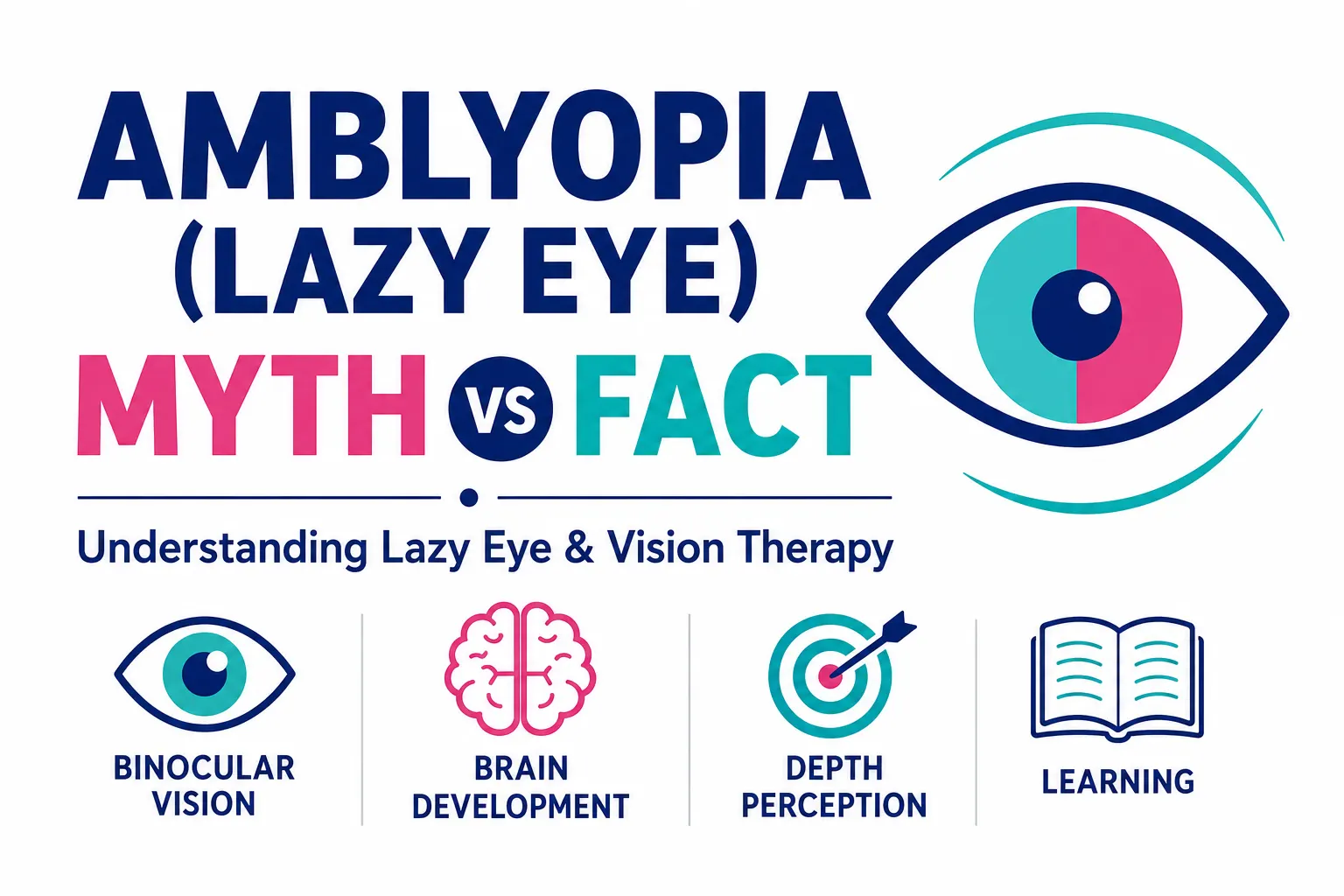
Learn the facts about amblyopia (lazy eye), including symptoms, causes, diagnosis, patching, vision therapy, binocular vision treatment, and whether adults can improve with treatment.
Book a ConsultationWhat Are the Most Common Myths About Amblyopia (Lazy Eye)?
Learn the facts about amblyopia (lazy eye), including symptoms, causes, diagnosis, patching, vision therapy, binocular vision treatment, and whether adults can improve with treatment.
When parents hear the term "Lazy Eye," many assume it is simply a cosmetic issue that a child will eventually outgrow. Unfortunately, these misconceptions often delay diagnosis and treatment, potentially affecting long-term visual development.
Amblyopia is one of the most common causes of preventable vision impairment in children, affecting approximately 2–5% of the population worldwide. The encouraging news is that early diagnosis, proper treatment, and modern Vision Therapy approaches can help many children significantly improve visual function and binocular vision skills.
What Is Amblyopia (Lazy Eye)?
Amblyopia is a neuro-developmental vision disorder in which one eye fails to achieve normal visual development because the brain favors one eye over the other. Over time, the brain begins suppressing visual information coming from the weaker eye. As a result, the affected eye may demonstrate reduced visual acuity, poor eye coordination, reduced depth perception, weakened binocular vision, and delayed visual development. Amblyopia is often called "Lazy Eye," but the condition is not caused by laziness — the problem involves both the eyes and the visual processing centers of the brain.
Myth 1: Amblyopia Is Just a Cosmetic Problem
Fact: Amblyopia Is a Neurological Vision Disorder
Many people assume amblyopia only affects appearance. In reality, amblyopia affects how the brain processes information from the eyes. Potential consequences include reduced visual acuity, poor binocular vision, weak depth perception, eye coordination problems, reading difficulties, reduced sports performance, and visual fatigue. The condition extends far beyond appearance.
Myth 2: Children Will Outgrow Lazy Eye
Fact: Amblyopia Does Not Resolve on Its Own
Without treatment, the weaker eye often remains underdeveloped. The longer amblyopia remains untreated, the greater the risk of persistent visual deficits, the more difficult treatment may become, and the greater the impact on binocular vision development. Regular pediatric eye examinations are essential for early detection.
Myth 3: If My Child Can See Clearly with One Eye, There Is No Problem
Fact: Many Children Appear to See Normally
Because the stronger eye compensates for the weaker eye, many children do not realize they have a vision problem. Possible warning signs include squinting, eye turning inward or outward, poor hand-eye coordination, difficulty catching balls, closing one eye during reading, and reduced attention during visual tasks. Comprehensive binocular vision testing is often required to identify amblyopia.
Myth 4: Glasses Always Cure Lazy Eye
Fact: Glasses Are Often Only the First Step
Corrective lenses help provide clear visual input. However, many children require additional treatment to improve how the brain uses visual information from both eyes. Treatment may include prescription glasses, Vision Therapy, patching, atropine therapy, binocular vision rehabilitation, and Neuro-Visual Rehabilitation. Every treatment plan should be individualized.
Myth 5: Patching Is the Only Treatment Available
Fact: Modern Amblyopia Treatment Goes Beyond Patching
Historically, patching was considered the primary treatment for amblyopia. Today, many treatment programs also focus on improving binocular vision and visual processing. Vision Therapy may help improve eye teaming, fusion, depth perception, eye tracking, visual attention, and binocular coordination. Modern treatment aims to help both eyes work together efficiently.
Myth 6: Amblyopia Only Occurs When an Eye Turns Inward
Fact: Many Children with Amblyopia Have Straight Eyes
Amblyopia can develop even when the eyes appear perfectly aligned. Common causes include strabismic amblyopia — caused by eye misalignment; refractive amblyopia — caused by a significant prescription difference between the two eyes; and deprivation amblyopia — caused by conditions such as congenital cataracts, ptosis (droopy eyelid), or corneal abnormalities. A child may therefore have amblyopia without an obvious eye turn.
Myth 7: Lazy Eye Is Rare
Fact: Amblyopia Is One of the Most Common Childhood Vision Disorders
Research suggests amblyopia affects approximately 1 in 20 children — around 2–5% of the population. Many cases remain undetected until school age because children often assume their vision is normal.
Myth 8: School Vision Screenings Are Enough
Fact: Screenings Can Miss Important Vision Problems
School screenings primarily evaluate distance vision. They may not identify binocular vision disorders, eye coordination problems, depth perception deficits, visual processing difficulties, or mild amblyopia. A comprehensive developmental vision examination provides much more information.
Myth 9: Amblyopia Cannot Be Treated After Age 7
Fact: Improvement Is Possible Beyond Childhood
Treatment is generally most effective when started early. However, advances in neuroscience demonstrate that the brain retains neuroplasticity throughout life. Many older children, teenagers, and adults continue to benefit from Vision Therapy, binocular vision training, Neuro-Visual Rehabilitation, and perceptual learning activities. It is rarely too late to seek professional evaluation.
Myth 10: Amblyopia Only Affects Vision
Fact: Amblyopia Can Affect Everyday Life
Reduced binocular vision may impact reading efficiency, academic performance, sports participation, driving skills, visual confidence, and occupational opportunities. Improving visual function can positively influence quality of life.
Myth 11: Treatment Can Stop Once Vision Improves
Fact: Visual Gains Must Be Stabilized
Stopping treatment too early may increase the risk of regression. Follow-up care helps monitor progress, reinforce binocular skills, prevent recurrence, and maintain visual improvements. Consistent monitoring is essential for long-term success.
Myth 12: Adults Cannot Benefit from Vision Therapy
Fact: Adults Can Still Improve Visual Performance
Although outcomes vary, many adults demonstrate meaningful improvement through structured therapy programs. Potential benefits include improved visual acuity, better contrast sensitivity, enhanced depth perception, improved eye coordination, and greater visual comfort. Adult treatment may require more time and commitment but can still be highly beneficial.
Signs Parents Should Watch For
Consider a comprehensive eye examination if your child frequently rubs their eyes, squints often, has an eye turn, tilts their head while viewing objects, experiences reading difficulties, struggles with sports involving depth judgment, frequently closes one eye, or has a family history of amblyopia or strabismus.
The Caring Vision Approach
At Caring Vision, amblyopia management extends beyond improving eyesight alone. Our comprehensive approach may include Pediatric Eye Examinations, Binocular Vision Assessment, Vision Therapy Programs, Neuro-Visual Rehabilitation, Eye Coordination Training, and Parent Education and Guidance. Our goal is to help every child achieve their fullest visual potential and improve how the eyes and brain work together.
Final Thoughts
Amblyopia is not simply a "lazy eye" that children outgrow. It is a treatable neuro-visual condition that requires timely diagnosis, proper assessment, and individualized management. One of the biggest barriers to successful treatment is often misinformation and delayed intervention.
By understanding the facts about amblyopia and seeking early care, parents can help protect their child's visual development and long-term quality of life. At Caring Vision, we are committed to helping children build stronger visual foundations through evidence-based pediatric eye care, binocular vision assessment, and Vision Therapy. Learn more about our amblyopia treatment programme or book a comprehensive vision evaluation.
Explore More at Caring Vision Therapy
Frequently Asked Questions
What is amblyopia?
Amblyopia is a developmental vision disorder in which one eye does not achieve normal visual development because the brain favors the other eye.
Is lazy eye the same as amblyopia?
Lazy eye is the common term for amblyopia, although the condition involves neurological visual development rather than laziness.
Can amblyopia be cured?
Many patients can achieve significant improvement when amblyopia is diagnosed and treated appropriately.
Does Vision Therapy help amblyopia?
Vision Therapy may help improve binocular vision, eye coordination, visual processing, and depth perception in appropriate cases.
Is patching still used?
Yes. Patching remains useful in selected cases but is often combined with additional treatment strategies.
Can adults improve with amblyopia treatment?
Yes. Many adults continue to benefit from Vision Therapy and Neuro-Visual Rehabilitation programs.