Is amblyopia the same as lazy eye?
Yes. Amblyopia is the medical name for lazy eye: reduced vision in one eye, or sometimes both, because the brain has not learnt to use it fully, even though the eye itself usually looks healthy. It is not the same as a squint, which is an eye that turns, although a squint is one of the common causes of amblyopia.
Can lazy eye be cured?
In most young children, vision in the weaker eye can be brought to normal or near normal, especially when treatment starts early and is completed. Older children and adults usually improve by a few lines rather than fully. About one child in four loses some vision after treatment stops suddenly, which is why it is tapered and reviewed.
What is the best treatment for lazy eye?
There is no single best treatment. Glasses always come first. After that, patching or atropine drops suit most young children, and binocular or dichoptic therapy suits older children, teenagers and adults, or anyone whose progress has stalled. The choice depends on age, the cause and how weak the eye is.
At what age is it too late to treat lazy eye?
There is no fixed age. Treatment works best before about seven, children up to 12 still respond well, and teenagers and adults can improve with binocular therapy, although the gains are usually smaller.
How long does lazy eye treatment take?
Many children improve within six to twelve weeks of patching. A typical binocular therapy course runs three to six months, and adult programmes usually run 24 to 40 weeks, with re-measurement at regular reviews.
Can lazy eye be treated without patching?
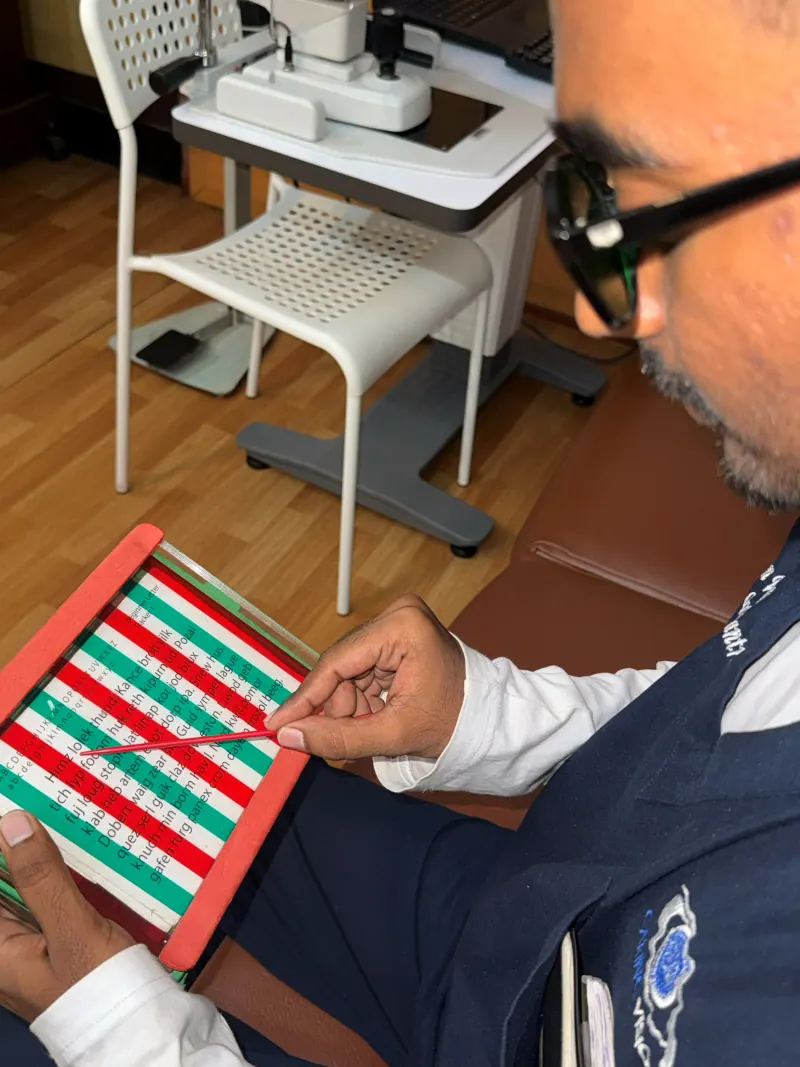
Yes. Atropine drops, blurring filters and binocular or dichoptic therapy are alternatives. Dichoptic therapy keeps both eyes open and trains the brain to stop suppressing the weaker eye.
What is lazy eye called in Hindi, Tamil and Telugu?
In Hindi it is usually called aalsi aankh (आलसी आँख), in Tamil somberi kan (சோம்பேறிக் கண்) and in Telugu somari kannu (సోమరి కన్ను). Eye doctors in every language use the word amblyopia, so it helps to know both names when you read a report or a prescription.
Is lazy eye genetic or hereditary?
Lazy eye itself is not passed on directly, but the things that cause it often run in families: a squint, a large difference in power between the two eyes, or a high prescription. If a parent, brother or sister had a squint or a lazy eye, have your child's eyes checked by age three to four, even if they look straight.
What happens if lazy eye is not treated? Can it cause blindness?
An untreated lazy eye does not spread to the other eye and does not cause total blindness. The risk is that vision in the weaker eye stays permanently reduced and depth perception stays poor. If the stronger eye is ever injured or diseased later in life, the person is left relying on the weaker one, which is why treatment in childhood matters.
Can Ayurveda or homeopathy cure lazy eye?
There is no published research showing that Ayurvedic, homeopathic or herbal medicines improve vision in a lazy eye. Lazy eye is a problem of how the brain uses the eye, so it improves when the brain is made to use that eye, with glasses, patching, drops or binocular therapy. If you want to try a traditional remedy, tell us, and do not let it delay treatment during the years when it works best.
Is lazy eye a disability in India? Can I get a disability certificate?
Disability certificates in India are issued by a government medical board, which tests the vision of both eyes with glasses on. A lazy eye in one eye with good vision in the other usually does not meet the criteria, but the board makes that decision, not the clinic. We can give you a written report of the vision measurements to take to the board.
How much does lazy eye treatment cost in India?
At Caring Vision Therapy the consultation is Rs 1,000 to Rs 1,500, online or in clinic. The programme is quoted in writing after the assessment, because it depends on age, severity and whether there is a squint.